PAGE_HEADER
Clarias batrachus (Linnaeus, 1758)
Image Showcase
Photographs, diagnostic angles and morphological variants



Community & Keeper Tally
Member interactions, breeding records and forum mentions
Aquarium Care & Husbandry
Dietary requirements, tank setup, compatibility and breeding
Feeding & Diet
Anything; this fish is totally omnivorous and will gorge itself on most offerings. [View Member Food Stats]
Aquarium Furniture & Decor
Very well rooted plants and large structures that provide some shade. Appropriately sized clay pipes seem to provide a readily accepted, if less cosmetically pleasing, hideaway for these fish.
Compatibility & Suggested Tankmates
Keep with large robust fish; anything small enough will be eaten. These should be fast growing or introduced as semi-adults. The walking catfish grows very fast indeed and although purchased at a ''safe'' size for it's co-inhabitants, this ratio will rapidly change to the danger of the smaller fishes.
Tankmates: Large Cyprinids (Silver Sharks, Tinfoil or Spanner Barbs for example) or Central American Cichlids.
Breeding Notes
See Shane's World article.
Habitat & Water Parameters
Natural distribution, biotope water conditions and temperature ranges
Geographic Distribution
Asia: Mekong and Chao Phraya basins, Malay Peninsula, Sumatra, Java, Borneo. Reported from Sri Lanka; popular for aquaculture in its native range but not regarded as such in other Southeast Asian countries. Trade restricted in Germany (Anl.3 BArtSchV). Several countries report adverse ecological impact after introduction.
Bangladesh Waters (click on these areas to find other species found there)
Indian waters (click on these areas to find other species found there)
Indonesian Waters (click on these areas to find other species found there)
Pacific, Malaysia Waters (click on these areas to find other species found there)
Myanmar Waters (click on these areas to find other species found there)
Sri Lanka Waters (click on these areas to find other species found there)
Thailand Waters (click on these areas to find other species found there)
Login to view the map.
Species Description & Identification
Morphology, diagnostic traits and sexual dimorphism
Identification
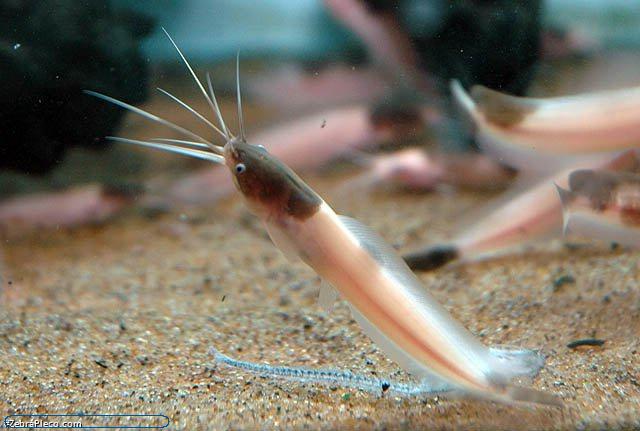
Clarias species are characterized by having an elongated body; a soft rayed dorsal fin extending to, or nearly to, the caudal fin base; a soft rayed anal fin extending from just behind the anus to the caudal fin base; pectoral fins each with a serrated anterior bony spine; head depressed, covered largely by firmly sutured, surface sculptured bony plates forming a protective helmet; four pairs of flagellate barbels (nasals, maxillaries, inner and outer mandibulars); air breathing organs derived from the 2nd and 4th epibranchials within a superbranchial chamber.
Shown above are the mottled or marbled colour variety and also the more commonly available pinky-white form. From time to time you also see the ''original'' brown with white belly wild form.
Sexual Dimorphism (Sexing)
Mature males have small spots along the dorsal fin; it is not known if this also applies to the albino colour variant.
Taxonomy, Synonyms & Etymology
Classification history, linguistic derivations and variant forms
Synonyms
Clarias betrachus, Clarias punctatus, Clarius bartrachus, Clarius batrachus, Silurus batrachus
Pronunciation
klar ee ass - bat rah chus
Etymology
Clarias: From the Greek chlaros, meaning lively; in reference to the ability of the fish to live for long periods out of water.
There is 1 other speciesAsterophysus batrachus with this specific name.
Literature & Resources
Scientific publications, external links and citation tools
Description Reference
Systema Naturae, Ed. X v. 1, pp 305.
External Databases
Related Searches