PAGE_HEADER
Image Showcase
Photographs, diagnostic angles and morphological variants

Community & Keeper Tally
Member interactions, breeding records and forum mentions
Aquarium Care & Husbandry
Dietary requirements, tank setup, compatibility and breeding
Breeding Notes
No member of this genus has been bred in the aquarium.
Habitat & Water Parameters
Natural distribution, biotope water conditions and temperature ranges
Geographic Distribution
Asia: known from the Indus River drainage in Afghanisan, Pakistan, and northwestern India.
Pakistan Waters, Indus (click on these areas to find other species found there)
Login to view the map.
Species Description & Identification
Morphology, diagnostic traits and sexual dimorphism
Identification
Bagrid catfishes of the genus Rita Bleeker, 1854 are found in large rivers throughout the
Indian subcontinent and Myanmar, and are capable of reaching sizes to 1500 mm TL (Talwar
and Jhingran, 1991), although mature specimens of ca. 200-300 mm SL are more commonly encountered. The genus is diagnosed by the following synapomorphies (Mo,
1991): single pair of mandibular barbels, elongated Weberian apparatus firmly sutured to
the basioccipital, and the sensory canal on the posttemporal enclosed within the bone.
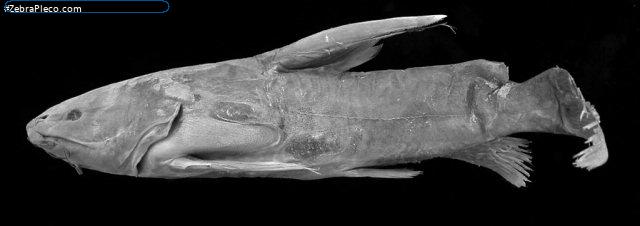
Rita macracanthus differs from all congeners in having a unique combination of the
following characters: dorsal spine reaching to middle of adipose-fin base; pectoral-spine length
28.7–30.0% SL; depth of caudal peduncle 7.6–8.4% SL; maximum length of premaxillary tooth
band 4.8–6.4 times its maximum width; eye diameter 6.9–8.7% HL; interorbital distance 39.4–
44.1% HL; dorsal surface of head between eyes and supraoccipital covered with thin skin wherein
the underlying bone is visible; two distinct vomerine tooth patches with rounded peg-like teeth.
Rita macracanthus is distinguished from R.rita in having longer dorsal and pectoral spines, a more slender caudal peduncle, and a longer premaxillary tooth band.
Sexual Dimorphism (Sexing)
Males have branched and comb-like testes.
General Remarks
According to Khan (1934), R. macracanthus (as R. rita) feeds on invertebrates and small fishes. Males have branched and comb-like testes and in the Jhelum River (a tributary of the Indus River), breeding season lasts from June to the end of July, during which the fish migrates to colder waters in shoals.
Taxonomy, Synonyms & Etymology
Classification history, linguistic derivations and variant forms
Pronunciation
REET ah - makra canth uss
Etymology
The name Rita is derived from the local name of the fish. From the Greek makros, meaning long, and akantha, meaning thorn, in reference to the relatively long dorsal and pectoral spines of this species. Used as a noun.
There are 4 other speciesBagrichthys macracanthus
Balroglanis macracanthus
Chromobotia macracanthus
Hemibarbus macracanthus with this specific name.
Literature & Resources
Scientific publications, external links and citation tools
Literature & References
External Databases
Related Searches