PAGE_HEADER
Hyalobagrus leiacanthus Ng & Kottelat, 1998
Image Showcase
Photographs, diagnostic angles and morphological variants

Community & Keeper Tally
Member interactions, breeding records and forum mentions
Aquarium Care & Husbandry
Dietary requirements, tank setup, compatibility and breeding
Feeding & Diet
Readily feeds on live/frozen foods and smaller-sized prepared foods such as micropellets, but shows a preference for the former. [View Member Food Stats]
Aquarium Furniture & Decor
They do best with plenty of shade (in the form of vegetation), so a heavily planted tank is the ideal setup for these fish.
Compatibility & Suggested Tankmates
A peaceful, diurnal shoaling species that should be kept in groups of four or more individuals.
Breeding Notes
Unreported in the aquarium.
Habitat & Water Parameters
Natural distribution, biotope water conditions and temperature ranges
Geographic Distribution
Asia: currently known only from the Kapuas and the Barito basins in central Borneo, Indonesia.
Pacific, Greater Sunda Island Rivers, Borneo Waters, Barito (click on these areas to find other species found there)
Pacific, Greater Sunda Island Rivers, Borneo Waters, Western Borneo Waters, Kapuas (click on these areas to find other species found there)
Login to view the map.
Species Description & Identification
Morphology, diagnostic traits and sexual dimorphism
Identification
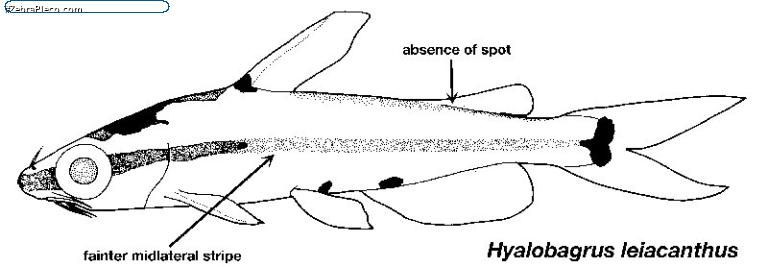
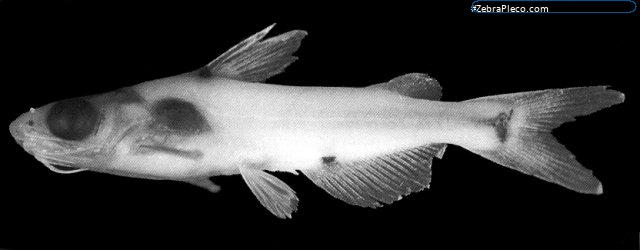
This species is distinguished from all its congeners by having a relatively shorter adipose-fin base (6.5-10.2% SL vs. 10.6-15.7), a larger eye (eye diameter 35.0-38.9% HL vs. 19.7-34.9), a smooth (vs. partially serrated) anterior edge of pectoral spine, and the absence (vs. presence) of both a dark spot on anterior base of the adipose fin and a dark midlateral band running longitudinally along sides of body.
Sexual Dimorphism (Sexing)
Males have an elongate genital papilla.
Taxonomy, Synonyms & Etymology
Classification history, linguistic derivations and variant forms
Pronunciation
HI ya low BAG russ - lay ah kan thuss
Etymology
From the greek hyalos, meaning transparent, and bagrus, the name of a catfish genus frequently used to form generic names. The specific epithet comes from the Greek leios, meaning smooth and akanthos, meaning thorn, in reference to the smooth anterior edge of the pectoral spine.
There are 3 other speciesClarias leiacanthus
Ompok leiacanthus
Pseudomystus leiacanthus with this specific name.
Literature & Resources
Scientific publications, external links and citation tools
Description Reference
Ichthyological Exploration of Freshwaters v. 9 (no. 4), pp 341, Fig. 9.
External Databases
Related Searches