
PAGE_HEADER
Sorubim lima (Bloch & Schneider, 1801)
Image Showcase
Photographs, diagnostic angles and morphological variants



Community & Keeper Tally
Member interactions, breeding records and forum mentions
Aquarium Care & Husbandry
Dietary requirements, tank setup, compatibility and breeding
Feeding & Diet
Carnivore that can be trained to accept most foods but patience is often required in this regard. Younger fish are more adaptable to new foods. [View Member Food Stats]
Aquarium Furniture & Decor
Large pieces of driftwood placed so as to form "tree roots". This effect is easily accomplished by attaching suction cups to the driftwood and "sticking" the wood to the back and sides of the tank. Plants will have to be chosen carefully as S. lima will sometimes dig.
Compatibility & Suggested Tankmates
Predatory and thus unsafe with anything small enough to be eaten, but otherwise very peaceful.
Tankmates: They are quite sociable as big cats go and it is possible to keep a group of these catfish in one tank. Three Lima shovelnoses would do well as a group in a large enough tank. This is especially true if all three are raised in the same tank together. Other tankmates must be chosen with great care. Large cichlids could be experimented with, but should not be aggressive species. Large plecos and other catfishes would be great tank-mates.
Breeding Notes
The Lima shovel nose has not been bred in captivity. There is one report that a pair laid eggs in a nest they constructed in the aquarium, but no fry hatched.
Habitat & Water Parameters
Natural distribution, biotope water conditions and temperature ranges
Geographic Distribution
South America: Amazon, Orinoco, Paraná and Parnaíba River basins. Syntopic with S. elongatus in the Orinoco basin and with S. elongatus and S. maniradii in the upper Amazon drainage of Brazil, Ecuador, Peru, and Bolivia.
Amazon (click on these areas to find other species found there)
La Plata, Uruguay, Middle Uruguay (click on these areas to find other species found there)
Orinoco (click on these areas to find other species found there)
La Plata, Paraná (click on these areas to find other species found there)
Piauí Rivers, Parnaíba (click on these areas to find other species found there)
Amazon, Juruá Imported (click on these areas to find other species found there)
Amazon, Lower Amazon, Xingu Imported (click on these areas to find other species found there)
Login to view the map.
Species Description & Identification
Morphology, diagnostic traits and sexual dimorphism
Identification
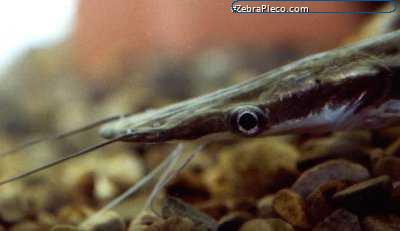
No other pimelodid genus possesses a dark horizontal stripe stretching entire length of head and body.
Some fish grow larger (particularly in the wild) than the size given here perhaps indicating a difference between the sexes or a group of species.
Sexual Dimorphism (Sexing)
Unknown
Taxonomy, Synonyms & Etymology
Classification history, linguistic derivations and variant forms
Synonyms
Platystoma lima, Platystoma luceri, Silurus gerupensis, Silurus lima, Sorubim infraoculare, Sorubim latirostris
Pronunciation
sarw oo bim - lee mah
Etymology
Sorubi is the Brazilian local name for this fish (and several other pimelodids), latinised to become Sorubim. This specific epithet literally means "a file" (lima=a file) and refers to its exposed pre-maxillary tooth patch.
There are 2 other speciesHypostomus lima
Rineloricaria lima with this specific name.
Literature & Resources
Scientific publications, external links and citation tools
Description Reference
M. E. Blochii, Systema Ichthyologiae, pp 384.
External Databases
Related Searches

