PAGE_HEADER
Balroglanis akwe Coelho, Chamon & Sarmento-Soares, 2021
Image Showcase
Photographs, diagnostic angles and morphological variants

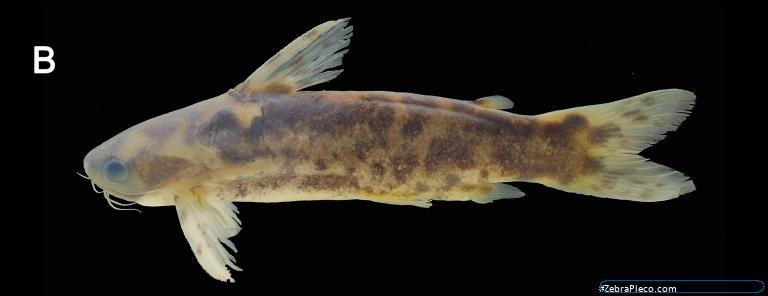
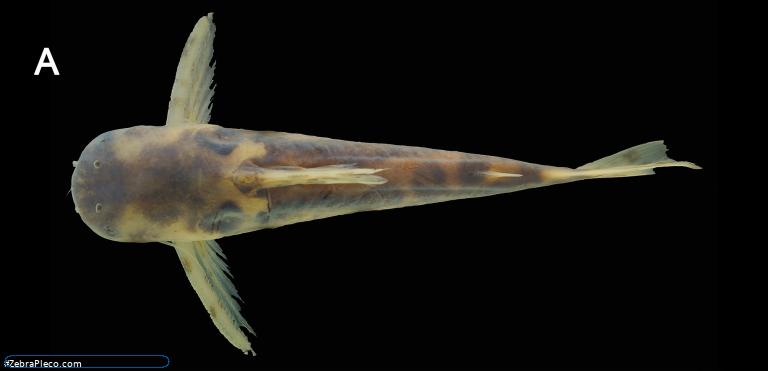


Community & Keeper Tally
Member interactions, breeding records and forum mentions
Aquarium Care & Husbandry
Dietary requirements, tank setup, compatibility and breeding
Aquarium Furniture & Decor
This species was found hidden in crevices within laterititic bedrock substrate covered by alluvial sediment.
Compatibility & Suggested Tankmates
Tankmates: Other species collected with C. akwe include Centromochlus schultzi, Tatia intermedia, Auchenipterichthys longimanus, Rhinodoras boehlkei, Platydoras armatulus, Rhamdia quelen, Leporacanthicus galaxias, Peckoltia vittata, P. sabaji, Parancistrus aurantiacus, Pseudacanthicus sp., and Spectracanthicus javae.
Habitat & Water Parameters
Natural distribution, biotope water conditions and temperature ranges
Geographic Distribution
Amazon, Lower Amazon, Tocantins, Lower Tocantins, Araguaia, Javaés (click on these areas to find other species found there)
Amazon, Lower Amazon, Tocantins, Upper Tocantins (click on these areas to find other species found there)
Login to view the map.
Species Description & Identification
Morphology, diagnostic traits and sexual dimorphism
Identification
Centromochlus akwe differs from other Centromochlinae by having a vermiculated colour pattern on the dorsum (vs. dorsum uniform in all Centromochlinae except Tatia brunnea, T. dunni, and T. meridionalis). The new species is distinguished from these three species by having eye ventrolaterally displaced on head in a way that almost the entire eye is visible in ventral view (vs. eye displaced dorsolaterally and not visible in ventral view). C. akwe is diagnosed from other Centromochlus by having the pectoral-fin spine with dark bars, alternating with light bars (vs. pectoral-fin spine with light and uniform colour in all Centromochlus). It is further distinguished from all congeners except C. carolae by the ventral surface of head moderate to largely pigmented (vs. ventral surface of head unpigmented or with few scattered dark chromatophores). It is distinguished from C. carolae by the presence of vermiculated colour pattern or scattered chromatophores on lateral surface of the body that extends to the caudal peduncle (vs. lateral surface of the body with distinct demarcation between dark and light areas continuous posteriorly onto the caudal peduncle whereas the dark pigmentation extends nearly to the ventral midline in C. carolae), by lacking dark large and rounded blotches over a pale background on head and trunk (vs. present in C. schultzi); and by the smaller length of the dorsal-fin spine (18.1-27.1% of SL vs. more than 27% of SL in C. macracanthus, C. heckelii, C. existimatus), and pectoral-fin spine (24.2-32.2% of SL vs. more than 33% of SL in C. macracanthus, C. heckelii, C. existimatus).
Sexual Dimorphism (Sexing)
Mature males have a modified anal fin, similar to that of other Centromochlus.
General Remarks
When this species has been collected in the past, it was usually misidentified as Centromochlus cf. punctatus (Tatia punctata). C. akwe can be distinguished from T. punctata by having two openings in the cranial fontanel (vs. one) and by the last branched ray of the modified anal fin of nuptial males being slightly shorter than the penultimate ray in the new species (vs. last ray being rudimentary in T. punctata).
Taxonomy, Synonyms & Etymology
Classification history, linguistic derivations and variant forms
Etymology
akwe: Named in honour to the Akwê (Xerente self-denomination) indigenous people.
Literature & Resources
Scientific publications, external links and citation tools
Description Reference
Zootaxa 4950 (no. 1), pp 150, Figs. 1-7.
External Databases
Related Searches