PAGE_HEADER
Farlowella acus (Kner, 1853)
Image Showcase
Photographs, diagnostic angles and morphological variants

Community & Keeper Tally
Member interactions, breeding records and forum mentions
Aquarium Care & Husbandry
Dietary requirements, tank setup, compatibility and breeding
Feeding & Diet
Captive feeding is easy and this fish quickly adapts to live, frozen and dry foods. Algae wafers should form the bulk of the diet and be supplemented with proteins twice weekly. [View Member Food Stats]
Aquarium Furniture & Decor
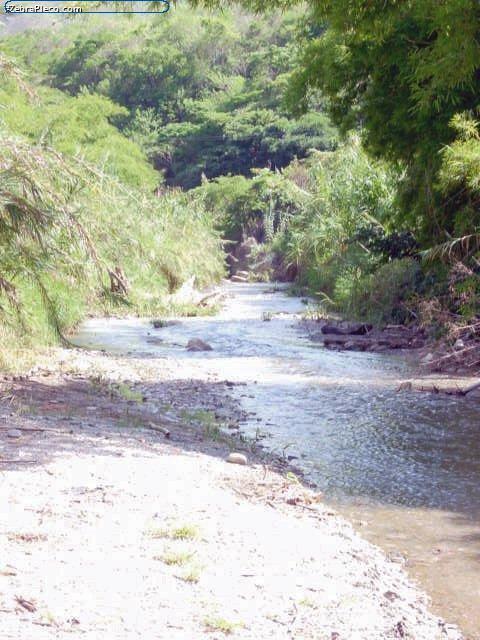
Substrate should be fine sand and rounded stones. This is a reophilic fish that rarely leaves the substrate. Driftwood is mostly absent from their natural habitat but they congregate where bamboo stalks hang into the water. It is only found in cool rivers and streams with a fair amount of current.
Compatibility & Suggested Tankmates
All Farlowella spp. are peaceful fish that do not compete well with aggressive tankmates. Large robust loricariids, medium to large cichlids and fast swimming shoaling fishes do not make good tankmates as Farlowella cannot compete with them for food.
Tankmates: Other small peaceful loricariids such as Otocinclus, Parotocinclus, and other Farlowella spp.
Breeding Notes
Assumed to be the similar to the rest of the genus with the male guarding the eggs but has never been spawned in captivity. Any published reports have turned out to be for misidentified species.
Habitat & Water Parameters
Natural distribution, biotope water conditions and temperature ranges
Geographic Distribution
South America: Lake Valencia and Torito River basins.
Orinoco, Middle Orinoco, Meta (click on these areas to find other species found there)
Tuy (click on these areas to find other species found there)
Valencia (click on these areas to find other species found there)
Valencia Imported (click on these areas to find other species found there)
Login to view the map.
Species Description & Identification
Morphology, diagnostic traits and sexual dimorphism
Identification
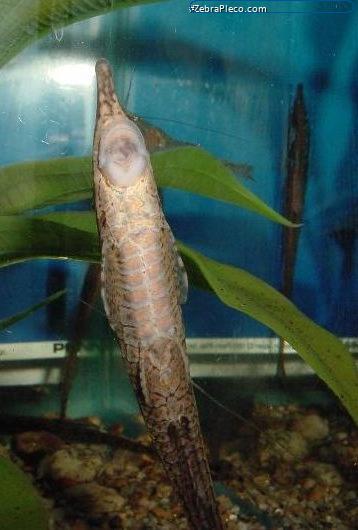
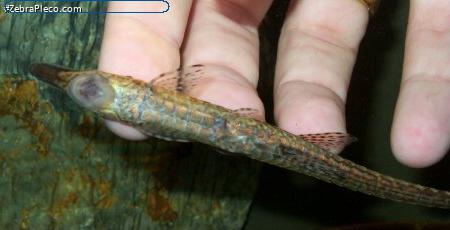
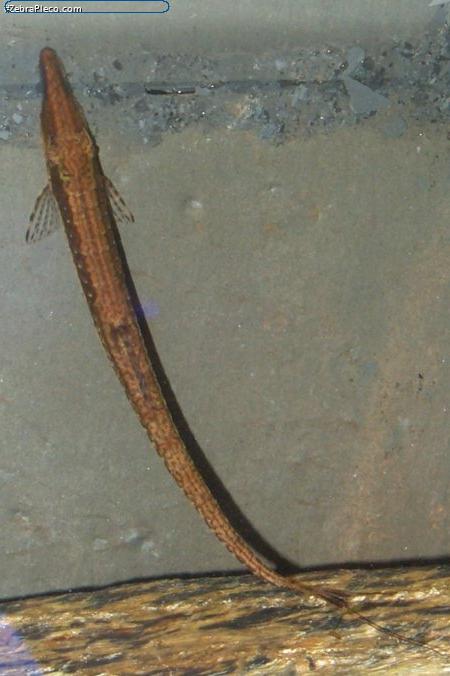
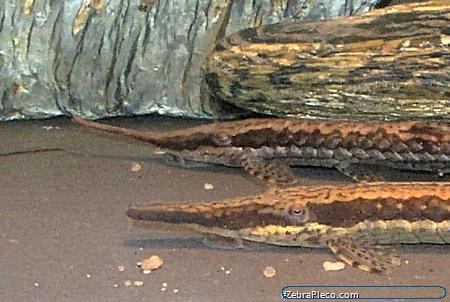
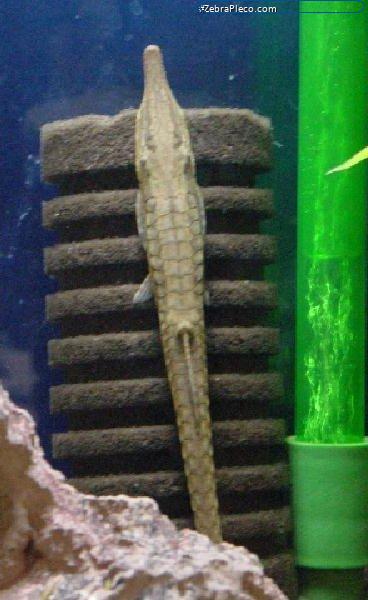
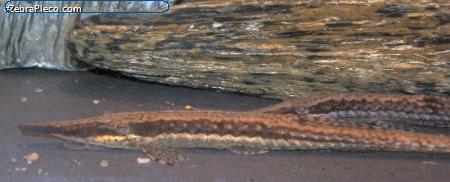
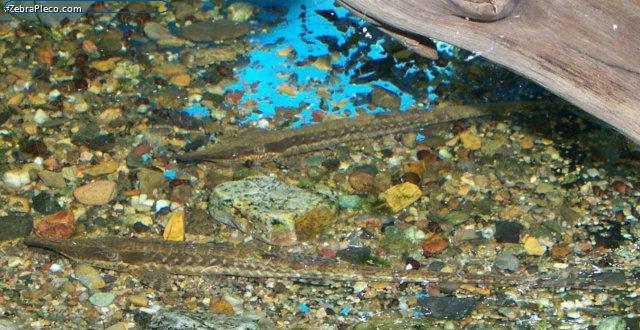
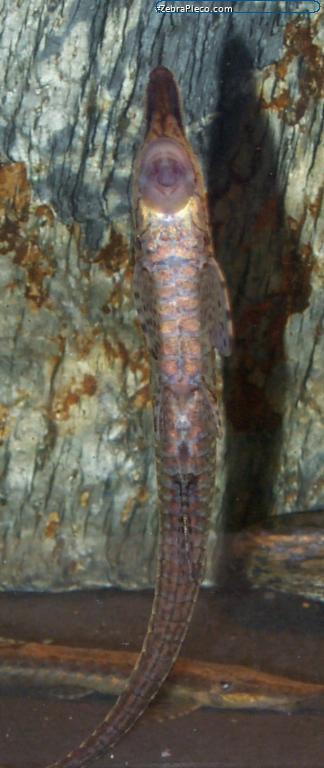
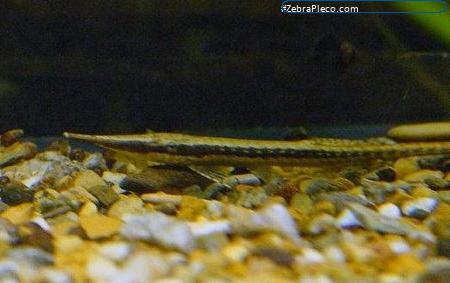
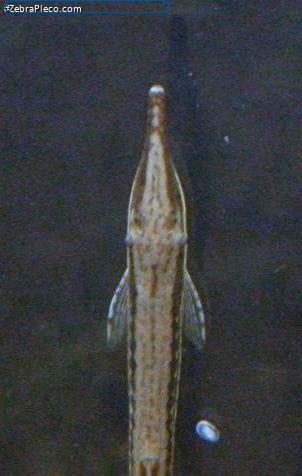
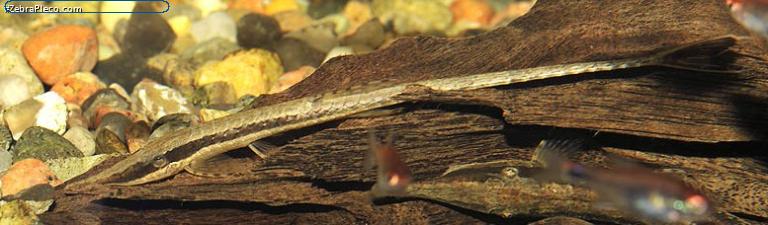
The genus Farlowella is distinguished by its elongate and slender body with a pronounced rostrum (of variable length), having the dorsal fin located near the middle of the body and only slightly anterior to the anal fin (vs. having the dorsal fin conspicuously closer to the head than the tail, and significantly further anterior than the anal fin), and having a brownish color with two lateral dark stripes beginning at the tip of the rostrum, passing through the eyes and ending at the tail. A key to the genus can be found here.
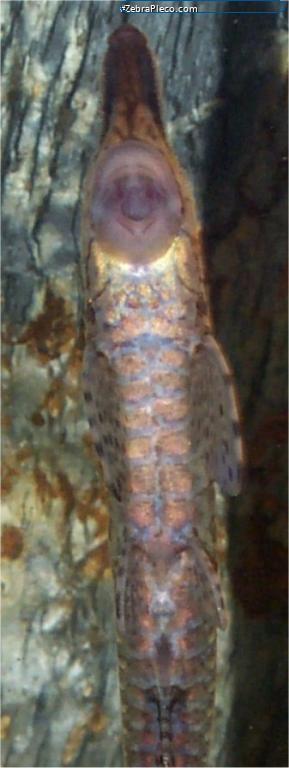
Readily identifiable by its short blunt rostrum. No other Farlowella species share the same habitat/range of F. acus.
Sexual Dimorphism (Sexing)
Males develop fairly long breeding odontodes along the sides of the rostrum.
General Remarks
This fish is highly endangered and could easily become extinct in the next twenty years. Although numerous aquarium books show photos labelled as Farlowella acus they are most likely all incorrect. It is very doubtful that this fish has ever been exported for the aquarium trade.
The holotype’s origin is listed as Caracas, Venezuela 8 August 1850. Reitzer and Page, 1996 state, “The type locality of Caracas probably refers to the general region of Venezuela.” However, I have encountered F. acus within the Rio Tuy drainage. The Rio Guaire, a tributary of the Rio Tuy, flows through Caracas and it would not be impossible that 150 years ago F. acus swam in the Rio Guaire. Thus the holotype may have actually come from the Rio Guaire or one of its feeder streams in the valley of Caracas.
Taxonomy, Synonyms & Etymology
Classification history, linguistic derivations and variant forms
Synonyms
Acestra acus, Farlowella scolopacina, Loricaria scolopacina
Pronunciation
far LOW ella - ah kuss
Etymology
This genus is named after W. G. Farlow, from Harvard University. This specific epithet literally means needle (acus=needle) and refers to its long, thin appearance.
Literature & Resources
Scientific publications, external links and citation tools
Description Reference
Denkschriften der Kaiserlichen Akademie der Wissenschaften in Wien, Mathematisch-Naturwissenschaftliche Classe. v. 6, pp 93 [29], Pl. 8 (fig. 1).
External Databases
Related Searches