PAGE_HEADER
Gelanoglanis varii Calegari & Reis, 2016
Image Showcase
Photographs, diagnostic angles and morphological variants
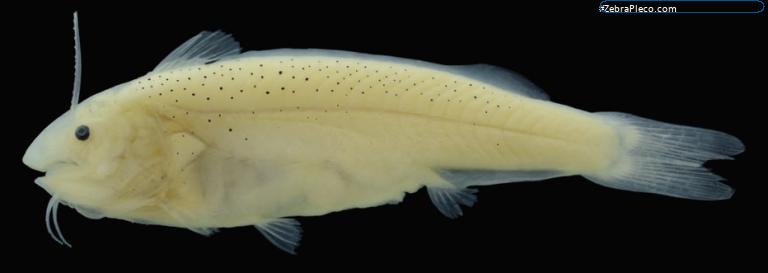
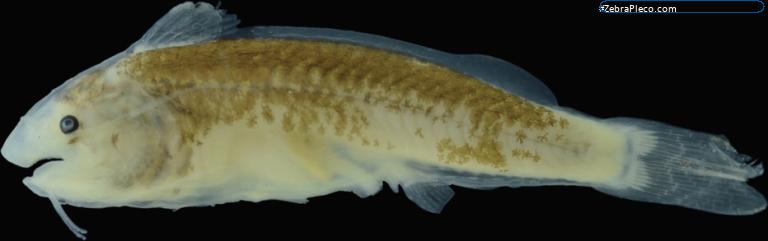
Community & Keeper Tally
Member interactions, breeding records and forum mentions
Aquarium Care & Husbandry
Dietary requirements, tank setup, compatibility and breeding
Feeding & Diet
Stomach contents of one wild-caught specimen included dipterans. [View Member Food Stats]
Breeding Notes
No member of this genus has been bred in the aquarium.
Habitat & Water Parameters
Natural distribution, biotope water conditions and temperature ranges
Geographic Distribution
Amazon, Lower Amazon, Tocantins, Middle Tocantins (click on these areas to find other species found there)
Login to view the map.
Species Description & Identification
Morphology, diagnostic traits and sexual dimorphism
Identification
Diminutive auchenipterid catfishes, distinguished by the following unique combination of characters: Single pair of chin barbels (vs. two pairs); pectoral spine, if present, lacking serrations on anterior margin; posterior nare large and immediately anterior to small eye; oblique, sinuous mouth with free fleshy flange around angle of gape; dorsal, anal, and paired fins short based with few rays; third pectoral-fin radial absent. Other shared traits include: Premaxillary tooth patches laterally oriented and widely separated anteriorly at midline; frontals sutured along midline for entire length; anterior fontanelle absent; vomer absent; mesopterygoid reduced to small round bone; mandibular ramus of lateral-line canal free from dentary.
Key for the species of Gelanoglanis (Calegari, Reis & Vari, 2014; Calegari & Reis, 2017)
1a. Pelvic fin almost reaching to the urogenital opening................ 2
1b. Pelvic fin falling short of the urogenital opening by a distance longer than the anal-fin length................ G. varii
2a. Dorsal and pectoral fins with spine................ 3
2b. Dorsal and pectoral fins lacking spine................ G. nanonocticolus
3a. Adult males with short gonopodium terminating at anal-fin origin; premaxillary teeth occupying two-thirds of length of premaxilla; anterior fontanel absent................ 4
3b. Adult males with long gonopodium extending posteriorly to midlength of base of anal fin; premaxillary teeth restricted to anterior portion of bone, occupying one-half or less of length of premaxilla; anterior fontanel present................ G. pan
4a. Dorsal-fin spine with strong serrae along posterior margin................ G. stroudi
4b. Dorsal-fin spine simple, without serrae along posterior margin................ G. travieso.
Gelanoglanis varii is distinguished from all congeners by the pelvic fin falling short of the urogenital opening by a distance longer than the anal-fin length.
Additionally, G. varii lacks a dorsal-fin spinelet; has the first unbranched pectoral and dorsal-fin rays soft; has the adipose fin in adults preceded by a long fleshy tissue ridge, originating close to the end of the dorsal-fin base; and has a shorter maxilla, ending about the middle of the hyomandibula (v. terminating posteriorly forward of the anterior margin or surpassing the middle of operculum).
Sexual Dimorphism (Sexing)
Males possess a gonopodium, which is separated from the anal-fin base.
General Remarks
In the wild, G. varii were collected in wide, open waters of the middle Tocantins River.
Taxonomy, Synonyms & Etymology
Classification history, linguistic derivations and variant forms
Etymology
Gelanoglanis: Greek, gelanes, -es, -es = happy, smiling + Greek, glanis = a fish that can eat the bait without touching the hook; a cat fish. varii: Named after Richard P. Vari, a tribute
for his great devotion, fascination and contributions to the study of the Auchenipteridae and other Neotropical fishes, and for his unlimited willingness to help young ichthyologists to develop their careers.
There are 6 other speciesCetopsis varii
Creagrutus varii
Rhyacoglanis varii
Sturisomatichthys varii
Trachelyichthys varii
Trichomycterus varii with this specific name.
Literature & Resources
Scientific publications, external links and citation tools
Literature & References
External Databases
Related Searches