PAGE_HEADER
Peckoltia simulata Fisch-Muller & Covain, 2012
Image Showcase
Photographs, diagnostic angles and morphological variants
Community & Keeper Tally
Member interactions, breeding records and forum mentions
Aquarium Care & Husbandry
Dietary requirements, tank setup, compatibility and breeding
Aquarium Furniture & Decor
In the wild, collected in areas with gravel bottoms with rocks, woods and leaves.
Compatibility & Suggested Tankmates
Tankmates: A medium sized pleco that can be combined with a very wide array of tankmates due to its unfussy nature. Perfectly safe with small fishes and shrimp or robust enough to withstand the attention of all but the largest cichlids.
Habitat & Water Parameters
Natural distribution, biotope water conditions and temperature ranges
Geographic Distribution
South America: Oyapock River in French Guiana.
Guyana Waters, Coastal Rivers of Guyanas, French Guyana Coastal Rivers, Oyapock (click on these areas to find other species found there)
Login to view the map.
Species Description & Identification
Morphology, diagnostic traits and sexual dimorphism
Identification
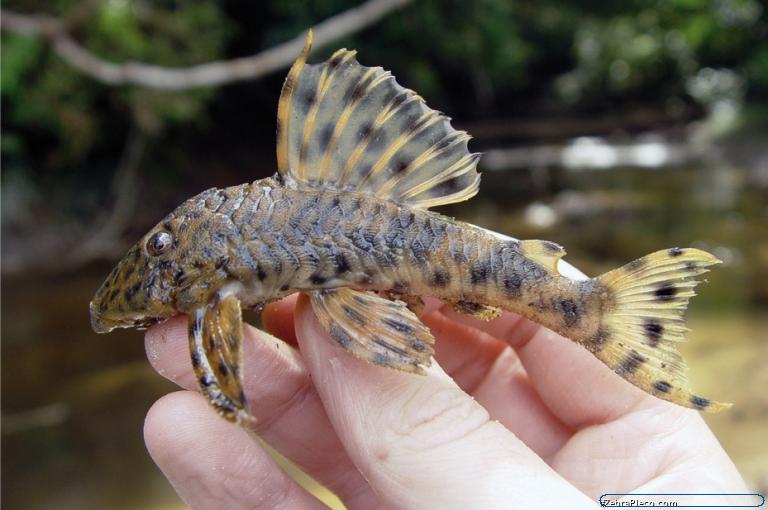
Peckoltia simulata is characterised by its specific barcode sequences (JF747001- JF747002), distinguishing it from Guianese species, and by a spotted pattern of colouration of body including posterior part, distinguishing it from all congeners except Peckoltia oligospila, P. bachi, P. sabaji, P. otali and P. capitulata. It is distinguished from the latter by teeth shape, with both lobes similar, long, lateral lobe being only very slightly smaller than medial lobe (versus distinctly smaller). Longer hypertrophied cheek odontodes, longest one passing posterior end of cleithrum (versus not reaching) additionally separate P. simulata from spotted species. It is further separated from P. bachi and P. otali by rounded spotting (versus mottling), from P. sabaji by smaller spots on caudal peduncle, and from P. capitulata by presence of spots on head (versus absence). It can be further distinguished from P. oligospila by having a smaller body depth (19.8-20.4% SL versus 21.1-23.4), narrower body (29.5-30.7% SL versus 30.9-32.8) and shorter orbital diameter (5.9-7.0% SL versus 6.9-8.1).
Sexual Dimorphism (Sexing)
Males develop small teeth-like odontodes which adorn the leading pectoral fin rays and the back half of the fishes body. Females remain unadorned and have a wider girth across the body most evident when the area just behind the pectoral fins is viewed from above.
General Remarks
Base colour brownish orange-coloured in life, lighter on lower part of caudal peduncle and ventrally, abdomen whitish. Faint dorsal saddles. Dark rounded spots on head, body and fins. Spots small to medium-sized (smaller or equal to pupil) on head, larger (less than eye) posteriorly. Spots rather irregularly distributed on head as well as on body, where they often superimpose. Similar spots on ventral surface, rarer on naked areas. Spots more contrasted, rounded and spaced on fins.
Taxonomy, Synonyms & Etymology
Classification history, linguistic derivations and variant forms
Pronunciation
peck OLE tea ah
Etymology
Peckoltia: named after Gustavo Peckolt, member of the Natural History Commission of Rondon. Specific epithet simulata, meaning counterfeit in reference to its similarity with Peckoltia oligospila.
Literature & Resources
Scientific publications, external links and citation tools
Description Reference
Cybium v. 36 (no. 1), pp 182, Figs. 7, 11.
External Databases
Related Searches