PAGE_HEADER
Silurus microdorsalis (Mori, 1936)
Image Showcase
Photographs, diagnostic angles and morphological variants
Community & Keeper Tally
Member interactions, breeding records and forum mentions
Aquarium Care & Husbandry
Dietary requirements, tank setup, compatibility and breeding
Feeding & Diet
Eats worms, crustaceans, insects and small fish. Frozen and pellet foods are accepted in captivity. [View Member Food Stats]
Aquarium Furniture & Decor
Provide outcrops of stones that the fish can swim in and around. Ceramic or PVC pipes, if supplied will be used as a cave. The substrate can be sand or fine gravel. Plants and wood decorations are a welcome addition and the fish will lounge on them on occasion but be sure to leave open water for swimming.
Compatibility & Suggested Tankmates
Peaceful with members of its own species
Tankmates: Tankmates should be large enough not to be eaten. Fishes from the same region safe to house with it include Hemibarbus labeo, large Carassius auratus, and the Coreoperca spp.
Breeding Notes
A breeding report in the Korean language book Korean Freshwater Fish (Pet Care vol. 4) states that courtship activity occurs over a 3 to 7 day period. During that time, the pair selects a spawning site among large gravel and stones. The males will frequently nudge the females belly and ventral regions and appears to assist in pressing the eggs out. Eggs are attached to the side or tops of stones and guarded by the male until hatching, The small fry feed first in infusoria but grow rapidly and can soon take newly hatched brine shrimp and finely powdered foods. In nature, spawning occurs in May/June and by September the fry have generally reached about 5cm in length.
Habitat & Water Parameters
Natural distribution, biotope water conditions and temperature ranges
Geographic Distribution
Asia: Yalu River in Korea and China.
Species Description & Identification
Morphology, diagnostic traits and sexual dimorphism
Identification
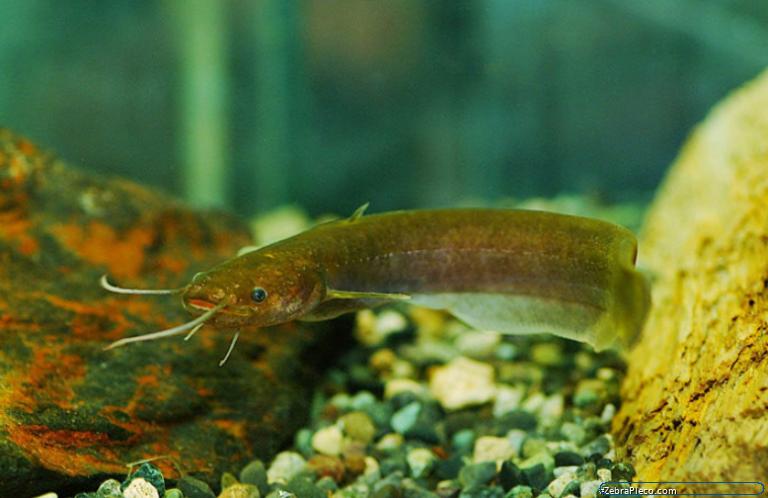
As the name suggests, S. microdorsalis possesses a very small dorsal fin. In addition, adult size is much smaller than the other Silurus species living in its native waters.
Sexual Dimorphism (Sexing)
Males much more slender than females, the latter which swell to twice their normal size when ripe with eggs
General Remarks
At a maximum length of just 25cm, this fish is the dwarf of the genus and far more suited for the average aquarist
Taxonomy, Synonyms & Etymology
Classification history, linguistic derivations and variant forms
Synonyms
Parasilurus microdorsalis
Pronunciation
See loo russ
Etymology
From the Greek silouros which is the name of the fish. The specific epithet, microdorsalis, means "with a small dorsal fin".
Literature & Resources
Scientific publications, external links and citation tools
Description Reference
Dobutsugaku Zasshi = Zoological Magazine Tokyo v. 48 (nos 8-10), pp 671, Pl. 24 (fig. 1)
External Databases
Related Searches