PAGE_HEADER
Synodontis afrofischeri Hilgendorf, 1888
Image Showcase
Photographs, diagnostic angles and morphological variants



Community & Keeper Tally
Member interactions, breeding records and forum mentions
Aquarium Care & Husbandry
Dietary requirements, tank setup, compatibility and breeding
Feeding & Diet
Feeds on molluscs and insects, particularly chironomid larvae and Povilla. [View Member Food Stats]
Aquarium Furniture & Decor
Historically (until the 1960s) this species was found throughout the Lake Victoria basin in a wide variety of habitats. Today, due to predation by the Nile Perch, they are primarily restricted to heavily vegetated swamps and feeder rivers that Nile Perch can not enter, as well as thick strands of reeds or hippo grass on the lake's margins. In captivity they will thrive in set ups as diverse as a rock habitat for Victorian Haplochromids to a Victorian papyrus swamp populated with Ctenopoma and larger killie fishes.
Compatibility & Suggested Tankmates
A peaceful fish, but should not be kept with very small fishes which it may mistake for food.
Breeding Notes
Chapman, Kaufman, and Chapman (1994) Why Swim Upside Down? A comparative study of two Mochokid catfishes. Copeia. 1994 (1) pp 130-135. References that some of the S. afrofischeri used in their study were specimens obtained from a captive spawning in the Lake Victoria exhibit at the Franklin Park Zoo in Boston. No further details are given. Is thought to spawn in the Piti River or the Rungwa drainage at the beginning of the rains in November/December.
Habitat & Water Parameters
Natural distribution, biotope water conditions and temperature ranges
Geographic Distribution
Africa: Lake Victoria, Lake Nabugabo, Victoria Nile, Lake Kyoga, Kagera River, Ihema Lake, Kingani River, Malagarasi (Nile Basin).
African Waters, Ihema (click on these areas to find other species found there)
African Waters, Western Rift Valley Lakes, Victoria, Kagera (click on these areas to find other species found there)
African Waters, Nile, Upper Nile, White Nile, Kyoga (click on these areas to find other species found there)
African Waters, Nabugabo (click on these areas to find other species found there)
African Waters, Western Rift Valley Lakes, Victoria (click on these areas to find other species found there)
African Waters, Nile, Upper Nile, White Nile (click on these areas to find other species found there)
Login to view the map.
Species Description & Identification
Morphology, diagnostic traits and sexual dimorphism
Identification
All species in the genus Synodontis have a hardened head cap that has attached a process (humeral process) which is situated behind the gill opening and pointed towards the posterior. The dorsal fin and pectoral fins have a hardened first ray which is serrated. Caudal fin is always forked. There is one pair of maxillary barbels, sometimes having membranes and occasionally branched. The two pairs of mandibular barbels are often branched and can have nodes attached. The cone-shaped teeth in the upper jaw are short. S-shaped and movable in the lower jaw. These fish produce audible sounds when disturbed rubbing the base of the pectoral spine against the pectoral girdle.
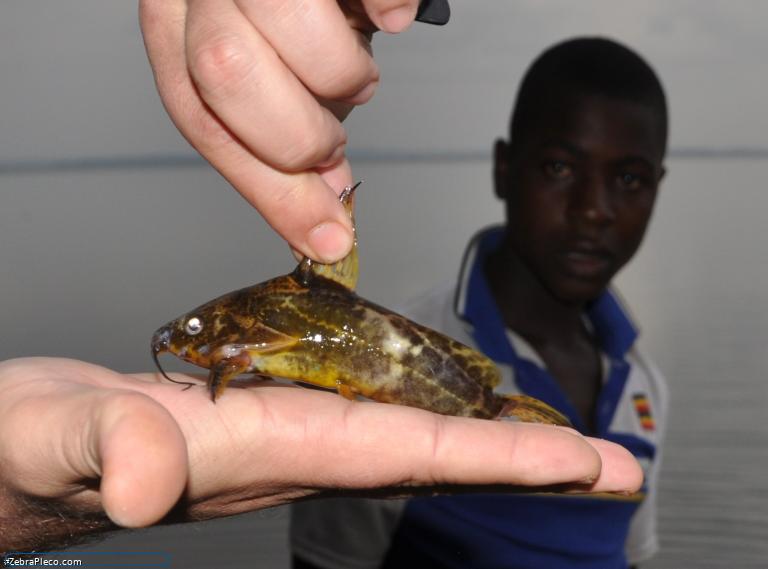
Maxillary barbels reaching almost to the origin of the pelvic fin in some specimens and to the tip of the humeral process in others. Outer mandibular barbels with slender branches, inner pair with shorter, but slender branches. Marbled yellowish-brown (marbling is extremely variable, some individuals uniformly brown).
A quite constant feature is a dark to black band from the eye to the mouth and two irregular light vertical bands anteriorly and posteriorly of the adipose fin.
It is difficult to distinguish juvenile S.afrofisceri from juvenile S.fuelleborni by coloration only.
Sexual Dimorphism (Sexing)
First lay the fish in your hand with its head toward your palm and the tail toward your fingers. Hold the dorsal spine between your middle and ring finger so the fish is belly up and you won't get punctured by the sharp fin spines (which hurts - be careful). The genital pore is in a small furrow of tissue (in healthy fish) and will be obstructed by the pelvic fins. Pull down on the tail gently to arch the fish's spine and the pelvic fins will stand and the furrow open to display the genital pore and the anus of the fish. The male has a somewhat ridged genital papillae on which the spermatoduct is on the back side, facing the tail fin. A gravid female will also show an extended papillae but the oviduct is on the ventral side of the papillae. It may also show a little redness if gravid. A thin or emaciated female will have just two pink pores, the oviduct and the anus.
General Remarks
Rarely grows to lengths greater than 15 cm SL. In the Piti River specimens at two occasions were caught between dense vegetation near the river banks. This species has adapted to a wide variety of habitats and thrives equally as well in the hard, alkaline waters of Lake Victoria as in the soft, acidic waters of swamps.
Taxonomy, Synonyms & Etymology
Classification history, linguistic derivations and variant forms
Synonyms
Synodontis afrofisheri
Pronunciation
sin oh don tiss
Etymology
According to Cuvier, Synodontis is an "ancient name for an undetermined fish from the Nile". It is not derived, as often reported, from syn-, together and odous, tooth, presumed etymology of the lizardfish genus Synodus and refers to the closely-spaced lower jaw teeth of both genera. In honour of the German researcher Dr.G.A. Fischer, who collected the first species of fishes known to science from Lake Victoria and some other places within East Africa.
Literature & Resources
Scientific publications, external links and citation tools
Description Reference
Sitzungsberichte der Gesellschaft Naturforschender Freunde zu Berlin 1888, pp 77.
External Databases
Related Searches