PAGE_HEADER
Lophiobagrus brevispinis Bailey & Stewart, 1984
Image Showcase
Photographs, diagnostic angles and morphological variants



Community & Keeper Tally
Member interactions, breeding records and forum mentions
Aquarium Care & Husbandry
Dietary requirements, tank setup, compatibility and breeding
Feeding & Diet
Readily accepts flake and frozen food, but especially relishes live food such as crustaceans, insect larvae, small fry and worms. [View Member Food Stats]
Aquarium Furniture & Decor
Lots of rocks and hiding places. Because of Lophiobagrus? digging habits, sand is best for substrate, gravel is not suitable, unless very fine.
Compatibility & Suggested Tankmates
L. brevispinis is a social fish which should be kept in a small group, but with enough hiding places, at least one for every fish. Single specimens are very shy.
Tankmates: Any not overly aggressive cichlid-species is suitable, and they can be kept with other Tanganyikan catfish like Synodontis or Phyllonemus. When combining with L. cyclurus, make sure there's room and plenty of caves, or the more peaceful L. brevispinis may be harassed by the bigger, more aggressive L. cyclurus.
Breeding Notes
Bi-parental cave breeder. Parents show elaborate care for both eggs and fry, and will remove or eat spoiled eggs or dead fry, as well as defend the cave. The fish will remain in a cave for at least three weeks! During that time no food is taken at all. Often the female leaves after two or three weeks due to hunger, leaving the male to complete the rearing of the fry. In aquaria well stocked with cichlids, the female will stay with the male during the whole breeding cycle.
Habitat & Water Parameters
Natural distribution, biotope water conditions and temperature ranges
Geographic Distribution
Lake Tanganyika. Although exported from Burundi, it?s likely to have a lake-wide distribution.
African Waters, Western Rift Valley Lakes, Tanganyika (click on these areas to find other species found there)
Login to view the map.
Species Description & Identification
Morphology, diagnostic traits and sexual dimorphism
Identification
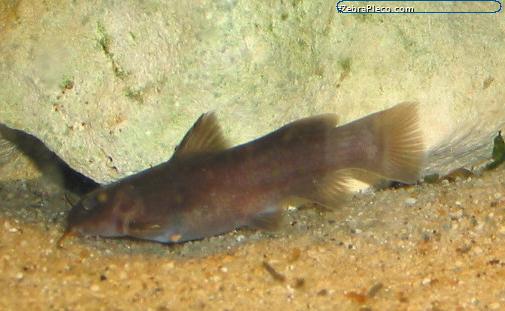
Similar to L. cyclurus but L. brevispinnis can be distinguished by the following clues:
- Smaller adult size (7cm male, 5cm female, versus 10 male and 8 female in L. cyclurus; sizes are not exactly to the mm but fairly accurate)
- Much more elongate build.
- Larger eyes that protrude above the head giving a ''frog'' like head profile.
- No clear edges on any fins!
-A rounded caudal fin, instead of truncate like L. cyclurus.
- Lighter overall colour; reddish brown with a white belly; instead of wine-red turning to black in L. cyclurus.
Sexual Dimorphism (Sexing)
Males are larger. When viewed from above, males have a large, broad head, females a rounded belly. The genital papilla on the female is only obvious near spawning time.
Taxonomy, Synonyms & Etymology
Classification history, linguistic derivations and variant forms
Pronunciation
- brev EE spin iss
Etymology
Lophiobagrus: The name comes from the broad, depressed anterior region of the fish, which reminded Poll of the Monkfish (Lophius piscatorius).
There is 1 other speciesGuyanancistrus brevispinis with this specific name.
Literature & Resources
Scientific publications, external links and citation tools
Literature & References
External Databases
Related Searches