PAGE_HEADER
Noturus gyrinus (Mitchill, 1817)
Image Showcase
Photographs, diagnostic angles and morphological variants



Community & Keeper Tally
Member interactions, breeding records and forum mentions
Aquarium Care & Husbandry
Dietary requirements, tank setup, compatibility and breeding
Feeding & Diet
Readily feeds on live and frozen foods. Madtoms appear to have difficulty in digesting earthworms and tubificid worms (even though they will gorge themselves when offered), and should not be fed these foods.
May also adapt to prepared
foods in the aquarium. [View Member Food Stats]
Aquarium Furniture & Decor
A gravel bottom is not neccesary for this species. Provide a bottom of sand mixed with peat moss, PVC pipes, flat rocks and vegetation.
Compatibility & Suggested Tankmates
Suitable for a coldwater community tank. Ideal tankmates include small- to mid-sized North American native fishes such as shiners and darters.
Tankmates: Ideal tankmates include small to midsized North American native fishes such as darters and shiners.
Breeding Notes
The northern populations spawn in May-August, although gravid females have been found in southern populations as early as April.
This species spawns in shelter and may use discarded containers for nesting sites. Both parents help to guard the nest and care for eggs (typically 93-150 in a clutch). The fish move over the egg mass in a shivering motion, with the anal fin in contact with the eggs, or take part of the egg mass into their mouths and spit it out.
Habitat & Water Parameters
Natural distribution, biotope water conditions and temperature ranges
Geographic Distribution
North America: Atlantic and Gulf Slope drainages from New Hampshire to Nueces River in Texas, USA; St. Lawrence-Great Lakes, Hudson Bay (Red River), and Mississippi River basins from Quebec to Saskatchewan in Canada and south to Gulf of Mexico in USA.
Gulf Coast Drainages, Mississippi (click on these areas to find other species found there)
Gulf Coast Drainages, Mississippi, Missouri (click on these areas to find other species found there)
Login to view the map.
Species Description & Identification
Morphology, diagnostic traits and sexual dimorphism
Identification
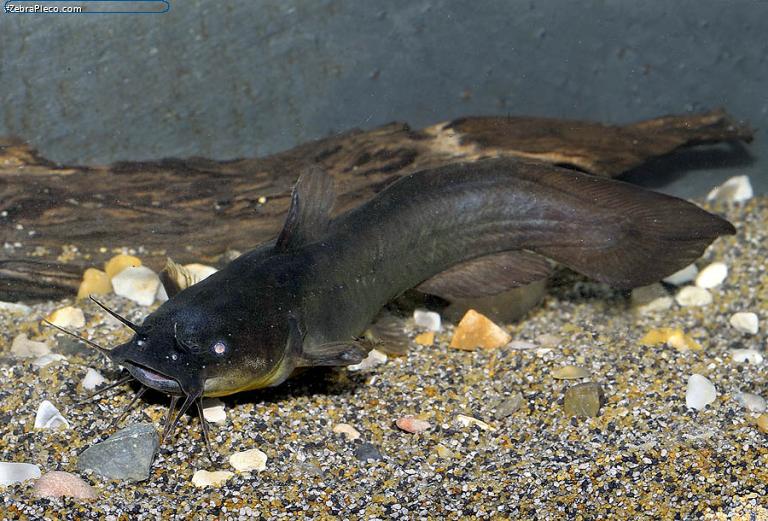
Short, stocky body. Terminal mouth with equal jaws. Posterior edge of pectoral spine without distinct serrations, golden yellow to dark chocolate brown body with dark midlateral stripe, 13-18 anal-fin rays.
Sexual Dimorphism (Sexing)
Breeding male with swollen lips, enlarged cephalic epaxial muscles, and large bulbous genital papilla. Female with papilla with deep median groove ending in a small bump.
General Remarks
W. Ralph Taylor (revised madtom catfishes in the 1960s) stabbed himself with each species of Noturus to try and discover which had the worst toxin. This dedicated research led him to the conclusion that this species, the tadpole madtom, was the worst.
Taxonomy, Synonyms & Etymology
Classification history, linguistic derivations and variant forms
Synonyms
Noturus sialis, Schilbeodes gyrinus, Schilbeodes mollis, Silurus gyrinus, Silurus mollis
Pronunciation
no two russ - jai ree nuss
Etymology
From the Greek notos, meaning back and oura, meaning tail. In reference to the confluent adipose and caudal fins. From the Greek gyrinus, meaning tadpole. In reference to the distinctive body form of this species.
There is 1 other speciesTatia gyrinus with this specific name.
Literature & Resources
Scientific publications, external links and citation tools
Literature & References
External Databases
Related Searches