
PAGE_HEADER
Hoplisoma panda (Nijssen & Isbrücker, 1971)
Image Showcase
Photographs, diagnostic angles and morphological variants



Community & Keeper Tally
Member interactions, breeding records and forum mentions
Aquarium Care & Husbandry
Dietary requirements, tank setup, compatibility and breeding
Feeding & Diet
Suggested foods are high quality flake foods, sinking wafers, frozen blood worms, grindal worms, tubificid worms. [View Member Food Stats]
Aquarium Furniture & Decor
Sandy bottom with an open swimming space lined with bogwood and plants to retreat into.
Compatibility & Suggested Tankmates
Peaceful community fish.
Tankmates: Small peaceful characins or other non aggressive community fish. Keep in shoals.
Breeding Notes
Spawned by Eric Bodrock in September 1996 who provided these notes. Easy fish to spawn. He used tanks from 10 to 90 gallons. Good hatch rate with a pH of 6.4–6.8 and TDS of 140–180 ppm. Temperature of 74°F (23°C). Normally deposit 50–60 eggs in a sunken mop, sometimes over a two-day period. Hatch rate is extremely high, and fry grow quickly.
Habitat & Water Parameters
Natural distribution, biotope water conditions and temperature ranges
Geographic Distribution
South America: Upper Amazon River basin.
Amazon, Upper Amazon, Marañón, Ucayali (click on these areas to find other species found there)
Login to view the map.
Species Description & Identification
Morphology, diagnostic traits and sexual dimorphism
Identification
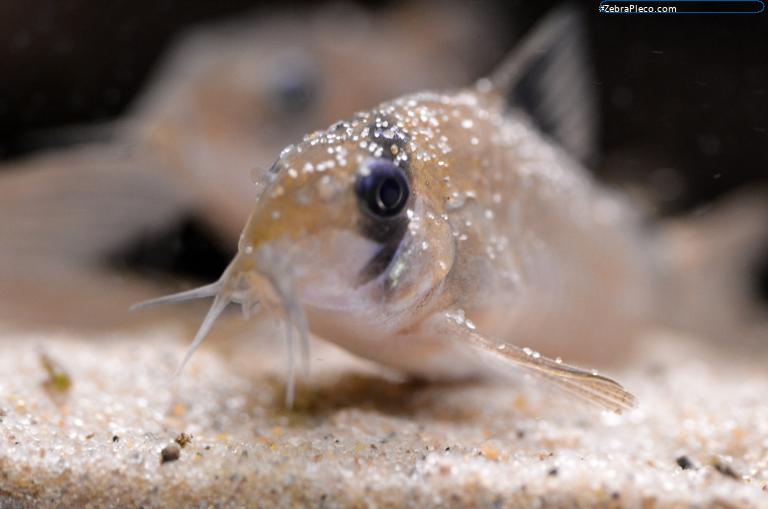
Corydoras panda has a light coloured body with black blob covering their eyes (like the panda), a black spot the dorsal fin, and a spot on or near the base of the caudal fin.
Sexual Dimorphism (Sexing)
Females are more rubust. The male has more of a streamlined body while the female is more rounded when viewed fromt he side. Easiest to view from the top. While breeding the female will be carrying the eggs with her ventral fins.
General Remarks
First collected for aquarium hobbyists in 1969 by Foersch and Hanrieder. They were first collected in a mountain brook at the side of the Rio Lullapichis (Ucayali/Peru).
Taxonomy, Synonyms & Etymology
Classification history, linguistic derivations and variant forms
Pronunciation
hop lee so mah - PANN dah
Etymology
The genus name is latin for wavy, referring to “dark purplish spots tending to run together, forming undulating longitudinal bands” - a common if not uniform colouration pattern found in this genus. Panda in allusion to the Chinese mammal - see ID notes.
There is 1 other speciesGlyptothorax panda with this specific name.
Literature & Resources
Scientific publications, external links and citation tools
Description Reference
Beaufortia v. 18 (no. 239), pp 186, Fig. 2.
External Databases
Related Searches

