PAGE_HEADER
Benitochromis finleyi (Trewavas, 1974)
Image Showcase
Photographs, diagnostic angles and morphological variants
Community & Keeper Tally
Member interactions, breeding records and forum mentions
Aquarium Care & Husbandry
Dietary requirements, tank setup, compatibility and breeding
Feeding & Diet
Omnivorous, but feed just small to very small particles; sand sifter. [View Member Food Stats]
Aquarium Furniture & Decor
Accepts plants well, needs a good number of possibilities to hide.
Compatibility & Suggested Tankmates
Tankmates: Small other cichlids from the region or medium sized Characins, Cyprinids, Killies. If the tank is big enough, it can be kept in groups - and of course it would be preferable not just to keep one pair but a group, so that a compatible pair can form - as cooperation is of highest importance for breeding success.
Breeding Notes
Biparental mouthbrooder, both parents are incubating eggs and larvae - exchange of eggs and larvae between the parents can occur several times per day.
Habitat & Water Parameters
Natural distribution, biotope water conditions and temperature ranges
Geographic Distribution
Africa: Mungo and Meme Rivers, Fernando Poo and Kribi Rivers.
African Waters, Cameroon waters (click on these areas to find other species found there)
African Waters, Cameroon waters, Mungo (click on these areas to find other species found there)
Login to view the map.
Species Description & Identification
Morphology, diagnostic traits and sexual dimorphism
Identification
Small chromidotilapiine cichlids with four openings of the laterosensory system in the lachrymal bone and three additional tubular infra-orbital bones, 16 circumpeduncular scales. All species are mouthbrooders.
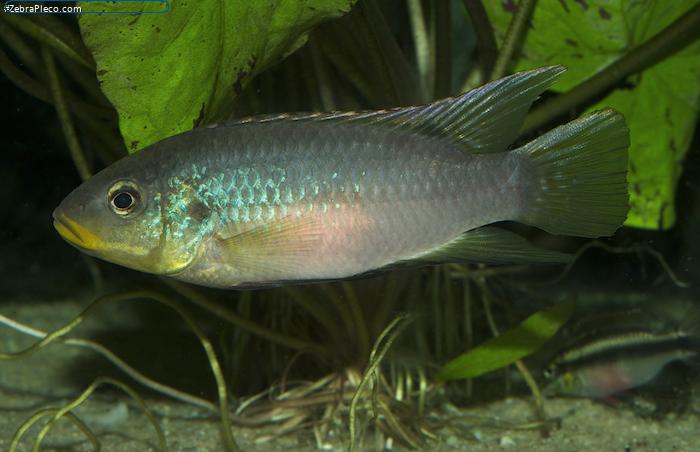
Yellow-brownish body, cheeks and opercles iridescent blue, also anterior parts of body in most individuals. Rarely some red dots are visible on the flanks.
Sexual Dimorphism (Sexing)
In females, the iridescent parts of the dorsal and caudal fin are rosy to whitish and more prominent then in males. Males with few reddish macula on the caudal fin and posterior parts of anal fin, females without such dots or at least much lesser. Additionally, males grow about 1 cm bigger then females.
Taxonomy, Synonyms & Etymology
Classification history, linguistic derivations and variant forms
Synonyms
Chromidotilapia finleyae, Chromidotilapia finleyi
Pronunciation
ben ee toe krow miss - fin lay eye
Etymology
The genus is named after the Benito River in Equatorial Guinea. The species is named in honour of Lee Finley, renowned American aquarist, author and all-round excellent chap.
Literature & Resources
Scientific publications, external links and citation tools
Description Reference
Bulletin of the British Museum (Natural History) Zoology v. 26 (no. 5), pp 393, Pl. 5; Fig. 16.
External Databases
Related Searches