PAGE_HEADER
Auchenoglanis acuticeps Pappenheim, 1914
Image Showcase
Photographs, diagnostic angles and morphological variants
Community & Keeper Tally
Member interactions, breeding records and forum mentions
Aquarium Care & Husbandry
Dietary requirements, tank setup, compatibility and breeding
Breeding Notes
Unreported in the aquarium.
Habitat & Water Parameters
Natural distribution, biotope water conditions and temperature ranges
Geographic Distribution
Lake Albert to the Lower Nile, the species does not appear to occur in the Blue Nile.
African Waters, Western Rift Valley Lakes, Albert (click on these areas to find other species found there)
African Waters, Nile, Lower Nile (click on these areas to find other species found there)
Login to view the map.
Species Description & Identification
Morphology, diagnostic traits and sexual dimorphism
Identification
The genus is diagnosed on the basis of a unique combination of characters: a deep and broad skull, narrow mouth, reduced pramaxillary tooth patches, anterior nostrils on the upper lip, and three large nuchal plates, the first which is in close proximity to the rear of the supraoccipital- a bone on the dorsal side of the great foramen(opening) of the skull.
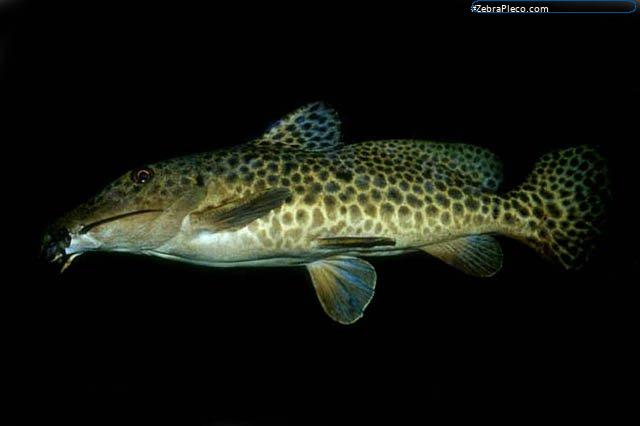
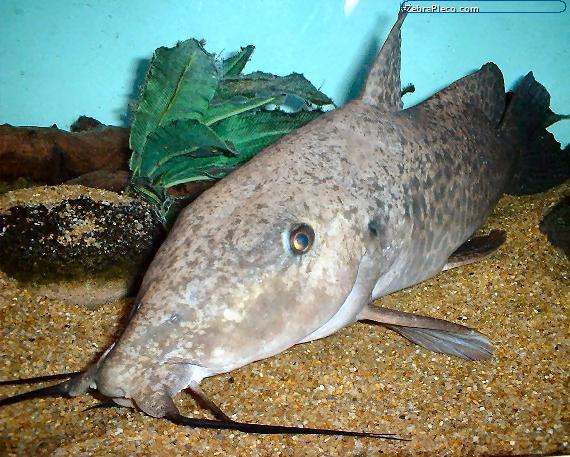
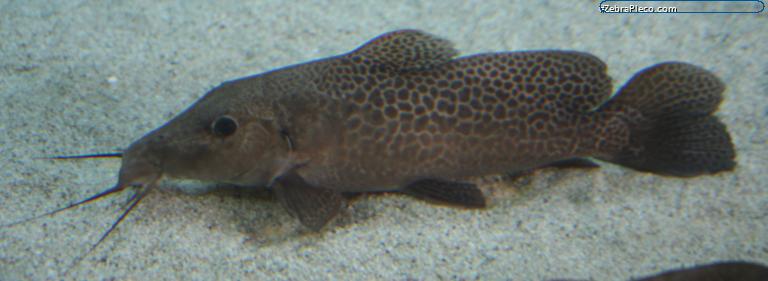
The adult body is dark dorsally and laterally but light ventrally. The upper body has a regular pattern of dark spots that may become vague dorsally. In small individuals the spots are large relative to those in large individuals. The spots may also be vague in the rayed and adipose fins and not at all apparent on the paired and anal fins that are otherwise brown or black. The caudal fin may be dark or with spots smaller than those on the body. On small individuals, the dark spots on the dorsal and caudal fins coalesce to form bands. The maxillary barbel is black, and the other barbels are white at the apex but may have some grey pigment distally. The upper lip is dark, lower lip is lightly pigmented. The sides and top of the head are dark and without spots. The lower side of the head is white with flecks of dark pigmentation. The anterior edge of the adipose fin rises gradually to its maximum height at the posterior end of the fin, well behind the mid-point of the fin.
General Remarks
There is a good chance the size potential of the different species of Auchenoglanis may be much bigger than what is shown on the data pages. Some of the current data comes from studies which do not always use fully grown adult fish, sizes will be adjusted as proof of larger adult sizes are revealed.
Taxonomy, Synonyms & Etymology
Classification history, linguistic derivations and variant forms
Etymology
Auchenoglanis: From the Greek, auchenos, meaning neck and glanis, meaning catfish; in reference to the long cranial shield.
There are 2 other speciesPharyngochromis acuticeps
Satanoperca acuticeps with this specific name.
Literature & Resources
Scientific publications, external links and citation tools
Description Reference
Retzer, ME, 2010. Taxonomy of Auchenoglanis Günther 1865 (Siluriformes: Auchenoglanididae). Zootaxa 2655: 25–51.
Wissenschaftliche Ergebnisse der Deutschen Zentral-Afrika Expedition, 1907-1908 v. 5 (Zool. 3)
External Databases
Related Searches