PAGE_HEADER
Acrochordonichthys falcifer Ng & Ng, 2001
Image Showcase
Photographs, diagnostic angles and morphological variants
Community & Keeper Tally
Member interactions, breeding records and forum mentions
Aquarium Care & Husbandry
Dietary requirements, tank setup, compatibility and breeding
Feeding & Diet
Ambush predator. Easily adapts to a diet of frozen food and pellets in the aquarium. May eat small bottom dwellers. [View Member Food Stats]
Aquarium Furniture & Decor
Inhabits clear, swiftly flowing forested streams with sandy or rocky bottoms; hides under submerged logs or rocks with some leaf litter in the swifter parts of the stream. The fish does appear to move about after dark, as it is often found wedged under cover during the day. Driftwood and rocks seem to be their favourite cover, so provide plenty of these.
Compatibility & Suggested Tankmates
Can be kept with anything other than small bottom dwellers.
Breeding Notes
Unreported in the aquarium.
Habitat & Water Parameters
Natural distribution, biotope water conditions and temperature ranges
Geographic Distribution
Asia: known only from the Kinatabangan and Segama river drainages, and possibly from the Kayan River drainage in northeastern Borneo, Malaysia.
Pacific, Greater Sunda Island Rivers, Borneo Waters, Kinabatangan (click on these areas to find other species found there)
Pacific, Greater Sunda Island Rivers, Borneo Waters, East Borneo Waters, Segama (click on these areas to find other species found there)
Login to view the map.
Species Description & Identification
Morphology, diagnostic traits and sexual dimorphism
Identification
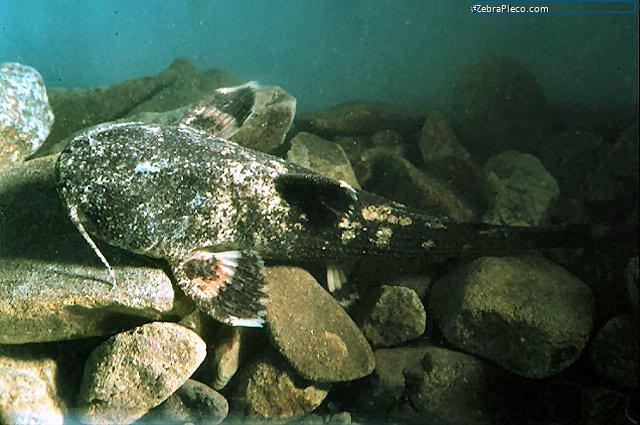
Catfish of the genus Acrochordonichthys are cryptically coloured species generally found at the bottoms of rivers throughout Southeast Asia. They have a highly rugose skin with tubercles arranged in longitudinal rows along the side of the body, a long low adipose fin and an emarginate caudal fin.
Colour pattern with many small spots of various shades of brown; many small, dark brown spots on the dorsal surface of the head. Head length 22.4-28% SL; width 24-28.6%SL; depth 14.5-19.5% SL). Body depth at anus 10.9-13.6% SL; caudal peduncle depth 5.4-6.6% SL. Dorsal to adipose distance 5.5-7.7% SL; snout length 36.8-40.9% HL. Dorsal-fin base 10.8-13.1% SL. Rounded posterior margin of adipose fin. Head with small tubercles with poorly demarcated and indistinct margins; tubercles on body arranged in 5-6 longitudinal rows on each side. Premaxillary tooth band not exposed when the mouth is closed. Pectoral spine without serrations.
Sexual Dimorphism (Sexing)
Difficult to sex. Males have a more slender genital papilla immediately in front of anus. Females tend to be larger and fuller-bodied.
Taxonomy, Synonyms & Etymology
Classification history, linguistic derivations and variant forms
Pronunciation
ack roe KOR don ick thees - fall siff err
Etymology
Acrochordonichthys: From the Greek akrochordon, meaning wart, and
ichthys, meaning fish; in reference to the tuberculate skin. The specific epithet comes from the Latin falx, meaning scythe and fere, meaning to bear; in reference to the curved and smooth pectoral spines.
There is 1 other speciesPuntioplites falcifer with this specific name.
Literature & Resources
Scientific publications, external links and citation tools
Description Reference
Journal of Fish Biology v. 58 (no. 2), pp 408, Figs. 5a, 6g, 16
External Databases
Related Searches