PAGE_HEADER
Panaque armbrusteri Lujan, Hidalgo & Stewart, 2010
Image Showcase
Photographs, diagnostic angles and morphological variants



Community & Keeper Tally
Member interactions, breeding records and forum mentions
Aquarium Care & Husbandry
Dietary requirements, tank setup, compatibility and breeding
Feeding & Diet
All Panaque appear to feed on wood, so wood should be present in the tank. They also take prepared algae wafers and fresh vegetables (zucchini, cucumber, peas, green beans) and tubers (potato, yams and similar). [View Member Food Stats]
Aquarium Furniture & Decor
Natural habitat is among fallen trees and wood-tangles.
Compatibility & Suggested Tankmates
Generally peaceful, but may defend their territory against conspecifics.
Breeding Notes
Unreported in the aquarium.
Habitat & Water Parameters
Natural distribution, biotope water conditions and temperature ranges
Geographic Distribution
South America: Brazil: Rio Tapajos river basin
Amazon, Lower Amazon, Tapajós (click on these areas to find other species found there)
Amazon, Lower Amazon, Tapajós, Upper Tapajós, Teles Pires Imported (click on these areas to find other species found there)
Amazon, Lower Amazon, Xingu Imported (click on these areas to find other species found there)
Login to view the map.
Species Description & Identification
Morphology, diagnostic traits and sexual dimorphism
Identification
The genus Panaque is identified by the teeth, which are spoon-shaped. This means that the teeth are noticeably wider at the tip than at the base. Other loricariidae have teeth that are similar width all the way from one end to the other. A second distinguishing feature is the lack of a buccal papilla, which is a "flap of skin" on the inside of the mouth. See pictures in this PDF on Pterygoplichthys.
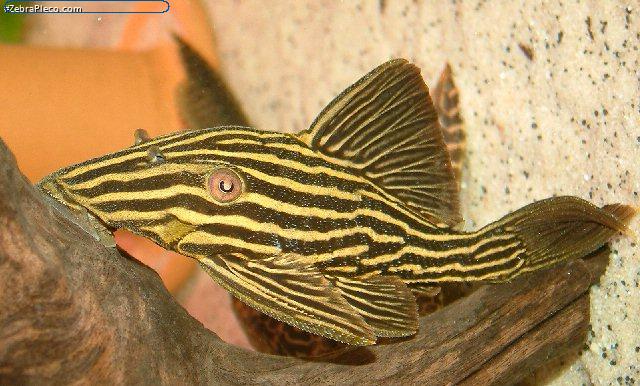
The base colouration of this fish is a brownish black with beige stripes. The eye colour is also beige. Young fish have a 1/3 clear stripe in their black/brown caudal fins that do not have any posterior edge colour. Adult fish (over 172mm SL) have teeth angles greater than 100°. Caudal fin is truncate rather than forked or lunate.
Sexual Dimorphism (Sexing)
Males have heavy odontal growth on pectoral fin and long interopercular spines.
General Remarks
The common name Thunder Royal Pleco comes from the English translation of a Japanese general term which refers to both lightning, the flash of light seen, as well as thunder, the sound it makes. It is reference to the lightening-like light coloured horizontal stripes seen especially in larger individuals.
Taxonomy, Synonyms & Etymology
Classification history, linguistic derivations and variant forms
Pronunciation
pan ah KAY. - arm brew sterr eye.
Etymology
The generic epithet "panaque" is a Venezuelan common name for this fish. The specific epithet honours Jonathan W. Armbruster,
ichthyologist, Associate Professor, and Curator of Fishes at
the Auburn University Museum Fish Collection.
There are 2 other speciesNotarius armbrusteri
Rhinodoras armbrusteri with this specific name.
Literature & Resources
Scientific publications, external links and citation tools
Description Reference
Copeia 2010 (no. 4), pp 677, Figs. 1-2, 4-5.
External Databases
Related Searches