PAGE_HEADER
Ameiurus platycephalus (Girard, 1859)
Image Showcase
Photographs, diagnostic angles and morphological variants
Community & Keeper Tally
Member interactions, breeding records and forum mentions
Aquarium Care & Husbandry
Dietary requirements, tank setup, compatibility and breeding
Feeding & Diet
A nocturnal feeder that feeds on mollusk, leeches crayfish and tiny fishes. [View Member Food Stats]
Aquarium Furniture & Decor
Open sand and rocks. Needs larger logs to hide under during day.
Compatibility & Suggested Tankmates
Social with virtually anything they can not swallow.
Breeding Notes
Unreported in the aquarium.
Habitat & Water Parameters
Natural distribution, biotope water conditions and temperature ranges
Geographic Distribution
North America: Atlantic Piedmont and Coastal Plain from Roanoke River drainage in Virginia, USA to Altamaha River drainage in Georgia, USA.
North American Atlantic Drainages, Altamaha (click on these areas to find other species found there)
North American Atlantic Drainages (click on these areas to find other species found there)
North American Atlantic Drainages, Roanoke (click on these areas to find other species found there)
Login to view the map.
Species Description & Identification
Morphology, diagnostic traits and sexual dimorphism
Identification
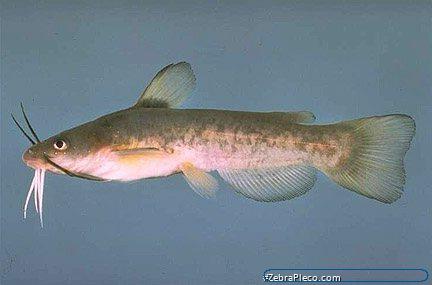
Flat head, relatively staight snout profile,Relatively short anal fin, rounded in outline,21-24 rays.Large dark blotch at dorsal fin base.Gold yellow to dark brown above,dark mottling on side, dull cream below, dusky fins, narrow black edge on median fins; 11-13 rakers on 1st gill arch.
Sexual Dimorphism (Sexing)
Females much fuller bodied during breeding season. This occurs during early spring.
General Remarks
Occurs in mud-, sand-, or rock-bottomed pools of small to large rivers. Also found in lakes, impoundments and ponds
Taxonomy, Synonyms & Etymology
Classification history, linguistic derivations and variant forms
Synonyms
Ictalurus platycephalus, Pimelodus platycephalus
Pronunciation
Ai MEE you russ - plah tee SEFF ah luss
Etymology
Ameiurus: ''curtailed'' refers to the lack of a deep notch in the caudal fin. Platys meaning flat and cephalus, head.
There are 5 other speciesAndeancistrus platycephalus
Clarias platycephalus
Miuroglanis platycephalus
Oreonectes platycephalus
Pseudohemiodon platycephalus with this specific name.
Literature & Resources
Scientific publications, external links and citation tools
Literature & References
External Databases
Related Searches