PAGE_HEADER
Clarias camerunensis Lönnberg, 1895
Image Showcase
Photographs, diagnostic angles and morphological variants
Community & Keeper Tally
Member interactions, breeding records and forum mentions
Aquarium Care & Husbandry
Dietary requirements, tank setup, compatibility and breeding
Feeding & Diet
Omnivorous and predatory. Will eat virtually anything that can be considered edible. [View Member Food Stats]
Aquarium Furniture & Decor
Open spaces for swimming and some cover is required.
Compatibility & Suggested Tankmates
Must be housed with lively, robust large fish.
Tankmates: Large Cyprinids (Silver Sharks, Tinfoil or Spanner Barbs for example) or Central American Cichlids.
Breeding Notes
Unreported in the aquarium.
Habitat & Water Parameters
Natural distribution, biotope water conditions and temperature ranges
Geographic Distribution
Africa: coastal rivers in Togo to the lower and central Congo system. Reported from Ghana.
African Waters, Congo, Lower Congo (click on these areas to find other species found there)
African Waters, Congo, Middle Congo (click on these areas to find other species found there)
Login to view the map.
Species Description & Identification
Morphology, diagnostic traits and sexual dimorphism
Identification
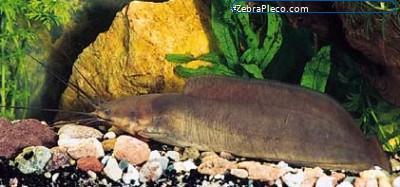
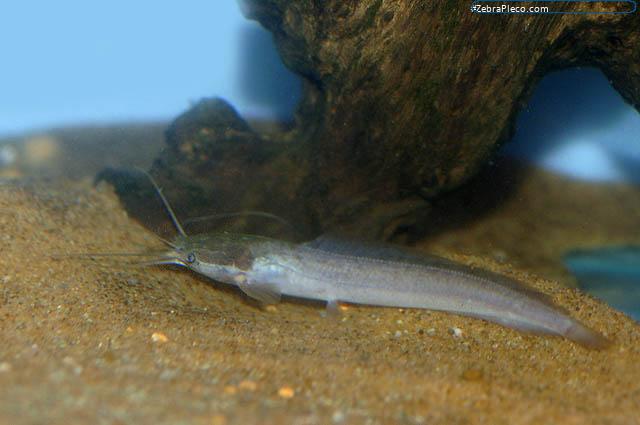
Clarias species are characterized by having an elongated body; a soft rayed dorsal fin extending to, or nearly to, the caudal fin base; a soft rayed anal fin extending from just behind the anus to the caudal fin base; pectoral fins each with a serrated anterior bony spine; head depressed, covered largely by firmly sutured, surface sculptured bony plates forming a protective helmet; four pairs of flagellate barbels (nasals, maxillaries, inner and outer mandibulars); air breathing organs derived from the 2nd and 4th epibranchials within a superbranchial chamber.
Dorsal rays 69-87; anal rays 52-70; vertebrae 56-61. Head rectangular dorsally; snout extremely broadly rounded; eyes more laterally placed. Frontal fontanelle long/narrow; occipital fontanelle long and oval-shaped. Supraorbital and `dermosphenotic' bones separated in specimens over 200 mm SL. Toothplate extremely broad. Pectoral spine slender; outer side showing strong downward serrations. Suprabranchial organ well developed. Openings of the secondary sensory canals show a regular pattern.
Sexual Dimorphism (Sexing)
The genital papilla, which is to the right of the anus as you look at the fish with its head to the left, is elongated and pointed in males while it is round and relatively larger (and larger than the anus) in females. In ventral view especially, females are much broader in the body than males of equal age and rearing practices.
Taxonomy, Synonyms & Etymology
Classification history, linguistic derivations and variant forms
Synonyms
Clarias breviceps, Clarias duchaillui, Clarias lualae, Clarias monkei, Clarias ngola, Clarias nigeriae, Clarias noensis, Clarias poensis, Clarias submarginatus, Clarias submarginatus thysvillensis, Clarias walkeri
Pronunciation
klar ee ass - kah mer roon
Etymology
Clarias: From the Greek chlaros, meaning lively; in reference to the ability of the fish to live for long periods out of water. Named after its type locality (Cameroon).
There are 3 other speciesCoptodon camerunensis
Micropanchax camerunensis
Zaireichthys camerunensis with this specific name.
Literature & Resources
Scientific publications, external links and citation tools
Description Reference
Öfversigt af Kongliga Vetenskaps-akademiens Forhandlingar v. 52 (no. 3), pp 182.
External Databases
Related Searches