PAGE_HEADER
Pterocryptis cochinchinensis (Valenciennes, 1840)
Image Showcase
Photographs, diagnostic angles and morphological variants
Community & Keeper Tally
Member interactions, breeding records and forum mentions
Aquarium Care & Husbandry
Dietary requirements, tank setup, compatibility and breeding
Feeding & Diet
Readily feeds on live/frozen foods and other prepared foods such as pellets. May eat very small fishes. [View Member Food Stats]
Aquarium Furniture & Decor
Provide plenty of rocks as hiding places.
Compatibility & Suggested Tankmates
Peaceful fish that is compatible with most (except very small) fish. Best kept in a well-oxygenated tank with a vigorous current. Ideal tankmates include balitorine loaches such as Homaloptera, and fast-swimming cyprinids such as Danio or Barilius.
Breeding Notes
Unreported in the aquarium.
Habitat & Water Parameters
Natural distribution, biotope water conditions and temperature ranges
Geographic Distribution
Asia: Nam Xam basin in Laos, Viet Nam, southeastern China and Thailand.
Vietnam waters, Central Vietnam Waters (click on these areas to find other species found there)
Login to view the map.
Species Description & Identification
Morphology, diagnostic traits and sexual dimorphism
Identification
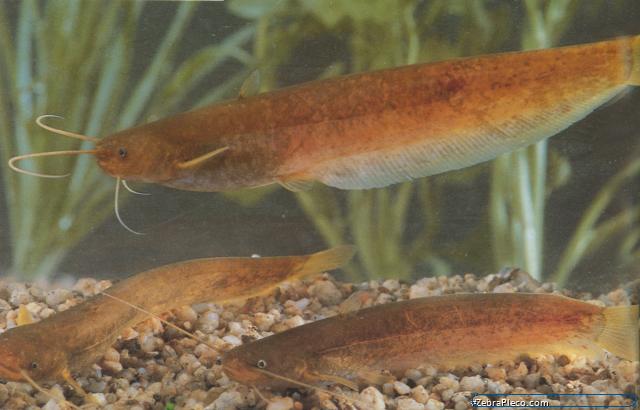
Catfishes of the genus Pterocryptis Peters, 1861, are medium-sized members of the Siluridae usually found in fast-flowing mountain streams throughout India, southern China and Southeast Asia. Pterocryptis had been considered a junior synonym of Silurus Linnaeus, 1758, until its rediagnosis by Bornbusch (1991). There are 16 nominal species of Pterocryptis (Ng & Freyhof, 2001). They can be distinguished from other siluroids by having a small dorsal fin, upper jaw longer than the lower jaw and a confluent anal and caudal fin with a distinct notch between them.
Easily distinguished by its blunt head and truncate caudal fin.
There are actually several species of Pterocryptis currently identified as
Sexual Dimorphism (Sexing)
Males have a small conical genital paiplla while females have a large, flattened, leaf-like papilla.
Males also have strong serrations on the posterior edge of the pectoral spine that females lack.
General Remarks
Found in hillstreams with moderate to swift current and a predominantly rocky bottom.
Taxonomy, Synonyms & Etymology
Classification history, linguistic derivations and variant forms
Synonyms
Herklotsella anomala, Parasilurus anomalus, Parasilurus cochinchinensis, Pterocryptis anomalus, Silurus anomalus, Silurus cochinchiensis, Silurus cochinchinensis
Pronunciation
Terr oh krip tiss - koh cheen chee nan siss
Etymology
The generic name comes from the Greek pteron, meaning fin, and kryptos, meaning hidden; in reference to the small dorsal fin. The specific epithet comes from Cochinchina (the old name for southern Vietnam), where the fish was first discovered.
Literature & Resources
Scientific publications, external links and citation tools
Description Reference
Histoire naturelle des poissons v. 14, pp 352.
External Databases
Related Searches