
PAGE_HEADER
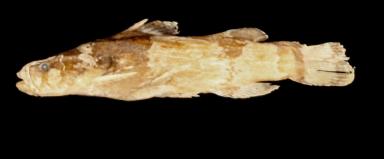 Holotype
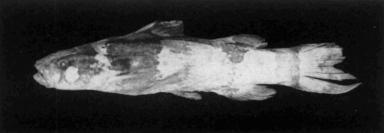 Holotype, 35 mm SL
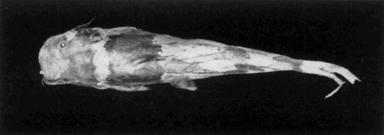 Holotype, dorsal view
| ⇓ Zebra Pleco (Hypancistrus zebra) Data Sheet | |
|---|---|
| Scientific Name | Microglanis iheringi Gomes, 1946 |
| Common Name | |
| Type Locality | Río Turmero, Aragua, Venezuela. |
| Synonym(s) | |
| Etymology | Micro - small, glanis - catfish - in reference to the rather small forms of catfish that this genus contains. There are 2 other speciesCambeva iheringi Cetopsorhamdia iheringi with this name. |
| ⇓ Species Information | |
| Identification | The genus Microglanis was described by Eigenmann
(1912) to include small pimelodids with the head as wide as long, the skull covered by skin only; the occipital crest small; frontal fontanel not extending much if any behind the eye, and a minute occipital fontanel sometimes present; eye without a free orbital margin; dorsal and pectoral spines well developed; and premaxillary patches of teeth without backward projecting angles. M. iheringi is identified by having a pale yellowish base colour with a dark black or brown saddle beneath the dorsal fin and with a small pale spot inside the saddle. The lower lobe of the caudal fin is slightly larger (with more soft rays) than the upper lobe. Because so few examples exist of this species collected from its type locality, there is little more reliable information on this species. |
| Sexing | Well-conditioned females are conspicuously wider in the abdomen than similarly sized males. |
| General Remarks | Real Microglanis iheringi from the Turmero basin in Venezuela are essentially non-existent in the aquarium hobby. To our knowledge, all fish sold as M. iheringi in the hobby are M. aff. iheringi, collected along the Orinoco basin, mostly in Eastern Colombia, rather than from Northern Venezuela. The Orinoco fish represent at least three different species of Microglanis, all similar to M. iheringi in colour pattern but each distinct in its own way. These species vary in size from 5cm to over 7cm maximum SL. |
| ⇓ Habitat Information | |
| Distribution | South America: Turmero River basin, Venezuela. Valencia, Turmero (click on these areas to find other species found there) Login to view the map. |
| IUCN Red List Category | Least Concern , a distribution map is available on the IUCN species page. Last assessed 2020. |
| ⇓ Husbandry Information | |
| Feeding | Omnivorous. User data. |
| Furniture | Dense leafy vegetation such as provided by large clumps of Java fern or Amazon swords. Narrow cracks or holes in between rocks or wood are also used. |
| Compatibility | Non aggressive and sociable with its own and other species. |
| Suggested Tankmates | Virtually all good community fish, although any young fry present in the aquarium will be in extreme jeopardy - especially after dark. |
| Breeding | Unreported for true M. iheringi, but reports exist for M. aff. iheringi. |
| Breeding Reports | There is no breeding report. |
| ⇓ Further Information | |
| Literature & References | Original Description: <b> Gomes, A. L.</b> 1946 (15 June) <a href="http://hdl.handle.net/2027.42/56932" target=_blank>See ref. online</a> |
| Wishlists | There is no wish to keep this species. |
| Spotters | There is no record of this fish being seen. |
| ⇓ More Resources | |
| Forum BBCode | |
| Find CLOG | 66 mentions on the forum, starting 11th Jan 04 |
 | Look up M. iheringi on PlanetCatfish.com |
 | Look up M. iheringi on Fishbase |
 | Look up M. iheringi on Encyclopedia of Life |
 | Look up M. iheringi on Global Biodiversity Information Facility |
 | LFS label creator ARN ref:1.31.106.8724 |
| Last Update | Wed Jan 01, 2025 8:22 pm (Species record created: Sun Jan 29, 2023 10:49 pm) |
