
PAGE_HEADER
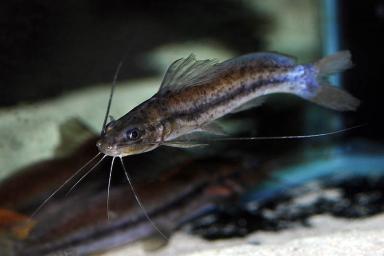
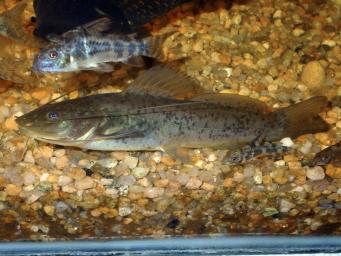
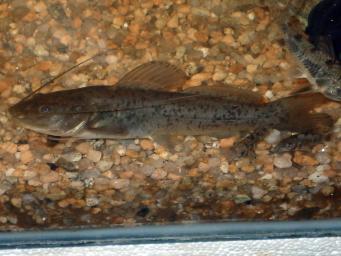
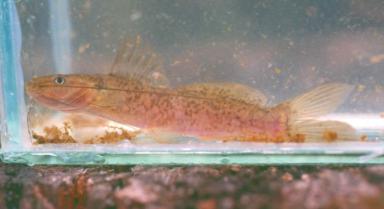
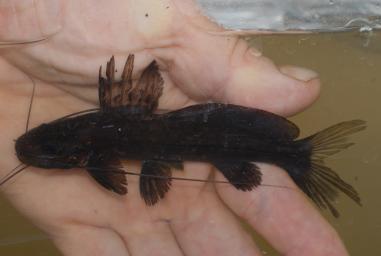 Collected in Rio Nanay, Peru
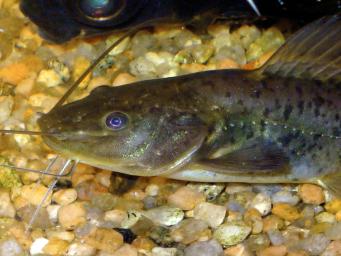 Close-up of head
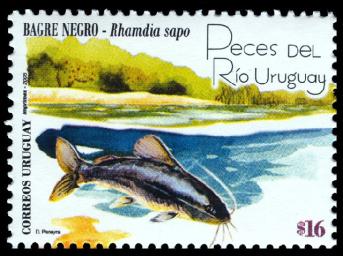 Stamp
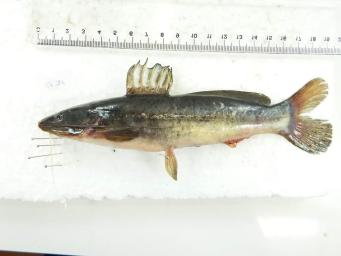 Rio Verde, Ponta Grossa
| ⇓ Zebra Pleco (Hypancistrus zebra) Data Sheet | |
|---|---|
| Scientific Name | Rhamdia quelen (Quoy & Gaimard, 1824) |
| Common Names | Silver Catfish Bagre (Spanish, South America), Bagre De Arroyo (Spanish, Venezuela), Barbilla (Spanish, Peru), Barbudo (Spanish, Peru), Canyon Catfish, Djaki Catfish, Jandia (Portuguese, Brazil), Nhandia (Portuguese, Brazil), Quelen-antennenwels (German, Germany) |
| Type Locality | Cachoeira de Macacu, tributary of the Rio Soarinho, Rio Macacu drainage, Baía de Guanabara hydrographic basin, Rio de Janeiro State, Brazil, 22°38'6"S, 42°43'6"W. |
| Synonym(s) | Caecorhamdella urichi, Caecorhamdia urichi, Heterobranchus sextentaculatus, Pimelenotus vilsoni, Pimelodus baronismuelleri, Pimelodus bathyurus, Pimelodus boucardi, Pimelodus cinerascens, Pimelodus cuyabae, Pimelodus deppei, Pimelodus godmanni, Pimelodus hilarii, Pimelodus micropterus, Pimelodus musculus, Pimelodus namdia, Pimelodus parahybae, Pimelodus pentlandii, Pimelodus quelen, Pimelodus queleni, Pimelodus queleni cuprea, Pimelodus sapo, Pimelodus sebae, Pimelodus sellonis, Pimelodus stegelichii, Pimelodus wagneri, Pimelodus wuchereri, Rhamdia barbata, Rhamdia baronismuelleri, Rhamdia bransfordii, Rhamdia cinerascens, Rhamdia depressa, Rhamdia godmani, Rhamdia guatemalensis depressa, Rhamdia heteracantha, Rhamdia hilarii, Rhamdia lehmanni, Rhamdia microps, Rhamdia mounseyi, Rhamdia nasuta, Rhamdia pentlandi, Rhamdia pubescens, Rhamdia riojae, Rhamdia sayaensis, Rhamdia sebae, Rhamdia vilsoni, Rhamdia wagneri, Silurus rivularis |
| Pronunciation | ram dee ah - kwee (or KEY) lenn |
| Etymology | The name Rhamdia is apparently a misspelling of 'nhamdiâ', an orthographic variant of the Tupi-Guarani name for the fish, 'jandiá'. The species is named after the abbe Quelen, who accompanied Quoy and Gaimard on their travels. |
| ⇓ Species Information | |
| Size | 350mm or 13.8" SL. Find near, nearer or same sized spp. |
| Identification | It is distinguished from congeners in having the following unique combination of characters: pectoral fin spine with serrae on both sides, caudal fin lobes subequal or with either lobe slightly longer, posterior nostril velum open posterolaterally, gill raker 5-16, post-Weberian vertebrae 36-44, eye medium sized. |
| Sexing | The genital papilla of males tends to be larger and more well developed. |
| ⇓ Habitat Information | |
| Distribution | Central and South America: Suriname and Argentina. Rio de Janeiro State Rivers (click on these areas to find other species found there) Amazon, Lower Amazon, Tocantins, Lower Tocantins, Acará Imported (click on these areas to find other species found there) La Plata, Paraná, Paranaíba, Araguari Imported (click on these areas to find other species found there) Sao Paulo State Rivers, Ribeira de Iguape, Betari Imported (click on these areas to find other species found there) Amazon, Lower Amazon, Guamá, Capim Imported (click on these areas to find other species found there) La Plata, Uruguay, Upper Uruguay, Chapecó Imported (click on these areas to find other species found there) São Francisco, Cipó Imported (click on these areas to find other species found there) Espirito Santo State Rivers, Doce Imported (click on these areas to find other species found there) Ecuador Pacific Coast Rivers, Esmeraldas Imported (click on these areas to find other species found there) Sao Paulo State Rivers, Iguape Imported (click on these areas to find other species found there) La Plata, Paraná, Iguatemi Imported (click on these areas to find other species found there) Ceará State Rivers, Jaguaribe Imported (click on these areas to find other species found there) Sao Paulo State Rivers, Iguape, Juquiá Imported (click on these areas to find other species found there) La Plata, Paraná, Paraguay, Upper Paraguay, Miranda Imported (click on these areas to find other species found there) Paraíba do Norte Imported (click on these areas to find other species found there) Rio de Janeiro State Rivers, Paraíba do Sul, Paraitinga Imported (click on these areas to find other species found there) La Plata, Paraná, Paranapanema Imported (click on these areas to find other species found there) Ceará State Rivers, Jaguaribe, Salgado Imported (click on these areas to find other species found there) Amazon, Lower Amazon, Tapajós, Upper Tapajós, Teles Pires Imported (click on these areas to find other species found there) Login to view the map. |
| IUCN Red List Category | Not Evaluated , a distribution map is available on the IUCN species page. Last assessed 2026. |
| pH | 4.0 - 8.0 |
| Temperature | 18.0-28.0°C or 64.4-82.4°F (Show species within this range) |
| Other Parameters | Able to tolerate a wide range of water conditions. |
| ⇓ Husbandry Information | |
| Feeding | Not a fussy eater and will take all manner of prepared and live foods. Will eat smaller tankmates. User data. |
| Furniture | Some driftwood/rocks/pipes as hiding spaces. |
| Compatibility | Should only be housed with large, robust fish (large central American cichlids are ideal), as smaller tankmates will be eaten. Territorial and aggressive towards conspecifics. |
| Suggested Tankmates | Large, robust fish (such as central American cichlids). |
| Breeding | Not reported in aquarium, but bred for aquaculture as food fish. Non-adhesive demersal eggs (1.1 to 2.8 mm diameter) are laid down, hatching after about 48 hours at 22°C. Ten days later, the larvae weigh approximately 100 mg but growth is slow (0.5 to 1.15 g per day). |
| Breeding Reports | There is no breeding report. |
| ⇓ Further Information | |
| Reference | Voyage autour du monde, pp 228, Pl. 49 (figs. 3-4). |
| Wishlists | There is no wish to keep this species. |
| Spotters | There is no record of this fish being seen. |
| ⇓ More Resources | |
| Forum BBCode | |
| Find CLOG | 39 mentions on the forum, starting 31st Aug 04 |
 | Look up R. quelen on PlanetCatfish.com |
 | Look up R. quelen on Fishbase |
 | Look up R. quelen on Encyclopedia of Life |
 | Look up R. quelen on Global Biodiversity Information Facility |
 | LFS label creator ARN ref:1.30.228.872 |
| Last Update | Thu Jan 02, 2025 9:36 am (Species record created: Thu May 23, 2002 7:00 am) |
