
PAGE_HEADER
| ⇓ Zebra Pleco (Hypancistrus zebra) Data Sheet | |
|---|---|
| Scientific Name | Hoplisoma osteocarus (Böhlke, 1951) |
| Common Names | C060, Bonehead Cory Knoglehovedpansermalle (Danish, Denmark), Panzerwels (German, Germany) |
| Type Locality | San Fernando de Atabapo, 4°03'N, 67°45'W, where Río Atabapo empties into Río Orinoco, Amazonas, Venezuela. |
| Synonym(s) | Corydoras osteocarus |
| Pronunciation | hop lee so mah - oss tee oh CARR uss |
| Etymology | The genus name is latin for wavy, referring to “dark purplish spots tending to run together, forming undulating longitudinal bands” - a common if not uniform colouration pattern found in this genus. Although all Corydoras have a 'helmet', the species name comes from the Greek for bone and head. Literally the bonehead Cory! |
| ⇓ Species Information | |
| Size | 40mm or 1.6" SL. Find near, nearer or same sized spp. |
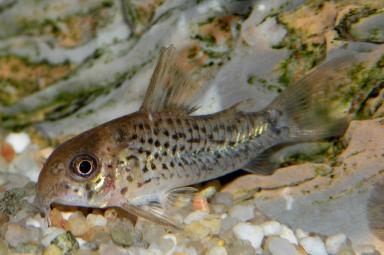
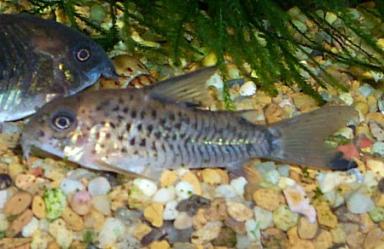
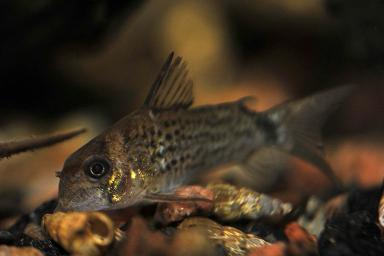
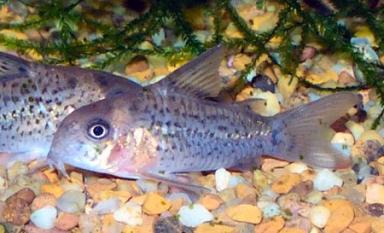
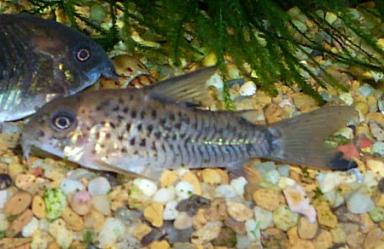
| Identification | A slender are slightly elongated, round head Corydoras; the fish shows more spots on the front half of the body behind the gills and these diminish past the posterior edge of the dorsal fin. A black band runs vertically down through the caudal peduncle. |
| Sexing | Females grow larger and are more full-bodied, this is best observed from above the fish. Males will typically have more pointed as opposed to more rounded fin tips as they mature. Females are larger and fuller especially when viewed from above. Males are more slender and have more pointed ends to the paired fins than the females. |
| General Remarks | The first three pictures of fish above were taken in Venezeula and are of fishes collected very close to the type locality. |
| ⇓ Habitat Information | |
| Distribution | South America: Orinoco River basin and coastal rivers in Suriname. Orinoco (click on these areas to find other species found there) Guyana Waters, Coastal Rivers of Guyanas, Suriname Coastal Rivers (click on these areas to find other species found there) Login to view the map. |
| IUCN Red List Category | Not Evaluated , a distribution map is available on the IUCN species page. Last assessed 2026. |
| pH | 6.0 - 7.0 |
| Temperature | 22.0-25.0°C or 71.6-77°F (Show species within this range) |
| Other Parameters | Undemanding in terms of water quality. Current should be minimal. |
| ⇓ Husbandry Information | |
| Feeding | Blood and glass worms (red and white mosquito larvae) as well as sinking pellets. User data. |
| Furniture | Shade provided by overhanging rock work, arching bogwood, tall or floating plants are all that is required. Ideally substrate should be sand, but rounded gravel will suffice. |
| Compatibility | A perfect citizen. |
| Breeding | Reportedly easy with well conditioned adults and a drop in water temperature. Spawning activity is typically frenzied. No information at present on rearing fry, but it should follow the pattern for similarly sized species. |
| Breeding Reports | There is no breeding report. |
| ⇓ Further Information | |
| Reference | Annals and Magazine of Natural History (Series 12) v. 4 (no. 44), pp 824. |
| Wishlists | There is no wish to keep this species. |
| Spotters | There is no record of this fish being seen. |
| ⇓ More Resources | |
| Forum BBCode | |
| Find CLOG | 5 mentions on the forum, starting 29th Jan 07 |
 | Look up H. osteocarus on PlanetCatfish.com |
 | Look up H. osteocarus on Fishbase |
 | Look up H. osteocarus on Encyclopedia of Life |
 | Look up H. osteocarus on Global Biodiversity Information Facility |
 | LFS label creator ARN ref:1.1.1580.864 |
| Last Update | Thu Jan 02, 2025 9:37 am (Species record created: Sun May 19, 2002 7:00 am) |
