
PAGE_HEADER

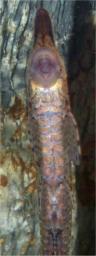
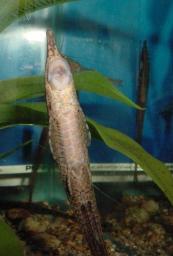 Ventral view detailing belly scutes arrangement
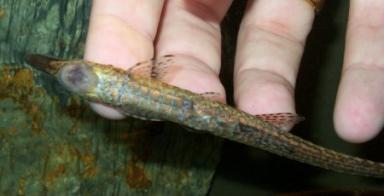 Ventral view detailing belly scutes arrangement
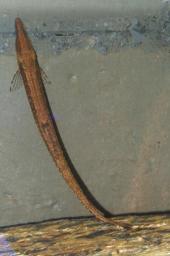 Dorsal view
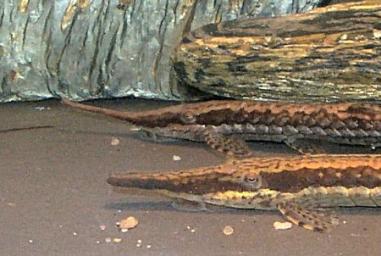 F. vittata above, F. acus below - compare rostrum.
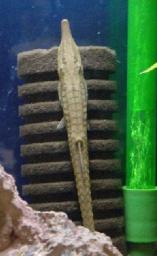
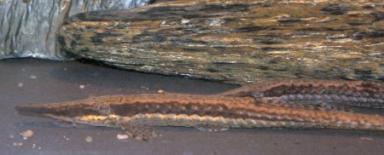
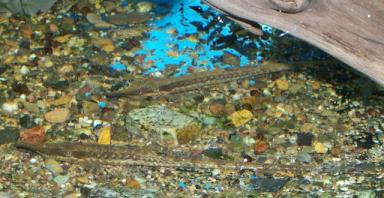
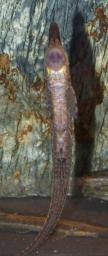
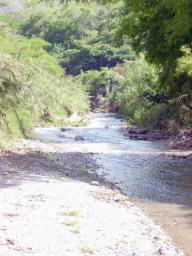 Habitat:- Rio Aragua, Venezuela
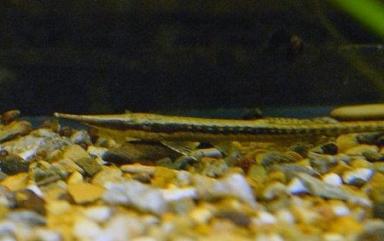 Juvenile
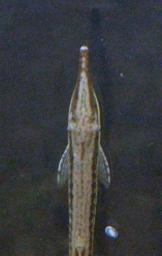 Juvenile
| ⇓ Zebra Pleco (Hypancistrus zebra) Data Sheet | |
|---|---|
| Scientific Name | Farlowella acus (Kner, 1853) |
| Common Names | Twig Catfish Aguja (Spanish, Venezuela), Almindelig Grenmalle (Danish, Denmark), Gemeiner Nadelwels (German, Germany) |
| Type Locality | Caracas, Venezuela. |
| Synonym(s) | Acestra acus, Farlowella scolopacina, Loricaria scolopacina |
| Pronunciation | far LOW ella - ah kuss |
| Etymology | This genus is named after W. G. Farlow, from Harvard University. This specific epithet literally means needle (acus=needle) and refers to its long, thin appearance. |
| ⇓ Species Information | |
| Size | 160mm or 6.3" SL. Find near, nearer or same sized spp. |
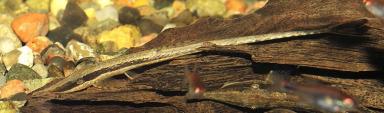
| Identification | The genus Farlowella is distinguished by its elongate and slender body with a pronounced rostrum (of variable length), having the dorsal fin located near the middle of the body and only slightly anterior to the anal fin (vs. having the dorsal fin conspicuously closer to the head than the tail, and significantly further anterior than the anal fin), and having a brownish color with two lateral dark stripes beginning at the tip of the rostrum, passing through the eyes and ending at the tail. A key to the genus can be found here. Readily identifiable by its short blunt rostrum. No other Farlowella species share the same habitat/range of F. acus. |
| Genus Topic | |
| Sexing | Males develop fairly long breeding odontodes along the sides of the rostrum. |
| General Remarks | This fish is highly endangered and could easily become extinct in the next twenty years. Although numerous aquarium books show photos labelled as Farlowella acus they are most likely all incorrect. It is very doubtful that this fish has ever been exported for the aquarium trade. The holotype’s origin is listed as Caracas, Venezuela 8 August 1850. Reitzer and Page, 1996 state, “The type locality of Caracas probably refers to the general region of Venezuela.” However, I have encountered F. acus within the Rio Tuy drainage. The Rio Guaire, a tributary of the Rio Tuy, flows through Caracas and it would not be impossible that 150 years ago F. acus swam in the Rio Guaire. Thus the holotype may have actually come from the Rio Guaire or one of its feeder streams in the valley of Caracas. |
| ⇓ Habitat Information | |
| Distribution | South America: Lake Valencia and Torito River basins. Orinoco, Middle Orinoco, Meta (click on these areas to find other species found there) Tuy (click on these areas to find other species found there) Valencia (click on these areas to find other species found there) Valencia Imported (click on these areas to find other species found there) Login to view the map. |
| IUCN Red List Category | Not Evaluated , a distribution map is available on the IUCN species page. Last assessed 2026. |
| pH | 6.8 - 7.6 |
| Temperature | 23.0-26.0°C or 73.4-78.8°F (Show species within this range) |
| Other Parameters | Water should be clear and high in dissolved oxygen. |
| ⇓ Husbandry Information | |
| Feeding | Captive feeding is easy and this fish quickly adapts to live, frozen and dry foods. Algae wafers should form the bulk of the diet and be supplemented with proteins twice weekly. User data. |
| Furniture | Substrate should be fine sand and rounded stones. This is a reophilic fish that rarely leaves the substrate. Driftwood is mostly absent from their natural habitat but they congregate where bamboo stalks hang into the water. It is only found in cool rivers and streams with a fair amount of current. |
| Compatibility | All Farlowella spp. are peaceful fish that do not compete well with aggressive tankmates. Large robust loricariids, medium to large cichlids and fast swimming shoaling fishes do not make good tankmates as Farlowella cannot compete with them for food. |
| Suggested Tankmates | Other small peaceful loricariids such as Otocinclus, Parotocinclus, and other Farlowella spp. |
| Breeding | Assumed to be the similar to the rest of the genus with the male guarding the eggs but has never been spawned in captivity. Any published reports have turned out to be for misidentified species. |
| Breeding Reports | There is no breeding report. |
| ⇓ Further Information | |
| Reference | Denkschriften der Kaiserlichen Akademie der Wissenschaften in Wien, Mathematisch-Naturwissenschaftliche Classe. v. 6, pp 93 [29], Pl. 8 (fig. 1). |
| Wishlists | There is no wish to keep this species. |
| Spotters | There is no record of this fish being seen. |
| ⇓ More Resources | |
| Forum BBCode | |
| Find CLOG | 23 mentions on the forum, starting 24th Jun 08 |
 | Look up F. acus on PlanetCatfish.com |
 | Look up F. acus on Fishbase |
 | Look up F. acus on Encyclopedia of Life |
 | Look up F. acus on Global Biodiversity Information Facility |
 | LFS label creator ARN ref:1.4.80.777 |
| Last Update | Thu Jan 02, 2025 9:36 am (Species record created: Fri Jan 11, 2002 8:00 am) |
