
PAGE_HEADER
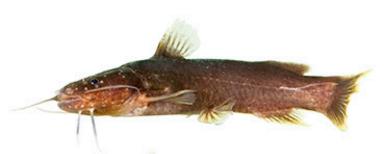
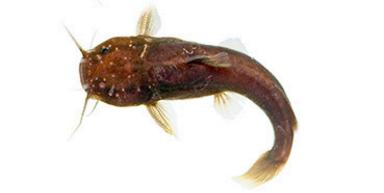 Dorsal view
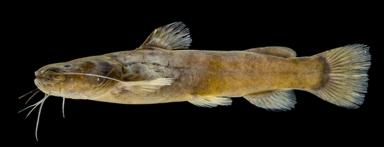 Holotype, male 54.2 mm SL
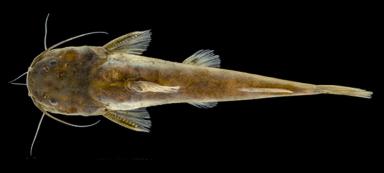 Dorsal view
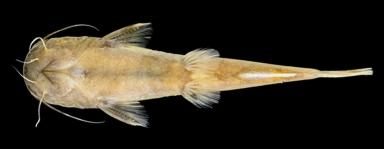 Ventral view
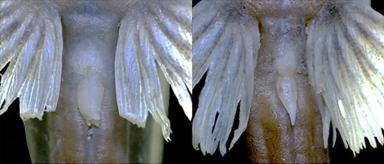 Close-up of urogenital papillae. A. Female, B. Male.
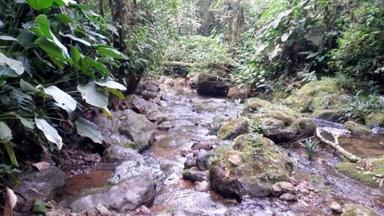 Habitat of type locality
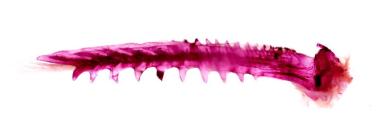 Pectoral fin spine, dorsal view. Bar = 1mm
| ⇓ Zebra Pleco (Hypancistrus zebra) Data Sheet | |
|---|---|
| Scientific Name | Microglanis berbixae Tobes, Falconí-López, Valdiviezo-Rivera & Provenzano, 2020 |
| Common Name | |
| Type Locality | Quebrada Sune, a tributary of Pachijal River, Esmeraldas River basin, Pacific slope, Parroquia de Pacto, Pichincha Province, Ecuador, 0°05'28.56"N, 78°53'53.04"W, elevation 960 metres. |
| Synonym(s) | |
| Etymology | Micro - small, glanis - catfish - in reference to the rather small forms of catfish that this genus contains. The specific name “berbixae”, honour María Resurección Sesma Lizari, “Berbixe”, mother of Ibon Tobes Sesma, for its unconditional support and infinite love. A genitive. |
| ⇓ Species Information | |
| Identification | The genus Microglanis was described by Eigenmann
(1912) to include small pimelodids with the head as wide as long, the skull covered by skin only; the occipital crest small; frontal fontanel not extending much if any behind the eye, and a minute occipital fontanel sometimes present; eye without a free orbital margin; dorsal and pectoral spines well developed; and premaxillary patches of teeth without backward projecting angles. Microglanis berbixae is distinguished from congeners by its colour pattern. Head and body uniform, pale brown, yellowish or greyish, without any kind of blotches, bands, or dots, except a transverse lunate band, dark brown or black, at caudal-fin origin (vs. head and body mottled or marbled brown with whitish or cream blotches, bands, or dots in other species). M. berbixae is further distinguished from M. variegatus, its geographically closest species, by belly pigmentation; in M. berbixae the belly colour is uniform, yellowish or greyish brown, without aggregates of small black dots/melanophores (vs. usually possessing a whitish or creamy belly with randomly arranged aggregates of melanophores). |
| Sexing | Well-conditioned females are conspicuously wider in the abdomen than similarly sized males. Females and males can be sexed by their genital papillae: Female: Cylindrical-shaped papilla with truncated ending and a small pointed flap. Male: Elongate and triangular papilla, pointed tip, no flap. |
| ⇓ Habitat Information | |
| Distribution | Found in two small rivers of the Pachijal River system, the Sune and Mashpi Rivers, part of the Esmeraldas River Basin, Pacific Ocean versant, northwestern Ecuador, Pichincha province. Ecuador Pacific Coast Rivers, Esmeraldas (click on these areas to find other species found there) Login to view the map. |
| IUCN Red List Category | Not Evaluated , a distribution map is available on the IUCN species page. Last assessed 2026. |
| pH | 7.8 - 7.8 |
| Temperature | 20.0-23.5°C or 68-74.3°F (Show species within this range) |
| Other Parameters | In nature, found in two streams: Both with shallow rapids. Water temperature 20.3ºC - 23.2ºC , conductivity 46.5 - 78.7 μS cm-1, dissolved oxygen saturation 74.9% - 89.4%, and pH 7.8. |
| ⇓ Husbandry Information | |
| Furniture | In the wild, specimens have these microhabitat preferences: central area of small streams, characterised by shallow rapids (< 20 cm; < 0.3 m s-1) with sand, gravel, pebbles and small scattered boulders. Riparian forest almost intact, shading 90% - 100% of the stream. |
| Compatibility | Non aggressive and sociable with its own and other species. |
| Suggested Tankmates | In wild, fish communities included these spp.: (mostly) Rhoadsia altipinna and Andinoacara blombergi, with fewer specimens of Bryconamericus dahli, Astroblepus cyclopus, Astroblepus sp., Trichomycterus sp., Pseudopoecilia festae, and Pimelodella modesta. |
| Breeding Reports | There is no breeding report. |
| ⇓ Further Information | |
| Literature & References | Original Description: <b> Tobes, I., A. Falconí-López, J. Valdiviezo-Rivera and F. Provenzano</b> 2020 (26 June) <a href="https://doi.org/10.1590/1982-0224-2019-0023" target=_blank>See ref. online</a> |
| Wishlists | There is no wish to keep this species. |
| Spotters | There is no record of this fish being seen. |
| ⇓ More Resources | |
| Forum BBCode | |
| Find CLOG | 2 mentions on the forum, starting 3rd Jul 20 |
 | Look up M. berbixae on PlanetCatfish.com |
 | Look up M. berbixae on Fishbase |
 | Look up M. berbixae on Encyclopedia of Life |
 | Look up M. berbixae on Global Biodiversity Information Facility |
 | LFS label creator ARN ref:1.31.106.7675 |
| Last Update | Wed Jan 01, 2025 8:22 pm (Species record created: Fri Jul 03, 2020 6:50 pm) |
