
PAGE_HEADER
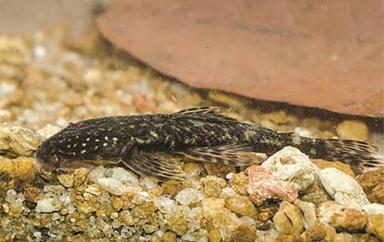 Paratype, female. Photo by Haroldo Palo Jr.
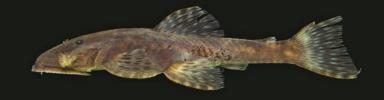 Holotype, female.
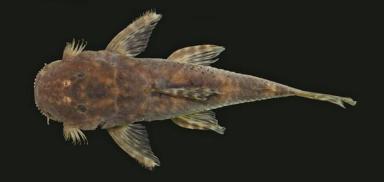 Holotype, dorsal. Female.
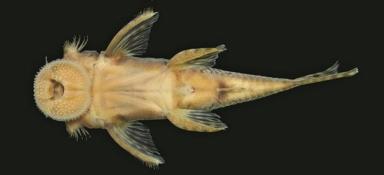 Holotype, ventral. Female.
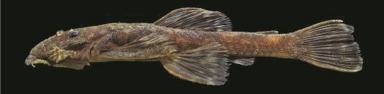 Paratype, male.
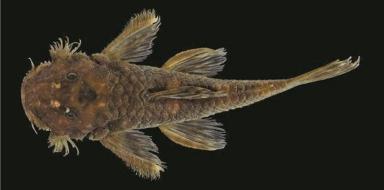 Paratype, dorsal. Male.
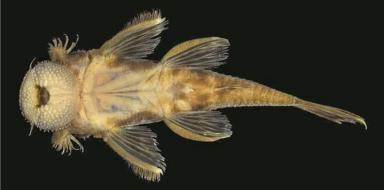 Paratype, ventral. Male.
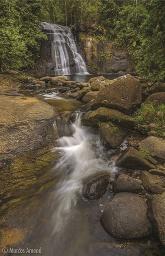 Type locality. Photo by Marcos Amend.
| ⇓ Zebra Pleco (Hypancistrus zebra) Data Sheet | |
|---|---|
| Scientific Name | Paralithoxus mocidade Rapp-Py-Daniel, Oliveira, Bastos, Ito, Zuanon & Briglia-Ferreira, 2019 |
| Common Name | |
| Type Locality | Stream tributary to Ajarani River, Branco River basin, upstream of large waterfall, Serra da Mocidade, Caracaraí Municipality, Roraima State, Brazil, 01°42'52.70"N, 61°48'17.64"W. |
| Synonym(s) | |
| Pronunciation | PAH rah lith OX uss |
| Etymology | Greek: Para = The side of + lithos = stone + oxys = sharp. The specific epithet mocidade is in allusion to the type locality, in Serra da Mocidade National Park. A noum in apposition. |
| ⇓ Species Information | |
| Size | 55mm or 2.2" SL. Find near, nearer or same sized spp. |
| Identification | Paralithoxus mocidade differs from most species of Paralithoxus by the presence of a large pelvic fin, whereas in other species the pectoral is clearly larger than the pelvic fin. Additionally, P. mocidade differs from all congeners except P. bovallii by having truncate teeth (vs. pointed to acute teeth). It differs from P. bovallii by the truncate caudal fin (vs. caudal-fin forked). P. mocidade differs from P. pallidimaculatus and P. surinamensis by the presence of adipose fin (vs. absence). It differs from P. planquettei and P. stocki by having a more depressed and elongate body; from P. raso by the larger interorbital distance and larger dentaries; from P. stocki and P. boujardi by the caudal fin conspicuously mottled, with alternating dark and light blotches (vs. caudal fin dark with clear distal band); and from P. jariensis by having seven to eight plates between dorsal and adipose fins (vs. four) and 24-26 lateral median plates (vs. 23-24). |
| Sexing | Cheek plate odontodes more hypertrophied on males than females. Fins more developed on males than females: pectoral spine larger, stronger, bearing more developed odontodes on distal half; first pelvic-fin unbranched ray strong, rounded for entire length and enlarged medially; branched rays on pelvic fin conspicuously longer than unbranched ray. Male has caudal peduncle covered with odontodes, except around anal fin, whereas females and juveniles present caudal peduncle ventrally smooth, without aligned odontodes. Mature males may be darker (more melanic coloration) than females on body, fins and lips. |
| General Remarks | Overall body colour dark olive-brown on dorsum with light green spots on snout and cheek; thin creamy to light green vermiculations over interorbital area and posterior portion of head; clear marks on anterior portion of dorsum becoming larger and more irregular towards caudal peduncle. All fins with checkered pattern, alternating large dark blotches with clear ones. Four inconspicuous large transverse light bars on body: first on dorsal-fin origin, second large bar on posterior dorsal-fin base, third anterior to adipose, and fourth on base of caudal fin. Ventral side of body uniformly beige. |
| ⇓ Habitat Information | |
| Distribution | Ajarani River, a high-altitude (approximately 900 m elevation) tributary of Branco River basin. Amazon, Middle Amazon (Solimoes), Negro, Lower Negro, Branco (Roraima), Upper Branco (Roraima), Ajarani (click on these areas to find other species found there) Login to view the map. |
| IUCN Red List Category | Not Evaluated |
| pH | 5.5 - 5.5 |
| Temperature | 21.5-22.0°C or 70.7-71.6°F (Show species within this range) |
| Other Parameters | The collection site is a small fast-flowing river with clear water, low temperature, acidic pH, high dissolved oxygen (DO = 20.7%), and smooth rocks on the bottom. |
| ⇓ Husbandry Information | |
| Feeding | In nature, Paralithoxus mocidade grazes over smooth rocks. User data. |
| Furniture | Fast flowing water over smooth rocks. |
| Suggested Tankmates | In nature, P. mocidade co-occurs with an undescribed species of Ancistrus (Loricariidae) and Trichomycterus. |
| Breeding Reports | There is no breeding report. |
| ⇓ Further Information | |
| Literature & References | Original Description: <b> Rapp-Py-Daniel, L. H., A. S. Oliveira, D. A. Bastos, P. M. M. Ito, J. Zuanon and S. R. Briglia-Ferreira</b> 2019 (9 Dec.) <a href="https://doi.org/10.1590/1982-0224-20190041" target=_blank>See ref. online</a> |
| Wishlists | There is no wish to keep this species. |
| Spotters | There is no record of this fish being seen. |
| ⇓ More Resources | |
| Forum BBCode | |
| Find CLOG | 1 mention on the forum, starting 4th Dec 19 |
 | Look up P. mocidade on PlanetCatfish.com |
 | Look up P. mocidade on Fishbase |
 | Look up P. mocidade on Encyclopedia of Life |
 | Look up P. mocidade on Global Biodiversity Information Facility |
 | LFS label creator ARN ref:1.4.311.7592 |
| Last Update | Wed Jan 01, 2025 8:12 pm (Species record created: Wed Dec 04, 2019 5:09 pm) |
