
PAGE_HEADER

 Adult collected in Rio Xingu, Brazil

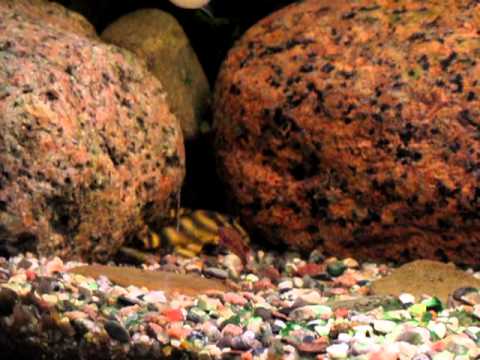 Video
 Eight day old fry
 Eight week old juveniles (& one LDA01 7 week old)
 Ten week old youngsters and already 4cm!
 Male on top clearly showing the body odontodes
 Male guarding fry


 Close-up of mouth
 Dorsal view
 Ventral view


 Dorsal view

 Fry development, one day to six months
 Four day old fry
 Seven day old
 Twelve day old
 Seventeen day old
 Thirty day old
 Six month old juvenile
 Eight month old juvenile


 Close-up of eye
| ⇓ Zebra Pleco (Hypancistrus zebra) Data Sheet | |
|---|---|
| Scientific Name | Peckoltia vittata (Steindachner, 1881) |
| Common Names | L015, Candy Striped Pleco Bolsjesugemalle (Danish, Denmark), Xingu-peckoltia (German, Germany) |
| Type Locality | Amazon River, Tajapouru, Xingú near Moz Port, Rio Madeira, Brazil. |
| Synonym(s) | Ancistrus vittatus, Chaetostomus vittatus, Peckoltia kuhlmanni, Peckoltichthys kuhlmanni |
| Pronunciation | peck OLE tea ah - vi tat ah |
| Etymology | Peckoltia: named after Gustavo Peckolt, member of the Natural History Commission of Rondon. This specific epithet literally means decorated with a ribbon(vittata=decorated with a ribbon) and refers to the bands of colour on its body. There are 10 other speciesBhava vittata Bujurquina vittata Crenicichla vittata Curimata vittata Farlowella vittata Gambusia vittata Pimelodella vittata Poecilia vittata Pyrrhulina vittata Trichopsis vittata with this name. |
| ⇓ Species Information | |
| Size | 140mm or 5.5" SL. Find near, nearer or same sized spp. |
| Identification | This fish, often labelled 'Candy Striped Peckoltia' has often been confused in hobby literature with the fish we now know as Panaque maccus, the clown pleco [For example, Baensch Atlas Vol. 1 has a picture of Panaque maccus with the label Peckoltia vittata next to it]. As with most Loricariids, colouration depends on mood. |
| Sexing | Males develop small teeth-like odontodes which adorn the leading pectoral fin rays and the back half of the fishes body. Females remain unadorned and have a wider girth across the body most evident when the area just behind the pectoral fins is viewed from above. Males develop small teeth-like odontodes which adorn the leading pectoral fin rays and the back half of the fishes body. Females remain unadorned and have a wider girth across the body most evident when the area just behind the pectoral fins is viewed from above. |
| General Remarks | L015 was collected in Brazil in the Rio Xingú at Altamira. |
| ⇓ Habitat Information | |
| Distribution | South America: Middle and lower Amazon River basin. Amazon, Lower Amazon (click on these areas to find other species found there) Amazon, Middle Amazon (Solimoes) (click on these areas to find other species found there) Amazon, Lower Amazon, Xingu (click on these areas to find other species found there) Amazon, Lower Amazon, Xingu Imported (click on these areas to find other species found there) Login to view the map. |
| IUCN Red List Category | Least Concern , a distribution map is available on the IUCN species page. Last assessed 2018. |
| pH | 5.6 - 7.0 |
| Temperature | 22.0-26.0°C or 71.6-78.8°F (Show species within this range) |
| Other Parameters | dH range 2-20. |
| ⇓ Husbandry Information | |
| Feeding | Omnivorous with a tendency towards meaty foods. Not an effective algae eater. Well fed individuals will not damage most plants. User data. |
| Furniture | Rock piles and wood tangles. Plants are not vital. |
| Compatibility | Peaceful if a little territorial. As a rough guide give each fish a 12 inch square area well broken up with decorations. |
| Suggested Tankmates | A medium sized pleco that can be combined with a very wide array of tankmates due to its unfussy nature. Perfectly safe with small fishes and shrimp or robust enough to withstand the attention of all but the largest cichlids. |
| Breeding | Has been bred in captivity. Follow details in Shane's World article. |
| Breeding Reports | There is no breeding report. |
| ⇓ Further Information | |
| Reference | Denkschriften der Kaiserlichen Akademie der Wissenschaften in Wien, Mathematisch-Naturwissenschaftliche Classe. v. 43, pp 115 [15], Pl. 2 (figs. 5-5a). |
| Wishlists | There is no wish to keep this species. |
| Spotters | There is no record of this fish being seen. |
| ⇓ More Resources | |
| Forum BBCode | |
| Find CLOG | 159 mentions on the forum, starting 4th Apr 04 |
 | Look up P. vittata on PlanetCatfish.com |
 | Look up P. vittata on Fishbase |
 | Look up P. vittata on Encyclopedia of Life |
 | Look up P. vittata on Global Biodiversity Information Facility |
 | LFS label creator ARN ref:1.4.18.75 |
| Last Update | Thu Jan 02, 2025 9:36 am (Species record created: Sat May 05, 2001 7:00 am) |
