
PAGE_HEADER
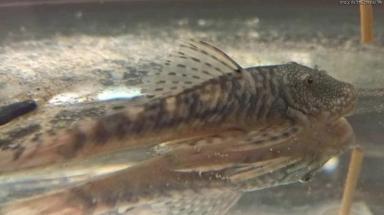
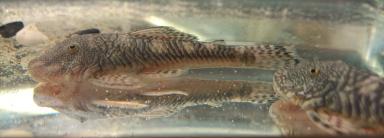
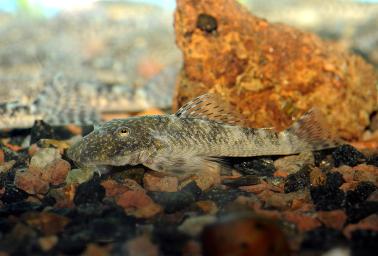
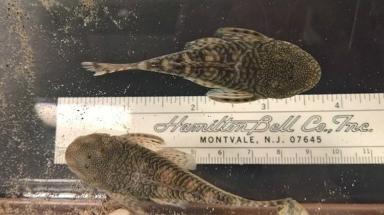 Dorsal view
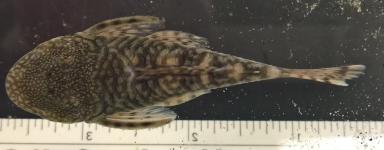 Dorsal view
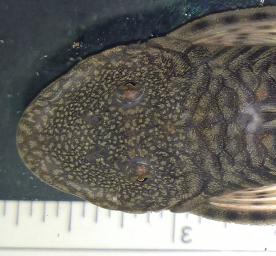 Close-up of head, dorsal view
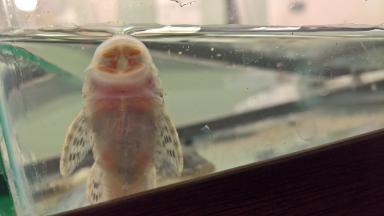 Ventral view
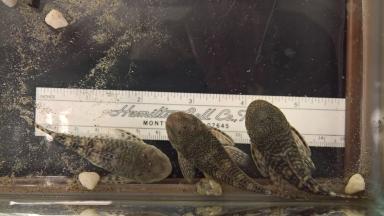 Dorsal view
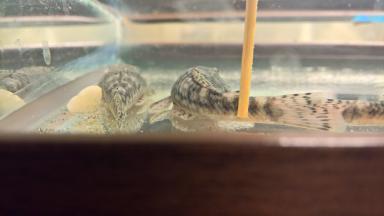
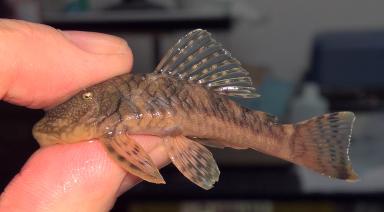
| ⇓ Zebra Pleco (Hypancistrus zebra) Data Sheet | |
|---|---|
| Scientific Name | Chaetostoma sp. (6) |
| Common Name | |
| Synonym(s) | |
| Pronunciation | KATE oh STOW mah |
| Etymology | Greek, chaite = hair + Greek, stoma = mouth. There are 4 other speciesAncistrus sp(6) Hypostomus sp(6) Rineloricaria sp(6) Synodontis sp(6) with this name. |
| ⇓ Species Information | |
| Identification | The genus Chaetostoma is not straightforward to identify, but as a general rule, the species has spines behind the gill-cover (interopercular odontodes), no plates on the abdomen, and aside from C. platyrhynchus also lack plates on the snout edge. Different from Ancistrus by not having fleshy tentacles on the snout. The body of sp(6) is more elongate than that of both Chaetostoma formosae and C. dorsale. Body is a tan base colour with a dark slate grey colouring over it. Head has a darker slate grey colour with light tan spots. The tan spots on the head are small, densely-packed, and irregular in shape, reminiscent of mosaic tiles or the pieces of a jigsaw puzzle. On the dorsal lip of the largest individual, the tan mosaic spots are much larger (3-4x larger) than on the head and are separated by greater distances of the dark grey colour. On the smaller specimens, the spots on the dorsal lip are more uniform in size relative to other spots on head. Body armour plates have pale grey diagonal lines (oriented from anterio-dorsal to posterio-ventral) along the crests of the plates. Most of the lines are broken near the midline of the body. Body has five prominent pale (tan base colour, not light grey) saddles. The most anterior saddle is located at the base of the dorsal fin spine, and the most posterior at the end of the caudal peduncle, immediately before the tail. The combination of pale grey lines and tan saddles creates an irregular camouflage pattern. Dorsal, pectoral, pelvic and caudal fins are banded, with the bands restricted to the fin spines and rays. Membranes of the dorsal, pectoral, pelvic and caudal fins are hyaline/transparent. These fish show little or no iridescence; there may be a slight gold iridescence on the face where the tan spots are, but otherwise, none. |
| Sexing | The males have however a larger and broader head, slimmer ventral sides and disproportionately large pelvic fins. Perhaps the over-sized pelvic fins play a large role in the fertilization of the eggs. By inverting these over the clutch of eggs, they prevent the sperm cells being carried away by fast water current. The three specimens used for this description appear to be sexually undeveloped. That said, one individual had pelvic fins with membranes extending beyond the tip of the pelvic spines; perhaps elongate pelvic fins is a male trait. |
| General Remarks | These three fish were found as contaminants with a shipment of mixed Chaetostoma formosae and C. dorsale. |
| ⇓ Habitat Information | |
| Distribution | Unknown. But considering that these fish were found as contaminants with a shipment of mixed Chaetostoma formosae and C. dorsale, this would indicate a distribution somewhere along the Orinoco drainage. |
| ⇓ Husbandry Information | |
| Furniture | Well rounded stones stacked to replicate a river bottom and provide caves. |
| Breeding Reports | There is no breeding report. |
| ⇓ Further Information | |
| Wishlists | There is no wish to keep this species. |
| Spotters | There is no record of this fish being seen. |
| ⇓ More Resources | |
| Forum BBCode | |
| Find CLOG | 2 mentions on the forum, starting 22nd Dec 18 |
 | Look up C. sp. (6) on PlanetCatfish.com |
 | LFS label creator ARN ref:1.4.26.7282 |
| Last Update | Sun Dec 23, 2018 10:54 am (Species record created: Sat Dec 22, 2018 6:19 pm) |
