
PAGE_HEADER
 Caught on Lake Nasser, Egypt
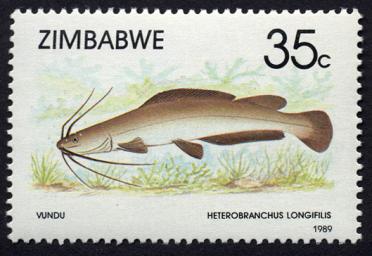 Stamp
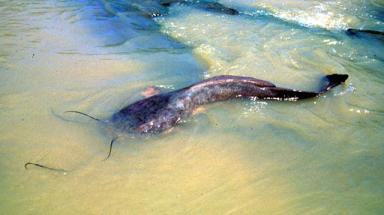
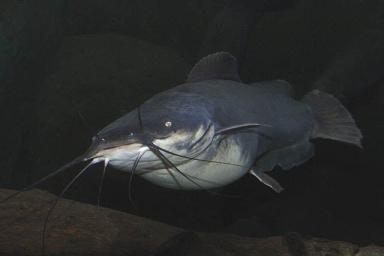 Adult
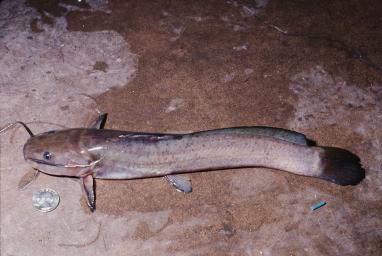

| ⇓ Zebra Pleco (Hypancistrus zebra) Data Sheet | |
|---|---|
| Scientific Name | Heterobranchus longifilis Valenciennes, 1840 |
| Common Names | Vundu Vundu-malle (Danish, Denmark) |
| Type Locality | Nile River, Egypt. |
| Synonym(s) | Clarias loangwensis, Heterobranchus laticeps, Heterobranchus longifinis, Heterobranchus platycephalus |
| Pronunciation | Het err o brach us - long ee fill iss |
| Etymology | Heterobranchus: From the Greek heteros, meaning different and branchos, meaning fin; in reference to the presence of the two dorsal fins (rayed and adipose). The specific epithet comes from the Latin longus, meaning long and filum, meaning thread; in reference to the long barbels of the fish. There are 3 other speciesAkysis longifilis Astroblepus longifilis Pareutropius longifilis with this name. |
| ⇓ Species Information | |
| Size | 1500mm or 59.1" SL. Find near, nearer or same sized spp. |
| Identification | Dorsal-fin rays 26-35; anal-fin rays 42-52; vertebrae 55-61. Head long, broad and somewhat rectangular in dorsal outline; snout broadly rounded; eyes with supero-lateral position. Frontal fontanelle long and narrow; occipital fontanelle oval-shaped. Toothplates wide. Suprabranchial organ well developed. Pectoral spine strongly serrated on anterior side. Adipose fin with blackish posterior part, nearly as long as dorsal fin; caudal fin barred. Openings of secondary canals hardly visible but display a regular pattern. |
| Sexing | The genital papilla, which is right below the anus, is elongated and pointy in males while it is round and relatively larger (and larger than the anus) in females. In ventral view especially, females are much broader in the body than males of equal age and rearing practices. Females stouter than males. |
| ⇓ Habitat Information | |
| Distribution | Africa: Nile, Niger, Senegal, Congo system, upper and middle Zambezi. Also from Lakes Tanganyika and Edward, Gambia and Benue River, Chad and Volta basins, and the coastal basins of Guinea to Nigeria. African Waters, Nigeria Waters, Niger, Bénoué (click on these areas to find other species found there) African Waters, Chad (click on these areas to find other species found there) African Waters, Congo (click on these areas to find other species found there) African Waters, Western Rift Valley Lakes, Edward (click on these areas to find other species found there) African Waters, Gambia (click on these areas to find other species found there) African Waters, Zambesi, Middle Zambesi (click on these areas to find other species found there) African Waters, Nigeria Waters, Niger (click on these areas to find other species found there) African Waters, Nile (click on these areas to find other species found there) African Waters, Western Rift Valley Lakes, Tanganyika (click on these areas to find other species found there) African Waters, Zambesi, Upper Zambesi (click on these areas to find other species found there) African Waters, Volta (click on these areas to find other species found there) Login to view the map. |
| IUCN Red List Category | Least Concern , a distribution map is available on the IUCN species page. Last assessed 2025. |
| pH | 5.4 - 7.6 |
| Temperature | 20.0-27.0°C or 68-80.6°F (Show species within this range) |
| Other Parameters | Hefty filtration is required to clean-up after this greedy fish. |
| ⇓ Husbandry Information | |
| Feeding | Simply anything digestible it can fit into its mouth. Will therefore take all normal aquarium foods. User data. |
| Furniture | Not really an aquarium fish. Although largely inactive and so doesn't require a great deal more room than simply to turn around do bear in mind though that this fish can easily reach the size of 1m in captivity. |
| Compatibility | Will attack surprisingly large fish often with fatal results, a greedy, voracious predator. One for a species tank. |
| Breeding | During spawning, the male first follows the female, swimming with the head against the side of the female, interspersed with periods of solitary swimming or inactivity). The pair then swim head against head with the male on top. This is followed by the male folding the body first around the head, and then the body of the female. During the latter stage, eggs and sperm are released. The female then pushes her head into the substrate and beats her tail vigorously, mixing the eggs and sperm. |
| Breeding Reports | There is no breeding report. |
| ⇓ Further Information | |
| Reference | Histoire naturelle des poissons v. 15, pp 394, Pl. 447. |
| Wishlists | There is no wish to keep this species. |
| Spotters | There is no record of this fish being seen. |
| ⇓ More Resources | |
| Forum BBCode | |
| Find CLOG | 11 mentions on the forum, starting 21st Mar 05 |
 | Look up H. longifilis on PlanetCatfish.com |
 | Look up H. longifilis on Fishbase |
 | Look up H. longifilis on Encyclopedia of Life |
 | Look up H. longifilis on Global Biodiversity Information Facility |
 | LFS label creator ARN ref:1.6.187.688 |
| Last Update | Thu Jan 02, 2025 9:38 am (Species record created: Tue Oct 02, 2001 7:00 am) |
