
PAGE_HEADER
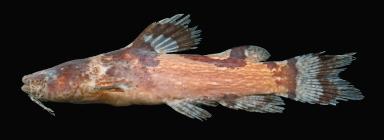 Holotype
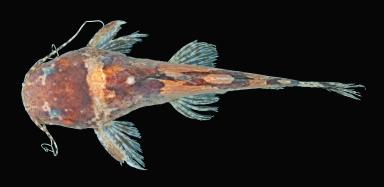 Holotype, dorsal view
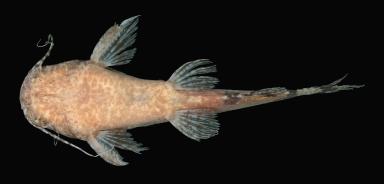 Holotype, ventral view
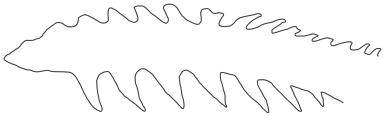 Pectoral fin spine, dorsal view. Bar = 1mm
| ⇓ Zebra Pleco (Hypancistrus zebra) Data Sheet | |
|---|---|
| Scientific Name | Microglanis leniceae Shibatta, 2016 |
| Common Name | |
| Type Locality | Rio Betione, Miranda, upper rio Paraguay basin, Mato Grosso do Sul, Brazil, 20°25'25''S, 56°23'57''W. |
| Synonym(s) | |
| Etymology | Micro - small, glanis - catfish - in reference to the rather small forms of catfish that this genus contains. The specific epithet is homage to Lenice Souza Shibatta, for her dedication to the study of biogeography and evolution of Neotropical fishes. A genitive noun. |
| ⇓ Species Information | |
| Identification | The genus Microglanis was described by Eigenmann
(1912) to include small pimelodids with the head as wide as long, the skull covered by skin only; the occipital crest small; frontal fontanel not extending much if any behind the eye, and a minute occipital fontanel sometimes present; eye without a free orbital margin; dorsal and pectoral spines well developed; and premaxillary patches of teeth without backward projecting angles. Microglanis leniceae differs from all congeners except M. lundbergi by the deeply forked caudal fin with pointed lobes, a character invariable even in small specimens (vs. emarginated, rounded, or bifurcated with rounded lobes). M. leniceae differs from M. lundbergi by lateral line canal surpassing vertical through end of dorsal fin (vs. not surpassing), 8 to 11 pores on lateral line (vs. 6 to 8), larger dorsal-fin spine length (15.1-17.8% vs. 11.4-15.9% SL), larger predorsal length (38.0-39.5% vs. 35.5-38.6% SL), larger interobital width (44.1-51.2% vs. 40.4-44.2% HL), and larger mouth width (61.5-72.0% vs. 38.0-47.3% HL). M. leniceae differs from M. cottoides-like specimens found in the upper rio Paraguay basin, and M. carlae from lower rio Paraguai basin, by the bifurcated hook on anterior margin of pectoral-fin spine (vs. antrorse and retrorse only). Colour pattern can be used to distinguish Microglanis leniceae from M. lundbergi. In general, the dorsal and lateral head surfaces are dark brown with light marks on the regions between the nostrils and the eye, on the adductor muscle of mandible, and on operculum. In M. leniceae the colour pattern of these regions is almost homogeneously dark brown, with only a narrow clear stripe between anterior nostril and eye. In M. lundbergi, this colour pattern is completely different, with a large clear spot between the anterior nostril and eye. These two species also differ by the light stripe on the nape, which is almost straight in M. leniceae, vs. two juxtaposed oval spots on M. lundbergi. |
| Sexing | Well-conditioned females are conspicuously wider in the abdomen than similarly sized males. |
| General Remarks | Colour in alcohol. Ground colour light brown; flanks covered by several darker stripes. Dorsal and lateral head dark brown, limited posterior at vertical through pectoral fin; light stripe between posterior nostril and eye; thin, undulated light stripe between anterior and posterior nostrils. Large, quadrangular dark brown saddle on trunk, starting soon after vertical through base of pectoral fin, finishing at vertical through posterior dorsal-fin base. Dark brown blotch V-shaped on trunk, starting soon after dorsal fin, finishing at middle adipose fin, rarely surpassing body axis ventrally. Caudal peduncle dark brown blotch Y-shaped. Dorsal-fin base dark brown blotch confluent anteriorly to dark brown arched stripe along superior third dorsal-fin; oval-shaped hyaline blotch between dark brown areas; hyaline superior margin. Rounded light spot on dorsal-fin anterior base. Pectoral fin hyaline; several dark brown spots on middle region. Pelvic fin hyaline; several spots scattered irregularly. Dark brown blotch on anterior half of adipose fin confluent downward with V-shaped blotch of trunk. Dark brown blotch on anterior region of anal-fin base; dark brown stripe on posterior third. Caudal fin hyaline; dark brown spots scattered irregularly; dark brown stripe on posterior third. Ventral region light brown, covered by dark brown spots. |
| ⇓ Habitat Information | |
| Distribution | Known from Pantanal wetlands of the upper rio Paraguay basin, in Mato Grosso and Mato Grosso do Sul states, Brazil. However, M. leniceae seems to prefer smaller streams over the widely flooded areas. La Plata, Paraná, Paraguay, Upper Paraguay, Miranda (click on these areas to find other species found there) Login to view the map. |
| IUCN Red List Category | Not Evaluated , a distribution map is available on the IUCN species page. Last assessed 2026. |
| ⇓ Husbandry Information | |
| Compatibility | Non aggressive and sociable with its own and other species. |
| Suggested Tankmates | Virtually all good community fish, although any young fry present in the aquarium will be in extreme jeopardy - especially after dark. |
| Breeding Reports | There is no breeding report. |
| ⇓ Further Information | |
| Literature & References | Original Description: <b> Shibatta, O. A.</b> 2016 (30 Sept.) <a href="http://dx.doi.org/10.1590/1982-0224-20160031" target=_blank>See ref. online</a> |
| Wishlists | There is no wish to keep this species. |
| Spotters | There is no record of this fish being seen. |
| ⇓ More Resources | |
| Forum BBCode | |
| Find CLOG | 2 mentions on the forum, starting 30th Sep 16 |
 | Look up M. leniceae on PlanetCatfish.com |
 | Look up M. leniceae on Fishbase |
 | Look up M. leniceae on Encyclopedia of Life |
 | Look up M. leniceae on Global Biodiversity Information Facility |
 | LFS label creator ARN ref:1.31.106.6717 |
| Last Update | Wed Jan 01, 2025 8:22 pm (Species record created: Fri Sep 30, 2016 3:47 am) |
