
PAGE_HEADER

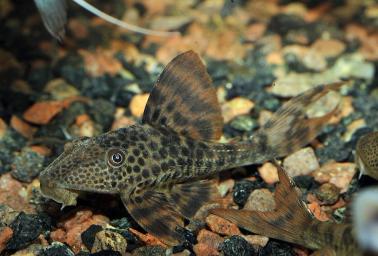 Juvenile
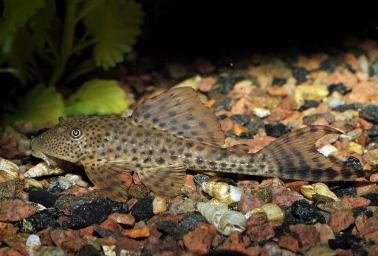


 Adult taken immediately after collection
 Adult taken immediately after collection
 Close-up of underside of head
 Habitat: Collecting adult fish from driftwood snag
 Habitat: Collecting adult fish from driftwood snag


| ⇓ Zebra Pleco (Hypancistrus zebra) Data Sheet | |
|---|---|
| Scientific Name | Hypostomus plecostomoides (Eigenmann, 1922) |
| Common Names | LDA038, Brown Pleco LDA042, Brun Sugemalle (Danish, Denmark) |
| Type Locality | Quebrada Gramalote, Villavicencio, Colombia |
| Synonym(s) | Cochliodon plecostomoides |
| Pronunciation | hi POSS tow muss |
| Etymology | Greek, hypo = under + Greek, stoma = mouth. This specific epithet literally means sucker(pleco=sucker) mouth(stomus=mouth) like(-oides=like). |
| ⇓ Species Information | |
| Size | 256mm or 10.1" SL. Find near, nearer or same sized spp. |
| Identification | Previously placed in Cochliodon and now included in the larger genus, Hypostomus as a member of the Hypostomus Cochliodon group. All these species have higher backs than other conspecifics and spoon shaped teeth (like Panaque). See link below. The three northern South American members of the Hypostomus cochliodon group, H. plecostomoides, H. taphorni, and H. hondae are very difficult to differentiate. The surest identification method is to know where the fish was imported from. H. plecostomoides is found throughout the Orinoco drainage, H. taphorni the Essequibo drainage, and H. hondae in northern Colombia and the Maracaibo drainage. |
| Sexing | Gravid females are wider when viewed from above. |
| General Remarks | Recorded in the Lake Valencia and Rio Tuy drainages in Venezuela. However, no specimens have been found in these drainages in some years and the heavy pollution present in these drainages may have extirpated this species from these drainages. |
| ⇓ Habitat Information | |
| Distribution | South America: Meta River basin. Orinoco, Middle Orinoco, Apure, Guarico (click on these areas to find other species found there) Orinoco (click on these areas to find other species found there) Login to view the map. |
| IUCN Red List Category | Least Concern , a distribution map is available on the IUCN species page. Last assessed 2020. |
| pH | 6.5 - 8.0 |
| Temperature | 21.0-27.0°C or 69.8-80.6°F (Show species within this range) |
| Other Parameters | In general, the water should be clear, soft to medium in hardness with a near neutral pH. A strong powerhead should provide a fair current. The oxygen level should also be kept high. |
| ⇓ Husbandry Information | |
| Feeding | Eats all normal aquarium foods. Fresh vegetables and driftwood are a must for this the proper care of this fish. User data. |
| Furniture | Typically found amongst driftwood snags in the main river channel. |
| Compatibility | A peaceful loricariid. The pictured specimen was captured in the Rio Tinaco, Cojedes State, Venezuela. It was captured on a large piece of driftwood along with Panaque maccus, P. nigrolineatus, L092, Hypoptopoma, Hypostomus emarginatus, and Lamontichthys llanero. |
| Breeding | Spawns in holes in the soil of the river bank in the wet season. In the dry season, Iguanas use these same holes for their nests. The holes measure about 4-6 inches wide and up to 18 inches deep. |
| Breeding Reports | There is no breeding report. |
| ⇓ Further Information | |
| Reference | Memoirs of the Carnegie Museum v. 9 (no. 1), pp225, Pl. 11 (figs. 1-3). |
| Wishlists | There is no wish to keep this species. |
| Spotters | There is no record of this fish being seen. |
| ⇓ More Resources | |
| Forum BBCode | |
| Find CLOG | 18 mentions on the forum, starting 11th Nov 05 |
 | Look up H. plecostomoides on PlanetCatfish.com |
 | Look up H. plecostomoides on Fishbase |
 | Look up H. plecostomoides on Encyclopedia of Life |
 | Look up H. plecostomoides on Global Biodiversity Information Facility |
 | LFS label creator ARN ref:1.4.17.643 |
| Last Update | Thu Jan 02, 2025 9:37 am (Species record created: Sat Apr 06, 2002 8:00 am) |
