
PAGE_HEADER
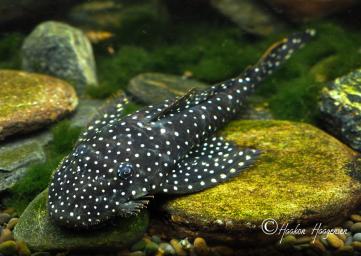
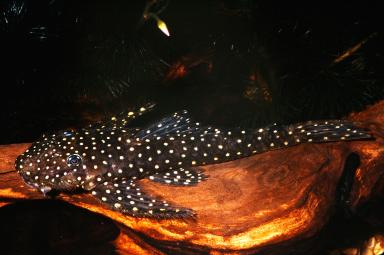
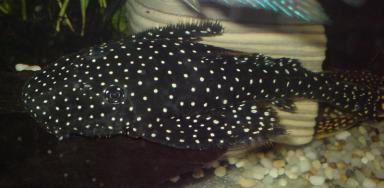
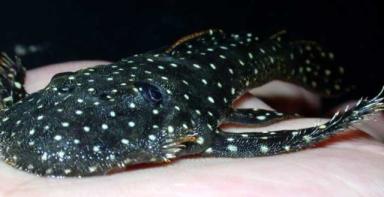
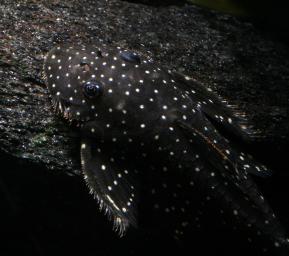
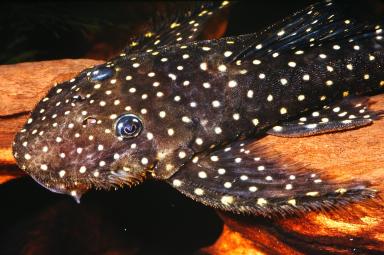 Close-up of head
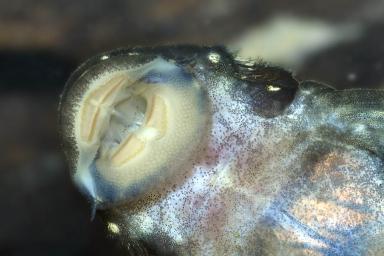 Close-up of mouth
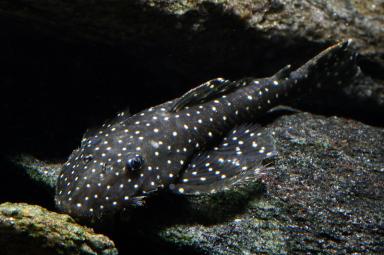
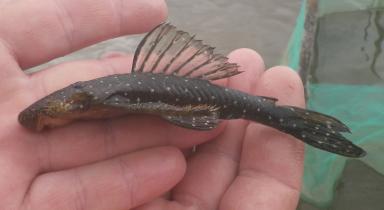
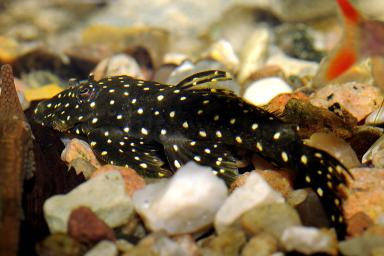 Juvenile
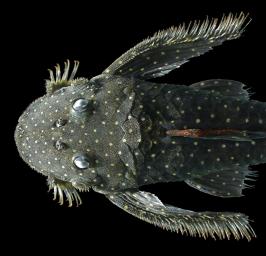
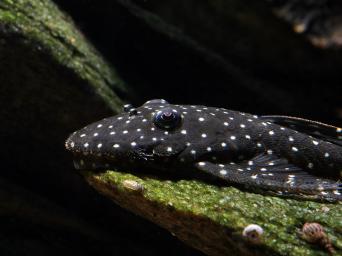
| ⇓ Zebra Pleco (Hypancistrus zebra) Data Sheet | |
|---|---|
| Scientific Name | Pseudolithoxus anthrax (Armbruster & Provenzano, 2000) |
| Common Names | L235, Flyer Cat Fliegerwels/flyer-cat (German, Germany), Hvidplettet Flyversugemalle (Danish, Denmark) |
| Type Locality | Río Orinoco backwater behind sand beach about 0.5 hr upstream from Isla Temblador, 3°04'N, 66°28'W, Estado Amazonas, Venezuela. |
| Synonym(s) | Lasiancistrus anthrax |
| Pronunciation | sue doh lith ox uss. - anth racks |
| Etymology | Greek, pseudes = false + Greek, lithos = stone + Greek, oxys = sharp. |
| ⇓ Species Information | |
| Size | 124mm or 4.9" SL. Find near, nearer or same sized spp. |
| Identification | According to Armbruster, P. anthrax should have two dorsal spines and seven to eight branched dorsal rays; one anal spine and four branched anal rays; 24-26 lateral line plates; seven to eight dorsal plates; seven to eight adipose-caudal plates and 12-14 post-anal plates. The fish is usually dark grey or black with white spots. |
| Sexing | When comparing adults, males have much longer cheek bristles. |
| ⇓ Habitat Information | |
| Distribution | South America: Upper and lower Orinoco tributaries, Caura and Aro rivers in Venezuela. Orinoco, Lower Orinoco, Aro (click on these areas to find other species found there) Orinoco, Lower Orinoco, Caura (click on these areas to find other species found there) Orinoco (click on these areas to find other species found there) Orinoco, Upper Orinoco (click on these areas to find other species found there) Login to view the map. |
| IUCN Red List Category | Near Threatened , a distribution map is available on the IUCN species page. Last assessed 2019. |
| pH | 6.2 - 7.0 |
| Temperature | 24.0-27.0°C or 75.2-80.6°F (Show species within this range) |
| Other Parameters | Tricky to acclimatise unless close attention is given to providing good water quality with plenty of oxygenation. |
| ⇓ Husbandry Information | |
| Feeding | Does well on commercial "algae" wafers but requires a meaty element to its diet (probably met by insect larvae in the wild). Newly imported specimens need such meaty food immediately to acclimatise properly. User data. |
| Furniture | Plants are not necessary but are left unmolested if present. Prefers flat rock caves to all other forms of refuge. |
| Compatibility | Some what territorial. Defends chosen cave structure from all other plecos; ignores larger fish. Should have adequate space. Can be kept in a community tank if this is taken into account. |
| Suggested Tankmates | Best kept with other fish that like a good water current. |
| Breeding | Unreported in the aquarium. |
| Breeding Reports | There is no breeding report. |
| ⇓ Further Information | |
| Literature & References | Original Description: <b> Armbruster, J. W. and F. Provenzano</b> 2000 (Nov.) <a href="https://www.researchgate.net/publication/285106405_Four_new_species_of_the_suckermouth_armored_catfish_genus_Lasiancistrus_Loricariidae_Ancistrinae" target=_blank>See ref. online</a> |
| Wishlists | There is no wish to keep this species. |
| Spotters | There is no record of this fish being seen. |
| ⇓ More Resources | |
| Forum BBCode | |
| Find CLOG | 31 mentions on the forum, starting 5th Jun 04 |
 | Look up P. anthrax on PlanetCatfish.com |
 | Look up P. anthrax on Fishbase |
 | Look up P. anthrax on Encyclopedia of Life |
 | Look up P. anthrax on Global Biodiversity Information Facility |
 | LFS label creator ARN ref:1.4.218.635 |
| Last Update | Wed Jan 01, 2025 8:12 pm (Species record created: Thu Jun 14, 2001 7:00 am) |
