
PAGE_HEADER


 Dorsal view of pair

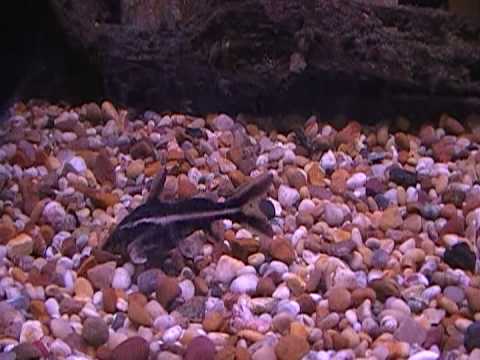 Video
 Ventral view
 Close-up of dorsal area
 Close-up of head

 Lateral view
 Rio Apure, 69.9mm SL (ANSP198871)
| ⇓ Zebra Pleco (Hypancistrus zebra) Data Sheet | |
|---|---|
| Scientific Name | Orinocodoras eigenmanni Myers, 1927 |
| Common Names | Eigenmann's Talking Catfish Orinoco Talking Catfish |
| Type Locality | Caño de Quiribana near Caicara, Venezuela. |
| Synonym(s) | |
| Pronunciation | or in oko DOOR ass - EYE gn MAN eye. |
| Etymology | Orinocodoras: From the Orinoco River and doras, meaning skin (also a
word commonly used in forming generic names for doradids); in reference
to the distribution. Species named in honour of Dr. Carl H. Eigenmann, Professor of Ichthyology in Indiana (1863-1927). There are 9 other speciesAstroblepus eigenmanni Copella eigenmanni Jenynsia eigenmanni Ossancora eigenmanni Phalloptychus eigenmanni Pimelodella eigenmanni Propimelodus eigenmanni Rineloricaria eigenmanni Serrasalmus eigenmanni with this name. |
| ⇓ Species Information | |
| Size | 200mm or 7.9" SL. Find near, nearer or same sized spp. |
| Identification | Can be distinguished from Platydoras armatulus, the striped or humbug talking catfish, as follows: snout is more pointed, whereas P. armatulus has a rounded snout. Eyes of O. eigenmanni are smaller. O. eigenmanni has a longer adipose fin. The skin of O. eigenmanni looks less plated and in almost like sandpaper in areas. Generally, the 'Orinoco' is by far the most elegant fish of the two. Soemtimes imported under incorrect names. Anyone who is interested in O. eigenmanni must look carefully through shipments of P. armatulus, for that is where they may be. And if so, you will easily spot them. |
| Sexing | Males are smaller and slighter. In larger fish a top view may give something away: males are more slender, adult females are more than 25% larger than similarly mature males. Differences in belly colouration have little to do with gender. |
| General Remarks | A monotypic genus. |
| ⇓ Habitat Information | |
| Distribution | South America: Orinoco River basin. Orinoco (click on these areas to find other species found there) Login to view the map. |
| IUCN Red List Category | Not Evaluated , a distribution map is available on the IUCN species page. Last assessed 2026. |
| pH | 6.0 - 7.8 |
| Temperature | 22.0-27.0°C or 71.6-80.6°F (Show species within this range) |
| Other Parameters | A hardy fish that will adapt to most conditions. Moderate current is preferred. |
| ⇓ Husbandry Information | |
| Feeding | Will eat anything; particularly fond of bloodworms and pellets or tablets. Is very visible when fed, even during the day. User data. |
| Furniture | Driftwood for hiding places. However, as the fish grows quite large, see to it that it remains able to swim. If necessary redecorate. Will not ruin plants. Ensure heater is not used as a hiding place. |
| Compatibility | A community fish for medium to larger aquariums; not suited for life with very aggressive fish or very, very small fish, the later may accidentally be regarded as food. |
| Suggested Tankmates | Goes very well with other peaceful catfish and characins. Can be kept alone, as a pair but best in a small group. |
| Breeding | |
| Breeding Reports | There is no breeding report. |
| ⇓ Further Information | |
| Reference | Bulletin of the Museum of Comparative Zoology v. 68 (no. 3), pp 124. |
| Wishlists | There is no wish to keep this species. |
| Spotters | There is no record of this fish being seen. |
| ⇓ More Resources | |
| Forum BBCode | |
| Find CLOG | 30 mentions on the forum, starting 16th Mar 05 |
 | Look up O. eigenmanni on PlanetCatfish.com |
 | Look up O. eigenmanni on Fishbase |
 | Look up O. eigenmanni on Encyclopedia of Life |
 | Look up O. eigenmanni on Global Biodiversity Information Facility |
 | LFS label creator ARN ref:1.12.172.612 |
| Last Update | Thu Jan 02, 2025 9:38 am (Species record created: Tue May 15, 2001 7:00 am) |
