
PAGE_HEADER

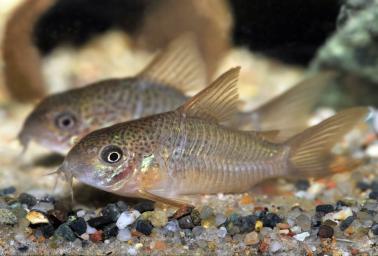
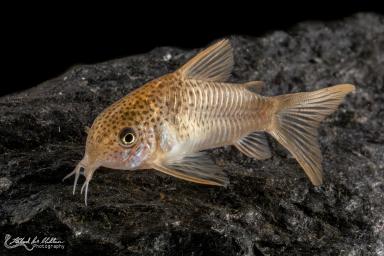
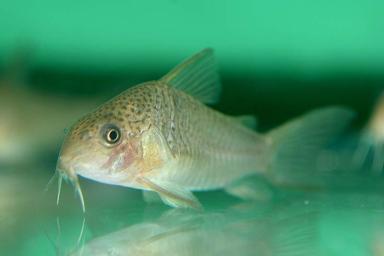


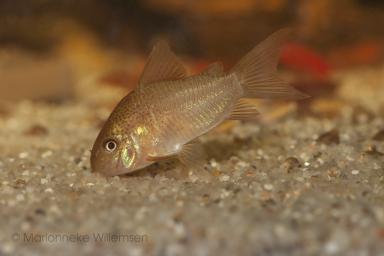


 Dorsal view

 Close-up of caudal fin
| ⇓ Zebra Pleco (Hypancistrus zebra) Data Sheet | |
|---|---|
| Scientific Name | Hoplisoma polystictum (Regan, 1912) |
| Common Names | Fine Spotted Cory Savannepansermalle (Danish, Denmark) |
| Type Locality | Upper Rio Paraguay, Descalvados, 16°45'S, 57°40'W, Mato Grosso, Brazil. |
| Synonym(s) | Corydoras polystictus, Corydoras virescens |
| Pronunciation | hop lee so mah - pol ee STICK tuss |
| Etymology | The genus name is latin for wavy, referring to “dark purplish spots tending to run together, forming undulating longitudinal bands” - a common if not uniform colouration pattern found in this genus. From the Greek poly meaning many amd stiktos meaning spotted, alluding to the small spots on this species. |
| ⇓ Species Information | |
| Size | 32mm or 1.3" SL. Find near, nearer or same sized spp. |
| Identification | This Corydoras has small spots all over its body, and a few on its dorsal fin. They also have pinkish bellies. |
| Sexing | Females grow larger and are more full-bodied, this is best observed from above the fish. Males will typically have more pointed as opposed to more rounded fin tips as they mature. Females are larger and broader when viewed from above. |
| ⇓ Habitat Information | |
| Distribution | South America: Paraguay River basin. La Plata, Paraná, Paraguay (click on these areas to find other species found there) La Plata, Paraná, Urugua-í (click on these areas to find other species found there) La Plata, Paraná, Paraguay, Upper Paraguay, Sepotuba Imported (click on these areas to find other species found there) Login to view the map. |
| IUCN Red List Category | Not Evaluated , a distribution map is available on the IUCN species page. Last assessed 2026. |
| pH | 6.0 - 7.6 |
| Temperature | 20.0-25.0°C or 68-77°F (Show species within this range) |
| ⇓ Husbandry Information | |
| Feeding | This species will eat just about any food that sinks down to their level. Flake foods and sinking pellets/wafers make up a good staple diet, for these fish. Frozen and live foods are great as treats. User data. |
| Furniture | Hiding places in the form of caves, driftwood, and plants are appreciated. As these catfish sometimes cavort out in the open, open swimming space is necessary. |
| Compatibility | Very peaceful fish, and will never bother a tankmate. They are completely harmless. |
| Suggested Tankmates | Avoid large or aggressive fish which are not good tankmates for any Corydoras. Small plecos, tetras and dwarf cichlids are good tankmates. |
| Breeding | This cory spawns the way most corys do. The pair will adopt the ''T'' position, and the female will gather eggs and sperm. Then, she swims to a flat, clean surface (usually the glass), and deposits the eggs. This is repeated numerous times. Spawned by Eric Bodrock in January 1997 who remembered that the eggs were rather small and numbered somewhere around 150. He spawned them several times. |
| Breeding Reports | There is no breeding report. |
| ⇓ Further Information | |
| Reference | Annals and Magazine of Natural History (Series 8) v. 10 (no. 56), pp 216. |
| Wishlists | There is no wish to keep this species. |
| Spotters | There is no record of this fish being seen. |
| ⇓ More Resources | |
| Forum BBCode | |
| Find CLOG | 3 mentions on the forum, starting 5th Jan 12 |
 | Look up H. polystictum on PlanetCatfish.com |
 | Look up H. polystictum on Fishbase |
 | Look up H. polystictum on Encyclopedia of Life |
 | Look up H. polystictum on Global Biodiversity Information Facility |
 | LFS label creator ARN ref:1.1.1580.490 |
| Last Update | Tue Sep 15, 2026 3:53 pm (Species record created: Sun Mar 30, 2003 8:00 am) |
