
PAGE_HEADER
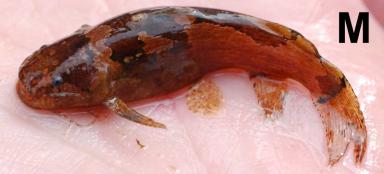
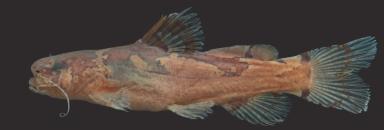 34.0mm SL. Rio de Janeiro state, Rio Macabu basin
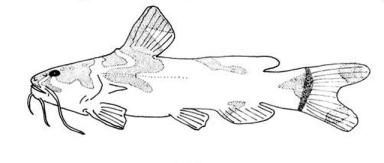 Schematic drawing of general colouration pattern
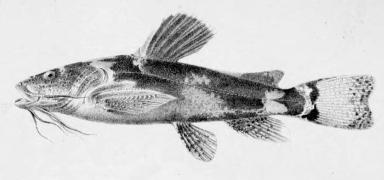 Drawing from original description
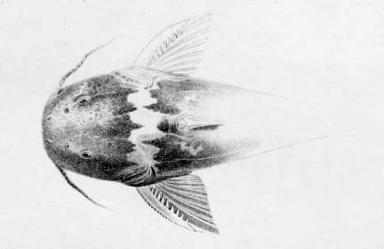 Drawing from original description; dorsal view
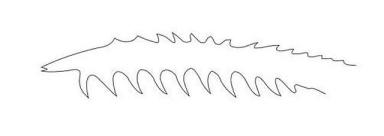 Pectoral fin spine, dorsal view. Bar = 1mm
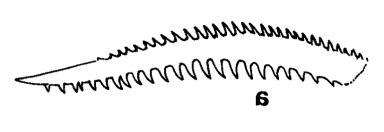 Pectoral fin spine, dorsal view
 South Espirito Santo river basins
| ⇓ Zebra Pleco (Hypancistrus zebra) Data Sheet | |
|---|---|
| Scientific Name | Microglanis parahybae (Steindachner, 1880) |
| Common Names | South American Bumblebee Catfish Großer Marmor-antennenwels, Großer Harlekinwels (German, Germany) |
| Type Locality | Rio Parahyba and Santa Cruz, Brazil. |
| Synonym(s) | Pseudopimelodus parahybae |
| Etymology | Micro - small, glanis - catfish - in reference to the rather small forms of catfish that this genus contains. There are 5 other speciesDelturus parahybae Ituglanis parahybae Pogonopoma parahybae Pseudotocinclus parahybae Steindachneridion parahybae with this name. |
| ⇓ Species Information | |
| Size | 80mm or 3.1" SL. Find near, nearer or same sized spp. |
| Identification | The genus Microglanis was described by Eigenmann
(1912) to include small pimelodids with the head as wide as long, the skull covered by skin only; the occipital crest small; frontal fontanel not extending much if any behind the eye, and a minute occipital fontanel sometimes present; eye without a free orbital margin; dorsal and pectoral spines well developed; and premaxillary patches of teeth without backward projecting angles. |
| Sexing | Well-conditioned females are conspicuously wider in the abdomen than similarly sized males. |
| ⇓ Habitat Information | |
| Distribution | South America: Paraíba do Sul river basin in Brazil. Reported from Argentina. Espirito Santo State Rivers, Doce (click on these areas to find other species found there) Espirito Santo State Rivers, Itabapoana (click on these areas to find other species found there) Espirito Santo State Rivers, Itapemirim (click on these areas to find other species found there) Rio de Janeiro State Rivers, Macabu (click on these areas to find other species found there) Rio de Janeiro State Rivers, Macacu (click on these areas to find other species found there) Rio de Janeiro State Rivers, Paraíba do Sul (click on these areas to find other species found there) Login to view the map. |
| IUCN Red List Category | Least Concern , a distribution map is available on the IUCN species page. Last assessed 2018. |
| pH | 6.2 - 7.8 |
| Temperature | 21.0-26.0°C or 69.8-78.8°F (Show species within this range) |
| ⇓ Husbandry Information | |
| Compatibility | Non aggressive and sociable with its own and other species. |
| Suggested Tankmates | Virtually all good community fish, although any young fry present in the aquarium will be in extreme jeopardy - especially after dark. |
| Breeding Reports | There is no breeding report. |
| ⇓ Further Information | |
| Reference | Denkschriften der Kaiserlichen Akademie der Wissenschaften in Wien, Mathematisch-Naturwissenschaftliche Classe. v. 42, pp 60 [8], Pl. 1 (figs. 2-2b). |
| Wishlists | There is no wish to keep this species. |
| Spotters | There is no record of this fish being seen. |
| ⇓ More Resources | |
| Forum BBCode | |
| Find CLOG | 5 mentions on the forum, starting 5th Jan 12 |
 | Look up M. parahybae on PlanetCatfish.com |
 | Look up M. parahybae on Fishbase |
 | Look up M. parahybae on Encyclopedia of Life |
 | Look up M. parahybae on Global Biodiversity Information Facility |
 | LFS label creator ARN ref:1.31.106.3816 |
| Last Update | Wed Jan 01, 2025 8:22 pm (Species record created: Mon Sep 19, 2011 8:54 pm) |
