
PAGE_HEADER

 Adult showing golden colouration


 Video

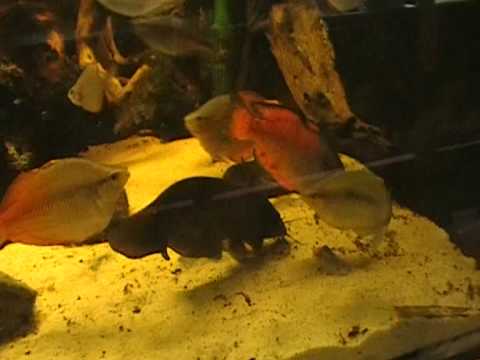 Video

 Frontal view
 Close-up of head


| ⇓ Zebra Pleco (Hypancistrus zebra) Data Sheet | |
|---|---|
| Scientific Name | Neosilurus ater (Perugia, 1894) |
| Common Names | Black Finned Eel Catfish Australian Eel-tailed Catfish, Black Catfish, Butter Jew, Narrow-fronted Tandan |
| Type Locality | Inawi, eastern New Guinea. |
| Synonym(s) | Lambertia atra, Lambertichthys ater, Lambertichthys ater sepikensis, Neosilurus ater sepikensis, Neosilurus mediobarbis, Tandanus ater |
| Pronunciation | Nee oh see loo russ - A terr |
| Etymology | The generic name comes from the Latin neo, meaning new and Silurus, a catfish name frequently used to form generic names. The specific epithet means black in Latin, and refers to the blackish colour of this species There are 2 other speciesGlyptothorax ater Microglanis ater with this name. |
| ⇓ Species Information | |
| Size | 470mm or 18.5" SL. Find near, nearer or same sized spp. |
| Identification | Distinguished from congeners by its relatively elongate snout. Grey to blackish overall (sometimes mottled), paler on the belly. In some populations, both sexes develop a bright golden-orange hue on the sides during breeding. |
| ⇓ Habitat Information | |
| Distribution | Oceania: northern Australia and central-southern New Guinea. Pacific, South Pacific, New Guinea Pacific area, New Guinea Waters, Central New Guinea Waters (click on these areas to find other species found there) Australia waters, Northern Australia Waters (click on these areas to find other species found there) Pacific, South Pacific, New Guinea Pacific area, New Guinea Waters, Southern New Guinea Waters (click on these areas to find other species found there) Login to view the map. |
| IUCN Red List Category | Least Concern , a distribution map is available on the IUCN species page. Last assessed 2019. |
| pH | 6.4 - 7.6 |
| Temperature | 20.0-27.0°C or 68-80.6°F (Show species within this range) |
| ⇓ Husbandry Information | |
| Feeding | Feeds on molluscs, insects and prawns in the wild. Carnivorous but not a fussy eater in the aquarium. Will not eat small fishes. User data. |
| Furniture | Found in rivers and smaller streams, usually where currents are relatively swift. Thus, plenty of swimming space is required. Hiding spaces in the form of PVC pipes and / or driftwood are necessary. |
| Compatibility | A peaceful, solitary species. Can be safely kept with smaller fishes. |
| Breeding | In northern Australia, breeding takes place during December in shallow areas with a good water flow and a sand / gravel substrate. Eggs of about 2 mm in diameter are produced. |
| Breeding Reports | There is no breeding report. |
| ⇓ Further Information | |
| Literature & References | Original Description: <b> Perugia, A.</b> 1894 (30 Sept.) <a href="https://www.biodiversitylibrary.org/page/7940586" target=_blank>See ref. at BHL</a> |
| Wishlists | There is no wish to keep this species. |
| Spotters | There is no record of this fish being seen. |
| ⇓ More Resources | |
| Forum BBCode | |
| Find CLOG | 21 mentions on the forum, starting 22nd Sep 04 |
 | Look up N. ater on PlanetCatfish.com |
 | Look up N. ater on Fishbase |
 | Look up N. ater on Encyclopedia of Life |
 | Look up N. ater on Global Biodiversity Information Facility |
 | LFS label creator ARN ref:1.11.22.35 |
| Last Update | Wed Jan 01, 2025 8:22 pm (Species record created: Tue Apr 24, 2001 7:00 am) |
