
PAGE_HEADER
 Male
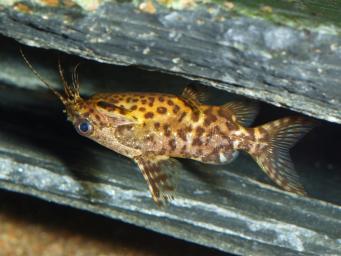


 Adult


 Schoal
 Shoal
 Stamp
 Stamp
 Zebra Kutu variant
"zebra kutu" variant Zebra Kutu variant
"zebra kutu" variant Zebra Kutu variant
"zebra kutu" variant Video
 Zebra Kutu variant-juveniles
"zebra kutu" variant Zebra Kutu variant-dorsal view
"zebra kutu" variant Zebra Kutu variant-ventral view
"zebra kutu" variant Zebra Kutu variant-stress colouration
"zebra kutu" variant Wild caught
 Habitat: Kouyou river basin, central Congo. Dots are S. nigriventris.
| ⇓ Zebra Pleco (Hypancistrus zebra) Data Sheet | |
|---|---|
| Scientific Name | Synodontis nigriventris David, 1936 |
| Common Names | Upside Down Catfish Rückenschwimmender Kongowels (German, Germany), Sortbuget Rygsvømmermalle (Danish, Denmark), Vändmal (Swedish, Sweden) |
| Type Locality | Buta, Democratic Republic of Congo. |
| Synonym(s) | Synodontis nigroventris |
| Pronunciation | sin oh don tiss - nig ree VENT riss |
| Etymology | According to Cuvier, Synodontis is an "ancient name for an undetermined fish from the Nile". It is not derived, as often reported, from syn-, together and odous, tooth, presumed etymology of the lizardfish genus Synodus and refers to the closely-spaced lower jaw teeth of both genera. nigri mean dark, ventris meaning belly. Alluding to the reversed counter-shading. There is 1 other speciesNeolamprologus nigriventris with this name. |
| Variants | Zebra Kutu |
| ⇓ Species Information | |
| Size | 96mm or 3.8" SL. Find near, nearer or same sized spp. |
| Identification | All species in the genus Synodontis have a hardened head cap that has attached a process (humeral process) which is situated behind the gill opening and pointed towards the posterior. The dorsal fin and pectoral fins have a hardened first ray which is serrated. Caudal fin is always forked. There is one pair of maxillary barbels, sometimes having membranes and occasionally branched. The two pairs of mandibular barbels are often branched and can have nodes attached. The cone-shaped teeth in the upper jaw are short. S-shaped and movable in the lower jaw. These fish produce audible sounds when disturbed rubbing the base of the pectoral spine against the pectoral girdle. A common import; although occasionally confused with the similar S. contracta which has a larger head and much larger eyes. |
| Sexing | First lay the fish in your hand with its head toward your palm and the tail toward your fingers. Hold the dorsal spine between your middle and ring finger so the fish is belly up and you won't get punctured by the sharp fin spines (which hurts - be careful). The genital pore is in a small furrow of tissue (in healthy fish) and will be obstructed by the pelvic fins. Pull down on the tail gently to arch the fish's spine and the pelvic fins will stand and the furrow open to display the genital pore and the anus of the fish. The male has a somewhat ridged genital papillae on which the spermatoduct is on the back side, facing the tail fin. A gravid female will also show an extended papillae but the oviduct is on the ventral side of the papillae. It may also show a little redness if gravid. A thin or emaciated female will have just two pink pores, the oviduct and the anus. Female is larger, plumper and with old age more pale. |
| ⇓ Habitat Information | |
| Distribution | Africa: Central Congo basin. African Waters, Congo, Middle Congo (click on these areas to find other species found there) Login to view the map. |
| IUCN Red List Category | Not Evaluated , a distribution map is available on the IUCN species page. Last assessed 2026. |
| pH | 6.0 - 7.5 |
| Temperature | 22.0-28.0°C or 71.6-82.4°F (Show species within this range) |
| ⇓ Husbandry Information | |
| Feeding | Will eat the vast majority of prepared and live foods. User data. |
| Furniture | Over hanging structures or tunnels - either rock, wood or large broad leafed plants. These are all to provide shady places of rest while upside down. Choice of substrate is unimportant. |
| Compatibility | An ideal catfish for the smaller aquarium. Peaceful with both its conspecifics and other residents. To get the best out of this fish it should be kept in small shoals as you would keep Corydoras. |
| Suggested Tankmates | Any small to medium sized community fish. |
| Breeding | In the North American Catfish Society Vol. 1 No. 1 Jan. 1996 there appeared an article entitled ''Luck In A Bucket'' by Jay and Mary Ann Angros. The authors keep some of their fishes outdoors in the summer. The catfish were placed in a five gallon bucket full of clay pots and PVC pipe from their regular tank. One author, Jay, took the bucket outside and promptly forgot about it for two days! When the bucket of fish was remembered and checked, the authors found fifty eggs in one piece of PVC. The fish were then brought back inside and placed in a tank that was completely full of crockery and PVC pipes. Sometime later this tank was broken down for cleaning and seven S. nigriventris fry were found. The spawning tank had pH 6.8 and the temperature fluctuated between 78F and 82F. The tank had about an inch of gravel over an under gravel filter. Tankmates included skunk Botia and other Synodontis spp. The fish were fed mainly frozen brine shrimp, bloodworm, and ProGreen (a mixture of green, clams, and shrimp). Based on the account above, it would seem that any attempt at spawning the USD Catfish requires, at a minimum, the following: A well-rounded high quality diet Drastic temperature drops to initiate spawning Soft acidic water Suitable spawning sites |
| Breeding Reports | There is no breeding report. |
| ⇓ Further Information | |
| Reference | Revue de Zoologie et de Botanique Africaines v. 28 (no. 3), pp 417. |
| Wishlists | There is no wish to keep this species. |
| Spotters | There is no record of this fish being seen. |
| ⇓ More Resources | |
| Forum BBCode | |
| Find CLOG | 100 mentions on the forum, starting 10th Feb 04 |
 | Look up S. nigriventris on PlanetCatfish.com |
 | Look up S. nigriventris on Fishbase |
 | Look up S. nigriventris on Encyclopedia of Life |
 | Look up S. nigriventris on Global Biodiversity Information Facility |
 | LFS label creator ARN ref:1.13.29.334 |
| Last Update | Thu Jan 02, 2025 9:37 am (Species record created: Sat Apr 21, 2001 7:00 am) |
