
PAGE_HEADER
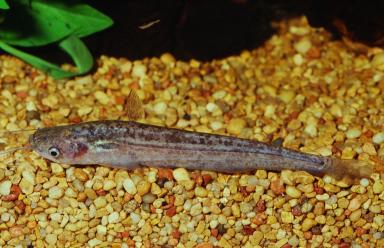
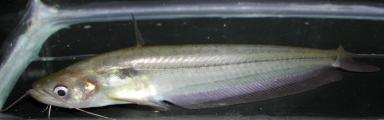
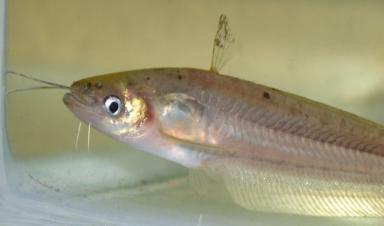
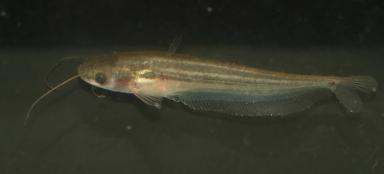
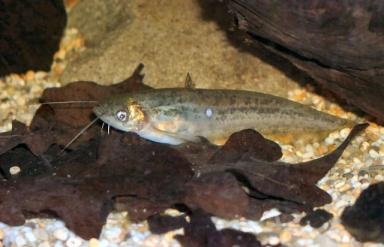
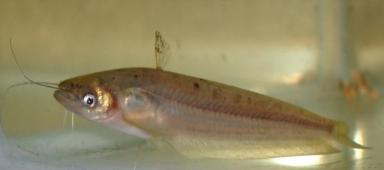
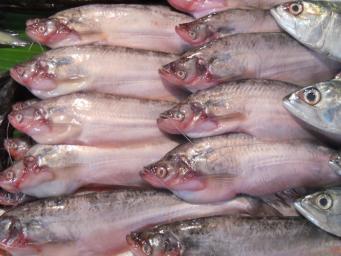 Fish Market In Calcutta, India
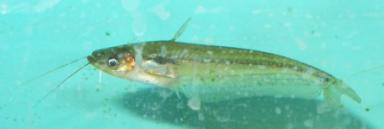
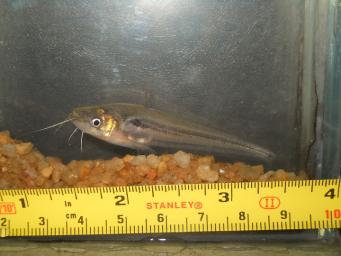 Juvenile Specimen.
| ⇓ Zebra Pleco (Hypancistrus zebra) Data Sheet | |
|---|---|
| Scientific Name | Ompok pabda (Hamilton, 1822) |
| Common Name | Two Stripe Gulper Catfish |
| Type Locality | Ponds and rivers of Bengal. |
| Synonym(s) | Callichrous anastomus, Callichrous egertonii, Callichrous pabda, Callichrous vittatus, Cryptopterus latovittatus, Ompok pabde, Ompok pabla, Silurichthys lamghur, Silurus anastomus, Silurus anostomus, Silurus lamghur, Silurus pabda, Wallago anastomus, Wallago pabda |
| Pronunciation | Awm pok - pahb DAH |
| Etymology | The etymology of Ompok is unclear. It is believed to be a corruption of the Indonesian name for mid-sized silurid catfishes, limpok. The specific epithet comes from pabda, the Bengali name of the fish. |
| ⇓ Species Information | |
| Size | 300mm or 11.8" SL. Find near, nearer or same sized spp. |
| Identification | The catfish genus Ompok La Cepède, 1803, consists of medium-sized silurid fishes found in inland waters throughout South and Southeast Asia. The genus is traditionally diagnosed by the presence of a short dorsal fin with 4 rays, strongly forked caudal fin, subcutaneous eye that is set immediately posterior to the mouth rictus and two patches of palatal teeth (Weber & de Beaufort, 1913). Bornbusch (1995) showed that Ompok, as currently understood, is probably paraphyletic. Distinguished by relatively short maxillary barbels (not extending beyond tip of pectoral fin) and 48-54 branched anal-fin rays. |
| Sexing | Males are more slender and have strong serrations on the posterior edge of the pectoral spine (females lack these serrations). |
| General Remarks | The species is said to occur throughout southern Asia as far west as Afghanistan and as far east as Mynamar, but the identities need to be verified. |
| ⇓ Habitat Information | |
| Distribution | Asia: Afghanistan, Pakistan, India, Bangladesh and Myanmar. Reported from Bhutan. Indian waters, North Eastern India Waters, Padma, Ganges (click on these areas to find other species found there) Login to view the map. |
| IUCN Red List Category | Not Evaluated , a distribution map is available on the IUCN species page. Last assessed 2026. |
| pH | 6.0 - 7.4 |
| Temperature | 22.0-27.0°C or 71.6-80.6°F (Show species within this range) |
| ⇓ Husbandry Information | |
| Feeding | Readily feeds on live/frozen foods and other prepared foods such as pellets. Will also eat small fishes/shrimps. User data. |
| Furniture | Provide plenty of hiding spaces in the form of driftwood or PVC pipes. Prefers an area of open water when active. |
| Compatibility | A relatively peaceful species that is compatible with most fish of equal size or larger. Not safe with small fishes. |
| Breeding | Not recorded. |
| Breeding Reports | There is no breeding report. |
| ⇓ Further Information | |
| Reference | An account of the fishes found in the river Ganges, pp 150, 374, Pl. 25 (fig. 47). |
| Wishlists | There is no wish to keep this species. |
| Spotters | There is no record of this fish being seen. |
| ⇓ More Resources | |
| Forum BBCode | |
| Find CLOG | 15 mentions on the forum, starting 17th Jun 05 |
 | Look up O. pabda on PlanetCatfish.com |
 | Look up O. pabda on Fishbase |
 | Look up O. pabda on Encyclopedia of Life |
 | Look up O. pabda on Global Biodiversity Information Facility |
 | LFS label creator ARN ref:1.7.113.333 |
| Last Update | Thu Jan 02, 2025 9:38 am (Species record created: Sat Apr 21, 2001 7:00 am) |
