
PAGE_HEADER
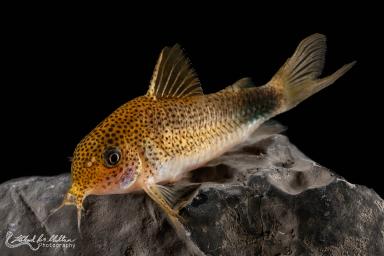
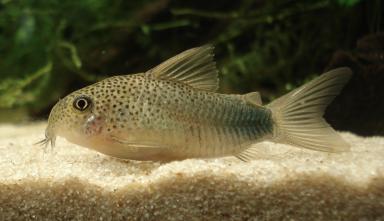
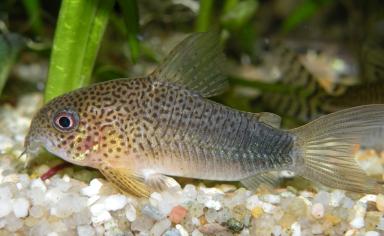
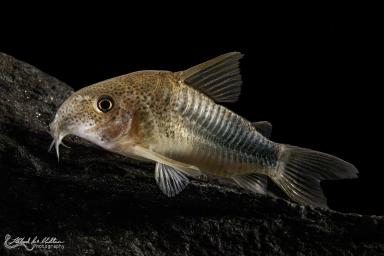
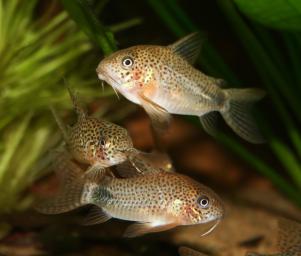 Male (below) with female laying eggs (in fins)
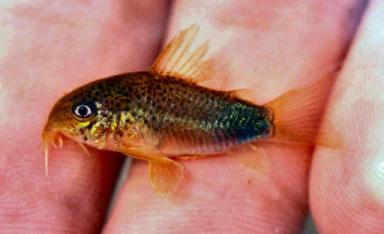 Taken at collection site - Rio Ma angana, French Guiana
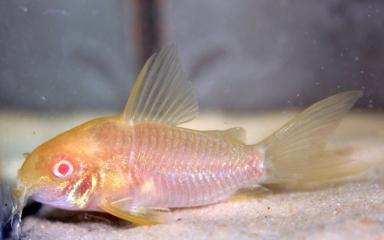 Albino
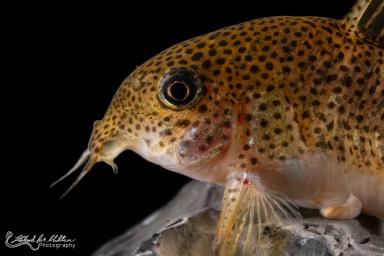 Close-up of head
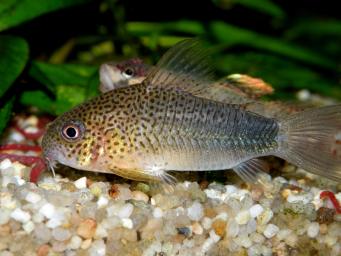
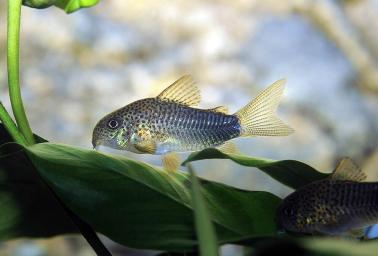
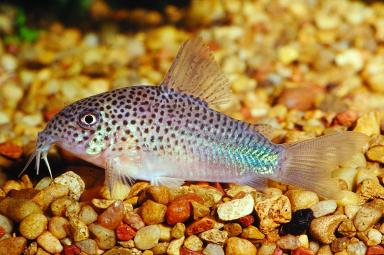
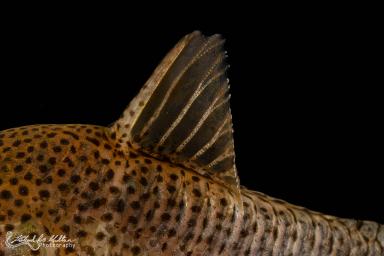 Close-up of caudal fin
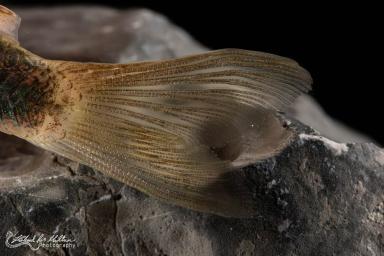 Close-up of caudal fin
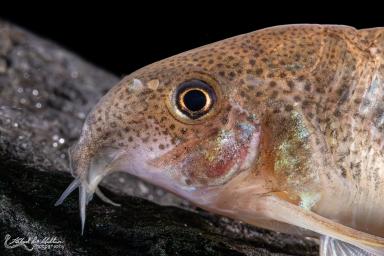 Close-up of head
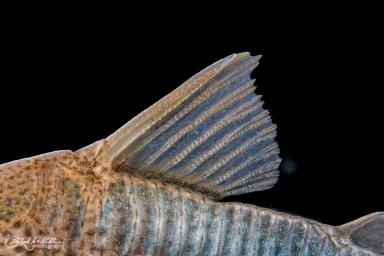 Close-up of dorsal fin
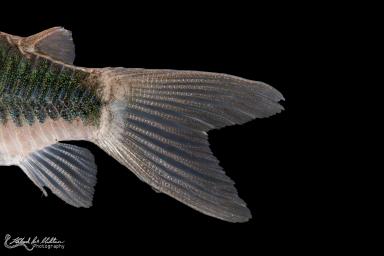 Close-up of caudal fin
| ⇓ Zebra Pleco (Hypancistrus zebra) Data Sheet | |
|---|---|
| Scientific Name | Hoplisoma simile (Hieronimus, 1991) |
| Common Names | Smudge Spot Cory Halvplettet Pansermalle (Danish, Denmark), Violet Cory, Violetta Cory |
| Type Locality | Tributary of Rio Madeira, vicinity of city of Ariqumes, Rondonia State, Brazil. |
| Synonym(s) | Corydoras similis |
| Pronunciation | hop lee so mah - sim ill iss |
| Etymology | The genus name is latin for wavy, referring to “dark purplish spots tending to run together, forming undulating longitudinal bands” - a common if not uniform colouration pattern found in this genus. Latin similis = like alluding to the similarity of the colouration of this species to Corydoras ourastigma. |
| ⇓ Species Information | |
| Size | 38mm or 1.5" SL. Find near, nearer or same sized spp. |
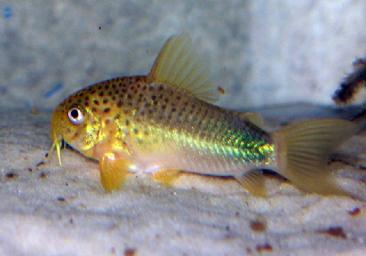
| Identification | C. similis is the round nosed ''version'' of the long snouted C. ourastigma. The smudged marking at the base of the caudal fin separates it from other head-spotted species that have a distinct spot marking instead. |
| Sexing | Females grow larger and are more full-bodied, this is best observed from above the fish. Males will typically have more pointed as opposed to more rounded fin tips as they mature. Female is fuller (when viewed from above) and larger. |
| ⇓ Habitat Information | |
| Distribution | South America: Madeira River basin. Amazon, Middle Amazon (Solimoes), Madeira, Jamari (click on these areas to find other species found there) Amazon, Middle Amazon (Solimoes), Madeira (click on these areas to find other species found there) Login to view the map. |
| IUCN Red List Category | Not Evaluated , a distribution map is available on the IUCN species page. Last assessed 2026. |
| pH | 5.6 - 7.0 |
| Temperature | 21.0-27.0°C or 69.8-80.6°F (Show species within this range) |
| ⇓ Husbandry Information | |
| Feeding | Flake, tablets. Live food such as whiteworm, bloodworm, brineshrimp and tubifex (sparingly). Frozen bloodworm is more easily supplied and seems to bring on growth in sub-adults very satisfactorily. User data. |
| Furniture | Other similar Corydoras, dwarf cichlids and tetras. A robust species that will adapt to larger peaceful tankmates. |
| Compatibility | A perfect citizen. |
| Suggested Tankmates | Ideally keep with dwarf cichlids and tetras. A robust species that will adapt to larger peaceful tankmates. Keep in groups of at least six. |
| Breeding | 1. A ratio of 2:1 males to females has been successful at a pH of 7.2 and water at 76F which was reduced by approximately 5-6 degrees the day before spawning took place. It was back up to 76 when they began to spawn. 2. The spawning followed the typical ' T ' mating clinch, where the female nuzzles into the side of the male at a point just behind the pectoral fin. The male then clamps the female by her barbels (hence the need for good barbels, poor barbels means poor grip and possibly poor fertilization). Once the grip is complete both fish seemed to tremble for a few seconds, during this time the female deposited two 1.8mm eggs into a pouch made by clamping her ventral fins together. The female then broke away from the male and proceeded to find a suitable place to deposit her eggs. Altogether 28 moderately sticky eggs (out of a scale of 1 to 10 the these were 3) were laid all on the tank sides, all at various levels. 3. All the eggs were fertile and hatched in 4 days. 2 days after hatching the fry were free swimming and given pre-soaked powdered flake. This was followed by alternate small feedings of either brine shrimp or micro worm. 4. Fry Development is pictured above. The fry grew rapidly and at 7 days were 6.2 mm, at 14 days 9.0 mm, in 1 month 12 mm, after 2 months 16.4 mm, and after three months 21.0 mm. Adult colouration in 10 weeks. 5. After the spawning was complete the adult fish were removed, and the water treated with a few drops of methylene blue (1 drop per gal) to protect the eggs from fungal attack. Once the fry had hatched the water was changed at a rate of about 20% per day, for 5 days, removing the methylene blue concentration. |
| Breeding Reports | There is no breeding report. |
| ⇓ Further Information | |
| Reference | Zeitschrift für Fischkunde v. 1 (no. 1), pp 39, Fig. 1. |
| Wishlists | There is no wish to keep this species. |
| Spotters | There is no record of this fish being seen. |
| ⇓ More Resources | |
| Forum BBCode | |
| Find CLOG | 24 mentions on the forum, starting 27th May 05 |
 | Look up H. simile on PlanetCatfish.com |
 | Look up H. simile on Fishbase |
 | Look up H. simile on Encyclopedia of Life |
 | Look up H. simile on Global Biodiversity Information Facility |
 | LFS label creator ARN ref:1.1.1580.301 |
| Last Update | Thu Jan 02, 2025 9:37 am (Species record created: Fri May 04, 2001 7:00 am) |
