
PAGE_HEADER


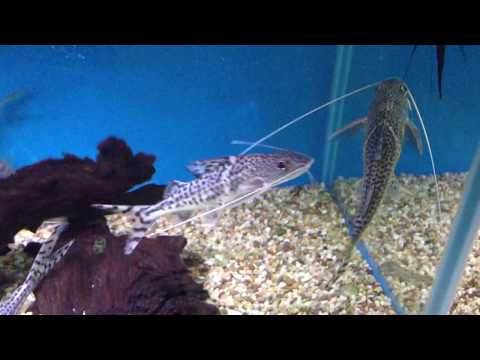 Video


 Ventral view


 Close-up of fin
 Close-up of spine

 Ventral view

| ⇓ Zebra Pleco (Hypancistrus zebra) Data Sheet | |
|---|---|
| Scientific Name | Pimelodus pictus Steindachner, 1876 |
| Common Names | Pictus Catfish Engelwels (German, Germany), Pictus, Pictus Pimelodus, Pimpictus, Plettet Trådmalle (Danish, Denmark) |
| Type Locality | Rio Hyavary, Peru-Brazil border. |
| Synonym(s) | Pimelodella picta, Pimelodella pictus |
| Pronunciation | pim ee LOW duss - PICK tuss |
| Etymology | pimele, fat; –odes, having the form of, i.e., fatty, referring to their adipose fins (at the time, this was a catch-all genus for many catfish species, most of which possess a “fatty” or adipose fin) [note: many online references report that –odes is derived from odous, meaning teeth, but this is incorrect]. This specific epithet literally means painted(pictus=painted) and refers to the spots on its body. There are 3 other speciesAkysis pictus Glyptothorax pictus Leiarius pictus with this name. |
| ⇓ Species Information | |
| Size | 110mm or 4.3" SL. Find near, nearer or same sized spp. |
| Identification | Two colour forms appear for sale. The first, Peruvian, variety has large ''dalmatian'' style spots all over its body with smaller spots around the head. The other, Colombian, variety (which reportedly grows larger) has many more spots that are smaller, less clearly defined and almost pin-prick size on the fish's head. This differentiation should only be used when comparing fish of a similar size as both patterns change with age. |
| Sexing | Unknown. |
| General Remarks | Pimelodus pictus have small hooks on the dorsal and pectoral fins that are notorious for getting stuck in nets. It's best to use a plastic container to catch the fish, rather than a net. |
| ⇓ Habitat Information | |
| Distribution | South America: Amazon and Orinoco River basins. Amazon (click on these areas to find other species found there) Orinoco (click on these areas to find other species found there) Login to view the map. |
| IUCN Red List Category | Not Evaluated , a distribution map is available on the IUCN species page. Last assessed 2026. |
| pH | 5.8 - 6.8 |
| Temperature | 22.0-25.0°C or 71.6-77°F (Show species within this range) |
| ⇓ Husbandry Information | |
| Feeding | An unfussy general carnivore. Most prepared are taken and the fish will gorge itself on live or frozen foods to a point where the aquarist must be careful not to feed too much in one sitting. Bloodworm induces a feeding frenzy and is good for acclimatising new acquisitions. The fish will eat huge amounts in one day, its belly swelling to resemble a marble and can happily live off this for up to a week. In nature the diet consists largely of invertebrates (such as insect larvae and crustaceans), but also found to eat fish. User data. |
| Furniture | Swimming space is needed as this fish likes to swim especially around feeding time. You will see much more of this fish during the day if you have relatively dim lighting. |
| Compatibility | Peaceful, but will soon eat smaller fish, such as neon tetras, but otherwise harmless. It is considered good to keep these fish in a group of at least five fish. When kept alone, they do not appear quite as happy and active as when kept in a group. |
| Suggested Tankmates | Larger active fish such as tetras and gouramis. Most barbs are no good company as they tend to nip fins and barbels. They should be kept in (small) groups. Most singly kept specimens will pine away eventually. Angelfish and other ''graceful'' fishes may be bothered by this species' barbels particularly during lights-out. |
| Breeding | Unreported in the aquarium. |
| Breeding Reports | There is no breeding report. |
| ⇓ Further Information | |
| Reference | Sitzungsberichte der Kaiserlichen Akademie der Wissenschaften. Mathematisch-Naturwissenschaftliche Classe v. 74 (1. Abth.), pp 144 [96]. |
| Wishlists | There is no wish to keep this species. |
| Spotters | There is no record of this fish being seen. |
| ⇓ More Resources | |
| Forum BBCode | |
| Find CLOG | 105 mentions on the forum, starting 26th Feb 04 |
 | Look up P. pictus on PlanetCatfish.com |
 | Look up P. pictus on Fishbase |
 | Look up P. pictus on Encyclopedia of Life |
 | Look up P. pictus on Global Biodiversity Information Facility |
 | LFS label creator ARN ref:1.15.101.276 |
| Last Update | Thu Jan 02, 2025 9:37 am (Species record created: Sat Apr 28, 2001 7:00 am) |
