
PAGE_HEADER

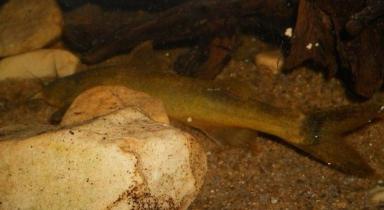


 Video
 Close-up of head

| ⇓ Zebra Pleco (Hypancistrus zebra) Data Sheet | |
|---|---|
| Scientific Name | Glyptothorax indicus Talwar, 1991 |
| Common Name | |
| Type Locality | Streams of Terai, Northern Bengal |
| Synonym(s) | |
| Pronunciation | Gleep toe thor axe - In dee cuss |
| Etymology | The generic name comes from the Greek glyptos, meaning carved, and thorax, meaning breastplate (or the part of the body covered by it), in reference to the folds of skin comprising the thoracic adhesive apparatus. There is 1 other speciesMystus indicus with this name. |
| ⇓ Species Information | |
| Size | 110mm or 4.3" SL. Find near, nearer or same sized spp. |
| Identification | Sisorid catfishes of the genus Glyptothorax Blyth are benthic inhabitants of torrential waters of rivers and streams in montane and submontane parts of tropical Asia. The members of the genus are adapted to attach themselves to rocks and boulders against strong currents by means of a thoracic adhesive apparatus comprising grooves and folded pleats of skin parallel or oblique to the longitudinal axis of the body. The genus has a wide distribution, ranging from Turkey and Syria in the west, to India and China in the east, and extending further southeastward to Indonesia. With 84 nominal species, Glyptothorax are the most speciose genus of catfishes in Asia (Eschmeyer et al., 1998, Ng, 2005); 67 species were treated as valid by Thomson & Page (2006). a) Paired fins not plated ventrally. Occipital process not reaching basal bone of dorsal fin. b) Adhesive apparatus rhomboidal in shape, very extensive from tip of pectoral fin traversing through gill membranes. |
| Sexing | Not known. |
| ⇓ Habitat Information | |
| Distribution | Asia: India and Nepal. Indian waters, North Eastern India Waters, Padma, Ganges, Koshi (click on these areas to find other species found there) Nepal Waters (click on these areas to find other species found there) Indian waters, Punjab waters (click on these areas to find other species found there) Indian waters, North Eastern India Waters, Padma, Ganges, Son, Rihand (click on these areas to find other species found there) Login to view the map. |
| IUCN Red List Category | Least Concern , a distribution map is available on the IUCN species page. Last assessed 2007. |
| Other Parameters | The water should be cool and heavily oxygenated with a good flow as these fish occur in hill streams. Anything above 25°C will hamper long term survival as these fish tend to wither away at higher temperatures. |
| ⇓ Husbandry Information | |
| Feeding | Is known to take only live food like bloodworms, frozen brineshrimp etc. Spot feeding will help in case tank mates are voracious feeders. User data. |
| Furniture | Fine sand for the bottom and smooth pebbles / rocks. This species seems to be quite active and likes to swim around, so the decor should permit this. |
| Compatibility | A peaceful species suitable for a hillstream biotope. |
| Suggested Tankmates | Cyprinids like Barilius and Danios and balitorine loaches like Homaloptera species. |
| Breeding | No member of this genus has been bred in the aquarium. |
| Breeding Reports | There is no breeding report. |
| ⇓ Further Information | |
| Literature & References | Original Description: <b> Talwar, P. K. and A. G. Jhingran</b> 1991 |
| Wishlists | There is no wish to keep this species. |
| Spotters | There is no record of this fish being seen. |
| ⇓ More Resources | |
| Forum BBCode | |
| Find CLOG | 4 mentions on the forum, starting 11th Jan 11 |
 | Look up G. indicus on PlanetCatfish.com |
 | Look up G. indicus on Fishbase |
 | Look up G. indicus on Encyclopedia of Life |
 | Look up G. indicus on Global Biodiversity Information Facility |
 | LFS label creator ARN ref:1.20.170.2548 |
| Last Update | Wed Jan 01, 2025 8:24 pm (Species record created: Tue Oct 12, 2010 12:15 am) |
