
PAGE_HEADER
 Juvenile
 Video
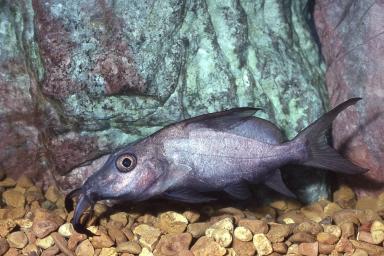
 Lateral view

 Large preserved specimen

 Import from Nigeria
 Juvenile
 Close-up of barbels
 Head-on view
 Close-up showing barbel detail
 Close-up showing barbel detail

 Stamp

| ⇓ Zebra Pleco (Hypancistrus zebra) Data Sheet | |
|---|---|
| Scientific Name | Synodontis membranaceus (Geoffroy - St. Hilaire, 1809) |
| Common Names | Moustache Catfish Membran-skægmalle (Danish, Denmark) |
| Type Locality | Nile River, Egypt. |
| Synonym(s) | Hemisynodontis membranacea, Hemisynodontis membranaceus, Pimelodus membranaceus, Synodontis guentheri, Synodontis membranaceous |
| Pronunciation | sin oh don tiss - mem bran ass ee uss |
| Etymology | According to Cuvier, Synodontis is an "ancient name for an undetermined fish from the Nile". It is not derived, as often reported, from syn-, together and odous, tooth, presumed etymology of the lizardfish genus Synodus and refers to the closely-spaced lower jaw teeth of both genera. membranaceus referring to the skin membranes on the maxillary and mandibular barbels. |
| ⇓ Species Information | |
| Size | 500mm or 19.7" SL. Find near, nearer or same sized spp. |
| Identification | All species in the genus Synodontis have a hardened head cap that has attached a process (humeral process) which is situated behind the gill opening and pointed towards the posterior. The dorsal fin and pectoral fins have a hardened first ray which is serrated. Caudal fin is always forked. There is one pair of maxillary barbels, sometimes having membranes and occasionally branched. The two pairs of mandibular barbels are often branched and can have nodes attached. The cone-shaped teeth in the upper jaw are short. S-shaped and movable in the lower jaw. These fish produce audible sounds when disturbed rubbing the base of the pectoral spine against the pectoral girdle. As very small fish (less than 30mm) these fish are patterned with a few large spots on their body. These fade quickly with growth. Can be confused with Synodontis batensoda but a quick look at the barbels will sort them out. In S. batensoda only the maxillary are membranous and to a lesser degree than in S. membranaceus. There is continuing debate as to whether this fish belongs in Synodontis or within a separate monotypic genus Hemisynodontis. Over the years, its placement has moved back and forth between the two genera. The most recent osteological study (Pinton & Otera, 2010) placed this species within Synodontis, observing that there are no reliable osteological traits that warrant breaking Hemisynodontis apart from Synodontis. |
| Sexing | First lay the fish in your hand with its head toward your palm and the tail toward your fingers. Hold the dorsal spine between your middle and ring finger so the fish is belly up and you won't get punctured by the sharp fin spines (which hurts - be careful). The genital pore is in a small furrow of tissue (in healthy fish) and will be obstructed by the pelvic fins. Pull down on the tail gently to arch the fish's spine and the pelvic fins will stand and the furrow open to display the genital pore and the anus of the fish. The male has a somewhat ridged genital papillae on which the spermatoduct is on the back side, facing the tail fin. A gravid female will also show an extended papillae but the oviduct is on the ventral side of the papillae. It may also show a little redness if gravid. A thin or emaciated female will have just two pink pores, the oviduct and the anus. Unknown |
| ⇓ Habitat Information | |
| Distribution | Africa: Chad, Niger (including the Bénoué), Senegal, Gambia and Volta basins; also the Nile in northern Africa. African Waters, Chad (click on these areas to find other species found there) African Waters, Gambia (click on these areas to find other species found there) African Waters, Nigeria Waters, Niger (click on these areas to find other species found there) African Waters, Nile (click on these areas to find other species found there) African Waters, Sénégal (click on these areas to find other species found there) African Waters, Volta (click on these areas to find other species found there) Login to view the map. |
| IUCN Red List Category | Least Concern , a distribution map is available on the IUCN species page. Last assessed 2020. |
| pH | 6.5 - 7.5 |
| Temperature | 22.0-25.0°C or 71.6-77°F (Show species within this range) |
| ⇓ Husbandry Information | |
| Feeding | In nature this fish feeds mainly on plankton but this is well substituted in the aquarium by frozen brineshrimp and daphnia which are eaten in huge quantities. User data. |
| Furniture | A solitary cave is all that is required for this fish. |
| Compatibility | Peaceful and not too anti-social with other catfish excepting other members of it's own family. Youngsters appear sociable to each other but become quarrelsome with age. |
| Suggested Tankmates | Although able to be kept with more sedate fish, boisterous Central American cichlids are an ideal mix for this fish as their messy eating habits provide plenty of food for the catfish. A good community fish for the larger tank. |
| Breeding | Unreported in the aquarium. |
| Breeding Reports | There is no breeding report. |
| ⇓ Further Information | |
| Reference | Poissons du Nil v. 1 (part 1), pp [312], Pl. 13 (figs. 1-2). |
| Wishlists | There is no wish to keep this species. |
| Spotters | There is no record of this fish being seen. |
| ⇓ More Resources | |
| Forum BBCode | |
| Find CLOG | 26 mentions on the forum, starting 30th May 04 |
 | Look up S. membranaceus on PlanetCatfish.com |
 | Look up S. membranaceus on Fishbase |
 | Look up S. membranaceus on Encyclopedia of Life |
 | Look up S. membranaceus on Global Biodiversity Information Facility |
 | LFS label creator ARN ref:1.13.29.252 |
| Last Update | Thu Jan 02, 2025 9:37 am (Species record created: Sat Apr 21, 2001 7:00 am) |
