
PAGE_HEADER

 Ventral view
 Dorsal view
 Pectoral fin spine
 Lateral view
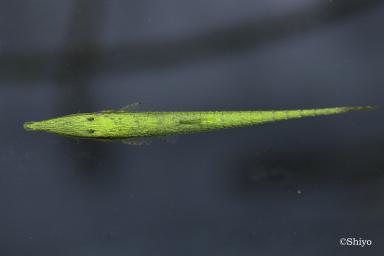 Dorsal view
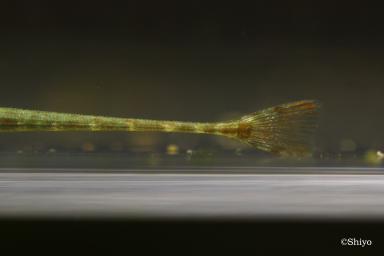 Close-up of caudal fin
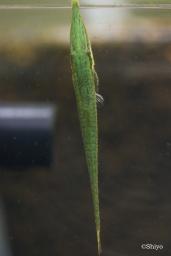 Dorsal view
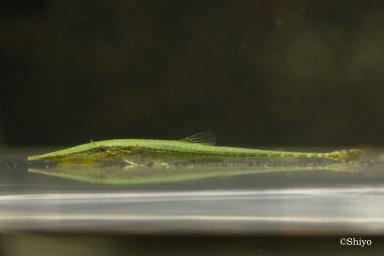
 Close-up of rostrum
 Close-up of ventral plates


| ⇓ Zebra Pleco (Hypancistrus zebra) Data Sheet | |
|---|---|
| Scientific Name | Acestridium triplax Rodriguez & Reis, 2007 |
| Common Names | Emerald Whiptail Catfish Whiptail Catfish, Smaragdgrenmalle (Danish, Denmark) |
| Type Locality | Municipio de Juruti, igarapé Mutum, tributary to rio Aruã, a tributary to rio Branco, a tributary. to rio Aripiuns, itself a tributary to the lower rio Tapajós, 2°36'45''S, 56°11'37''W, Pará State, Brazil. |
| Synonym(s) | |
| Etymology | The species epithet triplax from the Greek tri, three, and plax, plate, referring to the three series of abdominal plates. |
| ⇓ Species Information | |
| Size | 56mm or 2.2" SL. Find near, nearer or same sized spp. |
| Identification | Acestridium was diagnosed by Schaefer (1991) based on the following characters: ten principal caudal-fin rays; plates at anterior snout margin forming conspicuous spatulate projection; head and body very slender, depressed; dorsal surface of head and trunk with longitudinal ridges; dorsal fin placed posteriorly, well beyond pelvic fin and just anterior to anal-fin origin; adipose fin absent; dermal plates anterior to first dorsal-fin proximal radial expanded, bearing ventromedial keel contacting the dorsal margin of the neural arches of the vertebrae six through twelve; and ridge of bone on the ventral surface of the lateral ethmoid contacting the metapterygoid channel reflected mesially. A. triplax can be distinguished from all its congeners by having one series of middle abdominal plates between the lateral abdominal plates (vs no abdominal plates between the lateral abdominal plates). |
| Sexing | Males of Acestridium triplax have conspicuous urogenital papilla, immediately posterior to anal opening, these are not present in females. |
| ⇓ Habitat Information | |
| Distribution | South America: Rio Tapajós drainage, Amazon River basin in Brazil. Amazon, Lower Amazon, Tapajós (click on these areas to find other species found there) Login to view the map. |
| IUCN Red List Category | Least Concern , a distribution map is available on the IUCN species page. Last assessed 2018. |
| ⇓ Husbandry Information | |
| Furniture | In the wild inhabits small forest creeks which are usually shallow (0.3-1.0 m deep, 5-10 m wide), with a sandy bottom, clear or slightly black water, moderate water current and dense aquatic and marginal vegetation. |
| Breeding | Unreported in the aquarium. |
| Breeding Reports | There is no breeding report. |
| ⇓ Further Information | |
| Literature & References | Original Description: <b> Rodriguez, M. S. and R. E. Reis</b> 2007 <a href="http://dx.doi.org/10.1590/S1679-62252007000400001" target=_blank>See ref. online</a> |
| Wishlists | There is no wish to keep this species. |
| Spotters | There is no record of this fish being seen. |
| ⇓ More Resources | |
| Forum BBCode | |
| Find CLOG | 1 mention on the forum, starting 5th Jan 12 |
 | Look up A. triplax on PlanetCatfish.com |
 | Look up A. triplax on Fishbase |
 | Look up A. triplax on Encyclopedia of Life |
 | Look up A. triplax on Global Biodiversity Information Facility |
 | LFS label creator ARN ref:1.4.197.2495 |
| Last Update | Wed Jan 01, 2025 8:13 pm (Species record created: Sun Jul 04, 2010 11:58 am) |
