
PAGE_HEADER
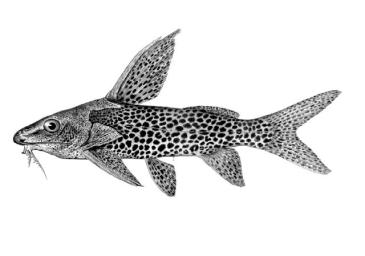 Lateral view
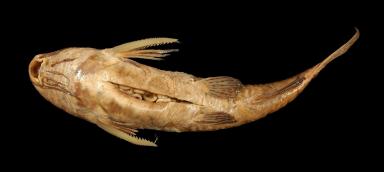 Ventral view
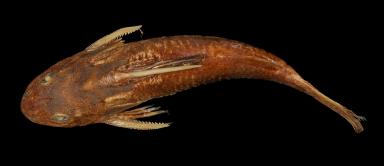 Dorsal view
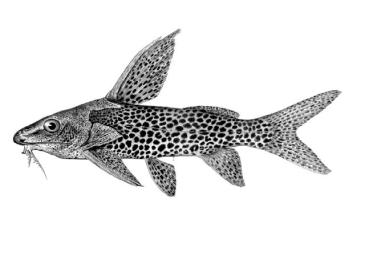
| ⇓ Zebra Pleco (Hypancistrus zebra) Data Sheet | |
|---|---|
| Scientific Name | Synodontis woosnami Boulenger, 1911 |
| Common Names | Upper Zambezi Squeaker Bo-zambesi-skreeubaber (Afrikaans, Republic of South Africa), Bubblebarb Squeaker |
| Type Locality | Okovango River, Lake Ngami District, Bechuanaland [Botswana], southern Africa. |
| Synonym(s) | |
| Pronunciation | sin oh don tiss |
| Etymology | According to Cuvier, Synodontis is an "ancient name for an undetermined fish from the Nile". It is not derived, as often reported, from syn-, together and odous, tooth, presumed etymology of the lizardfish genus Synodus and refers to the closely-spaced lower jaw teeth of both genera. |
| ⇓ Species Information | |
| Size | 205mm or 8.1" SL. Find near, nearer or same sized spp. |
| Identification | All species in the genus Synodontis have a hardened head cap that has attached a process (humeral process) which is situated behind the gill opening and pointed towards the posterior. The dorsal fin and pectoral fins have a hardened first ray which is serrated. Caudal fin is always forked. There is one pair of maxillary barbels, sometimes having membranes and occasionally branched. The two pairs of mandibular barbels are often branched and can have nodes attached. The cone-shaped teeth in the upper jaw are short. S-shaped and movable in the lower jaw. These fish produce audible sounds when disturbed rubbing the base of the pectoral spine against the pectoral girdle. Has the average build of the genus with a high dorsal fin. Most characteristic features are a broad, deep humeral process without a distinct point, slender simple barbels, mandibular barbels with filamentous branches and primary and secondary premaxillary teeth not separated. Mandibular teeth 14-24 in a narrow semicircular band, no distinct ventral shelf to the premaxillary toothpad, a single row of 11-12 tertiary premaxillary teeth. Maxillary barbels have a narrow dark basal membrane. Dark brown above, pale brown below,markings variable, generally smallish spots on body with underside of head and abdomen clear, some individuals with larger spots including oblong markings (more common in Cunene specimens), the fins exhibit small dots. |
| Sexing | First lay the fish in your hand with its head toward your palm and the tail toward your fingers. Hold the dorsal spine between your middle and ring finger so the fish is belly up and you won't get punctured by the sharp fin spines (which hurts - be careful). The genital pore is in a small furrow of tissue (in healthy fish) and will be obstructed by the pelvic fins. Pull down on the tail gently to arch the fish's spine and the pelvic fins will stand and the furrow open to display the genital pore and the anus of the fish. The male has a somewhat ridged genital papillae on which the spermatoduct is on the back side, facing the tail fin. A gravid female will also show an extended papillae but the oviduct is on the ventral side of the papillae. It may also show a little redness if gravid. A thin or emaciated female will have just two pink pores, the oviduct and the anus. |
| General Remarks | It appears that this species prefers larger backwaters, lakes, and similar bodies of water in the floodplains of rivers it inhabits. |
| ⇓ Habitat Information | |
| Distribution | Africa: Upper Zambezi, Okavango basin and Cunene river. African Waters, Cunene (click on these areas to find other species found there) African Waters, Okavango (Cubango) (click on these areas to find other species found there) African Waters, Zambesi, Upper Zambesi (click on these areas to find other species found there) Login to view the map. |
| IUCN Red List Category | Not Evaluated , a distribution map is available on the IUCN species page. Last assessed 2026. |
| ⇓ Husbandry Information | |
| Breeding | Unreported in the aquarium. |
| Breeding Reports | There is no breeding report. |
| ⇓ Further Information | |
| Reference | Catalogue of the fresh-water fishes of Africa v. 2, pp 424, Fig. 319. |
| Wishlists | There is no wish to keep this species. |
| Spotters | There is no record of this fish being seen. |
| ⇓ More Resources | |
| Forum BBCode | |
| Find CLOG | 1 mention on the forum, starting 3rd Feb 17 |
 | Look up S. woosnami on PlanetCatfish.com |
 | Look up S. woosnami on Fishbase |
 | Look up S. woosnami on Encyclopedia of Life |
 | Look up S. woosnami on Global Biodiversity Information Facility |
 | LFS label creator ARN ref:1.13.29.2411 |
| Last Update | Thu Jan 02, 2025 8:42 am (Species record created: Thu Jan 28, 2010 12:25 am) |
