
PAGE_HEADER

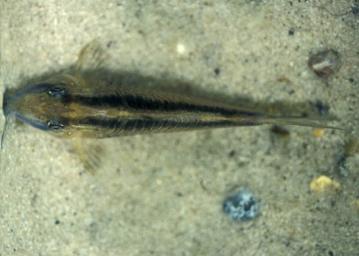 Dorsal view
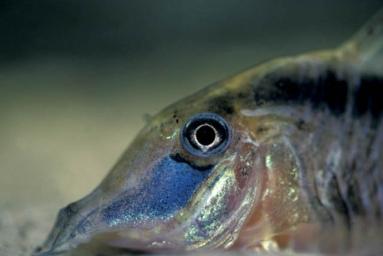 Close-up of head



| ⇓ Zebra Pleco (Hypancistrus zebra) Data Sheet | |
|---|---|
| Scientific Name | Corydoras narcissus Nijssen & Isbrücker, 1980 |
| Common Names | Long Nosed Arched Cory Langsnudet Buepansermalle (Danish, Denmark), Panzerwels (German, Germany), Purus Cory |
| Type Locality | Creek into Rio Ipixuna, 7°31'S, 63°16'W, 30 km west of Humaitá, Rio Purus system, Amazonas, Brazil. |
| Synonym(s) | |
| Pronunciation | kor ee doh rass. - nar SISS uss |
| Etymology | Cory = helmet, doras = skin. In this case it was incorrectly used to mean armour (cuirasse) instead of skin in allusion to the dual rows of plates that run along the flanks of this genus. Greek Mythology, After Narkissos, son of the Greek river god Kephissus. See catfish of the month article for a more detailed discussion. |
| ⇓ Species Information | |
| Size | 65mm or 2.6" SL. Find near, nearer or same sized spp. |
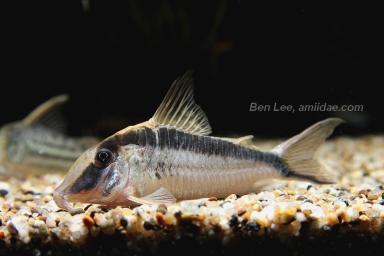
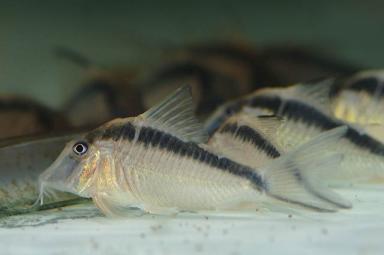
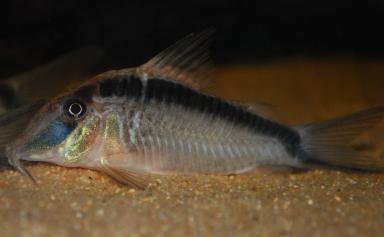
| Identification | Corydoras are identified by their twin rows of armour plates along the flanks and by having fewer than 10 dorsal fin rays. They are most commonly confused with the other genera in the sub-family, namely Brochis, Scleromystax and Aspidoras. C. narcissus is the long snouted ''version'' of C. arcuatus and is readily identifiable by this characteristic. Two species exist that are commonly sold as C. narcissus. The real one is longer (the ratio of body height to length being significantly different), has a more pronounced concave head and a slightly darker basic colouration. The other, shorter fish is C. bethanae. |
| Sexing | Females grow larger and are more full-bodied, this is best observed from above the fish. Males will typically have more pointed as opposed to more rounded fin tips as they mature. Female larger and stouter especially when viewed from above. Male has more pointed fin tips. |
| ⇓ Habitat Information | |
| Distribution | South America: Purus River basin in middle Amazon River basin. Amazon, Middle Amazon (Solimoes), Purus, Humaita (click on these areas to find other species found there) Login to view the map. |
| IUCN Red List Category | Data Deficient , a distribution map is available on the IUCN species page. Last assessed 2018. |
| pH | 6.0 - 7.0 |
| Temperature | 23.0-25.0°C or 73.4-77°F (Show species within this range) |
| ⇓ Husbandry Information | |
| Feeding | All prepared foods and frozen foods especially bloodworm and brineshrimp. Adults gorge on chopped mussel. User data. |
| Furniture | A little shading helps makes the fish feel at home. Sandy substrate brings out the best in these fish although because of the large size of the adult fish small pea gravel can also be employed. |
| Compatibility | Peaceful and not anti-social with other catfish excepting occasional quarrels with it's own species. Youngsters appear sociable to each other but become quarrelsome with age. Rival adult males may bully each other to death if kept in too small an aquarium. |
| Suggested Tankmates | South American dwarf Cichlids, larger Characins such as Silver Dollars (Metynnis spp.) are ideal although medium-sized Central American Cichlids and Asian anabantoids are good alternatives if you are not a biotope purist. |
| Breeding | Unknown |
| Breeding Reports | There is no breeding report. |
| ⇓ Further Information | |
| Reference | Netherlands Journal of Zoology v. 30 (no. 3), pp 497, Fig. 2. |
| Wishlists | There is no wish to keep this species. |
| Spotters | There is no record of this fish being seen. |
| ⇓ More Resources | |
| Forum BBCode | |
| Find CLOG | 7 mentions on the forum, starting 30th May 07 |
 | Look up C. narcissus on PlanetCatfish.com |
 | Look up C. narcissus on Fishbase |
 | Look up C. narcissus on Encyclopedia of Life |
 | Look up C. narcissus on Global Biodiversity Information Facility |
 | LFS label creator ARN ref:1.1.686.241 |
| Last Update | Thu Jan 02, 2025 9:37 am (Species record created: Mon Apr 30, 2001 7:00 am) |
