
PAGE_HEADER

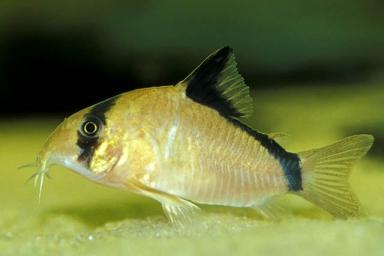


 Close-up of head


 One day old fry
 Three day old fry
 Six day old fry


 Five week old fry

 Close-up of dorsal fin
| ⇓ Zebra Pleco (Hypancistrus zebra) Data Sheet | |
|---|---|
| Scientific Name | Hoplisoma metae (Eigenmann, 1914) |
| Common Names | Bandit Cory Masked Cory, Meta River Cory, Meta-pansermalle (Danish, Denmark), Panzerwels/corydoras - Catfish (German, Germany) |
| Type Locality | Barrigona [Berrigón], Río Meta, Colombia. |
| Synonym(s) | |
| Pronunciation | hop lee so mah - MEH tay |
| Etymology | The genus name is latin for wavy, referring to “dark purplish spots tending to run together, forming undulating longitudinal bands” - a common if not uniform colouration pattern found in this genus. Named after the Rio Meta, from which it was collected. There are 3 other speciesHyphessobrycon metae Ituglanis metae Pimelodella metae with this name. |
| ⇓ Species Information | |
| Size | 48mm or 1.9" SL. Find near, nearer or same sized spp. |
| Identification | C. metae is often confused with C. melini (which has an unbroken black stripe from dorsal to caudal fins, C. metae has no colour on its caudal fin or mid-body flanks) and occasionally C. davidsandsi (Lighter, more orange basic colouration and slightly more elongate body). There is also an ''imitator'' long-snouted species (C. simulatus). |
| Sexing | Females grow larger and are more full-bodied, this is best observed from above the fish. Males will typically have more pointed as opposed to more rounded fin tips as they mature. Females are slightly larger (especially when viewed from above) than males. |
| ⇓ Habitat Information | |
| Distribution | South America: Meta River basin in Colombia. Orinoco, Upper Orinoco, Guaviare (click on these areas to find other species found there) Orinoco, Middle Orinoco, Meta, Upper Meta, Manacacías (click on these areas to find other species found there) Orinoco, Middle Orinoco, Meta (click on these areas to find other species found there) Orinoco, Middle Orinoco, Meta, Ocoa (click on these areas to find other species found there) Login to view the map. |
| IUCN Red List Category | Not Evaluated , a distribution map is available on the IUCN species page. Last assessed 2026. |
| pH | 6.5 - 7.5 |
| Temperature | 21.0-24.0°C or 69.8-75.2°F (Show species within this range) |
| ⇓ Husbandry Information | |
| Feeding | Will take prepared foods happily, but breeding condition will require bloodworm or other insect larvae. User data. |
| Furniture | Open gravel swimming space preferably shaded by large broadleaf plants. A large open cave for refuge also helps settle in these fish. They may sit inactive for periods of time when resting, but will always venture forth for food. |
| Compatibility | An ideal community fish. |
| Breeding | Spawned by Eric Bodrock in March 2001 who provided these notes. Six males and four females made up the spawning group. They were set up in a 20-gallon tank, pH of 6.6 with a temperature of 76°F (24.5°C). Approximately 40–50 large eggs were deposited over a couple of days. |
| Breeding Reports | There is no breeding report. |
| ⇓ Further Information | |
| Reference | Indiana University Studies v. 2 (no. 23), pp 230. |
| Wishlists | There is no wish to keep this species. |
| Spotters | There is no record of this fish being seen. |
| ⇓ More Resources | |
| Forum BBCode | |
| Find CLOG | 1 mention on the forum, starting 1st Feb 26 |
 | Look up H. metae on PlanetCatfish.com |
 | Look up H. metae on Fishbase |
 | Look up H. metae on Encyclopedia of Life |
 | Look up H. metae on Global Biodiversity Information Facility |
 | LFS label creator ARN ref:1.1.1580.24 |
| Last Update | Tue Sep 15, 2026 3:46 pm (Species record created: Wed Apr 25, 2001 7:00 am) |
