
PAGE_HEADER

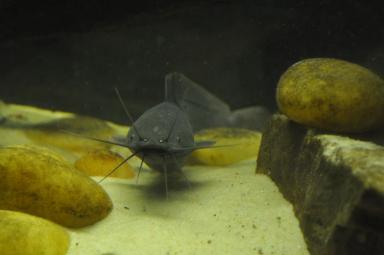
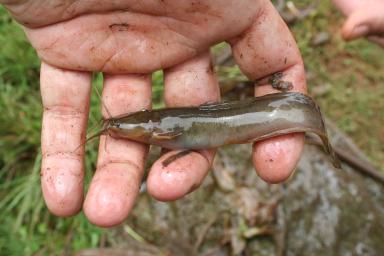

 Habitat: Papyrus swamp 8 km north of Nkozi, Uganda
 Habitat: Papyrus swamp, Uganda
 Habitat: Papyrus swamp, Uganda
 Video: collecting in the wild
 Video
 Juvenile
 Juvenile

 Close-up of head
 Close-up of tail
| ⇓ Zebra Pleco (Hypancistrus zebra) Data Sheet | |
|---|---|
| Scientific Name | Clarias alluaudi Boulenger, 1906 |
| Common Names | Alluaud's Walking Catfish Ssemutundu (Ganda, Uganda) |
| Type Locality | Lake Victoria [Victoria Nyanza]. |
| Synonym(s) | Clarias hilgendorfi |
| Pronunciation | klar ee ass |
| Etymology | Clarias: From the Greek chlaros, meaning lively; in reference to the ability of the fish to live for long periods out of water. In honour of C. Alluaud. |
| ⇓ Species Information | |
| Size | 350mm or 13.8" SL. Find near, nearer or same sized spp. |
| Identification | Clarias species are characterized by having an elongated body; a soft rayed dorsal fin extending to, or nearly to, the caudal fin base; a soft rayed anal fin extending from just behind the anus to the caudal fin base; pectoral fins each with a serrated anterior bony spine; head depressed, covered largely by firmly sutured, surface sculptured bony plates forming a protective helmet; four pairs of flagellate barbels (nasals, maxillaries, inner and outer mandibulars); air breathing organs derived from the 2nd and 4th epibranchials within a superbranchial chamber. Dorsal soft rays (total): 65 - 79; Anal soft rays: 57 - 64; Vertebrae: 52 - 55. Pectoral fin spine serrated on both inner and outer sides. Head oval-shaped in dorsal outline; snout short and slightly rounded; eyes more dorsally located. Frontal fontanelle long and narrow (`knife-shaped'); occipital fontanelle long and oval-shaped. Supraorbital and `dermospenoticum' joined. Tooth plates relatively small. gill rakers long, slender and distantly set. Suprabranchial organ well developed. Openings of the secondary sensory canals regularly arranged on flanks.The whole fish is uniformly brownish, lighter on the belly, which never is whitish as for example in C.gariepinus. |
| Sexing | The genital papilla, which is to the right of the anus as you look at the fish with its head to the left, is elongated and pointed in males while it is round and relatively larger (and larger than the anus) in females. In ventral view especially, females are much broader in the body than males of equal age and rearing practices. |
| General Remarks | A standard length of 35cm would be very large for this species and is most likely a mix-up with another species, most stay under 20cm. In and around Lake Rukwa the fish is common in smaller streams or swamps of the basin outside the lake.Probably there is some kind of ecological competition and C. alluaud is displaced from the lake by the larger C.gariepinus.This species can even be found in mountain streams if there is not too much current. |
| ⇓ Habitat Information | |
| Distribution | Africa: Lakes Victoria, Kyoga, Edward, Rukwa and Tanganyika. African Waters, Western Rift Valley Lakes, Edward (click on these areas to find other species found there) African Waters, Nile, Upper Nile, White Nile, Kyoga (click on these areas to find other species found there) African Waters, Southern Rift Lakes, Rukwa (click on these areas to find other species found there) African Waters, Western Rift Valley Lakes, Tanganyika (click on these areas to find other species found there) African Waters, Western Rift Valley Lakes, Victoria (click on these areas to find other species found there) Login to view the map. |
| IUCN Red List Category | Least Concern , a distribution map is available on the IUCN species page. Last assessed 2025. |
| ⇓ Husbandry Information | |
| Feeding | In the wild feeds mainly on insects, in the aquarium it is likely to be a typical clariid and be omnivorous and predatory, therefore will eat virtually anything that can be considered edible. User data. |
| Furniture | In the wild found in marginal water-lily and papyrus swamps, so very well rooted plants and structures such as pipes that provide some shade and hiding places. |
| Compatibility | Should be housed with lively, robust fish.Keeping in mind the smaller adult size as compared to other species of it's genus. |
| Suggested Tankmates | Medium to larger sized barbs, Ctenopoma, mid-sized Lake Victoria cichlids. |
| Breeding | Unreported in the aquarium. |
| Breeding Reports | There is no breeding report. |
| ⇓ Further Information | |
| Reference | Annals and Magazine of Natural History (Series 7) v. 17 (no. 101) (art. 49), pp 437. |
| Wishlists | There is no wish to keep this species. |
| Spotters | There is no record of this fish being seen. |
| ⇓ More Resources | |
| Forum BBCode | |
| Find CLOG | 3 mentions on the forum, starting 14th Apr 09 |
 | Look up C. alluaudi on PlanetCatfish.com |
 | Look up C. alluaudi on Fishbase |
 | Look up C. alluaudi on Encyclopedia of Life |
 | Look up C. alluaudi on Global Biodiversity Information Facility |
 | LFS label creator ARN ref:1.6.8.2250 |
| Last Update | Wed Jan 01, 2025 7:57 pm (Species record created: Thu Apr 09, 2009 6:31 am) |
