
PAGE_HEADER

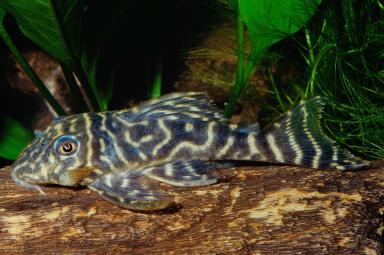 Male


 Pair (female right)
 Adult
 Dorsal view

 Fry
 Lateral view


 Close-up of dorsal fin
 Close-up of caudal fin
| ⇓ Zebra Pleco (Hypancistrus zebra) Data Sheet | |
|---|---|
| Scientific Name | Hypancistrus debilittera Armbruster, Lujan & Taphorn, 2007 |
| Common Names | L129, Colombian Zebra Pleco Colombiansk Zebramalle (Danish, Denmark) |
| Type Locality | Pasaganado, 38 kilometres north of San Fernando de Atabapo, 4°23'04''N, 67°46'28''W, Río Orinoco, Amazonas, Venezuela |
| Synonym(s) | |
| Pronunciation | hype an siss truss |
| Etymology | A contraction of the Greek hypo (meaning less than) and ancistrus, an allusion to the reduced number of teeth (particularly in the lower jaw) found in this genus. A combination of the Latin debilis meaning weak and littera meaning letter, in reference to the weak or absent E on the snout. |
| ⇓ Species Information | |
| Size | 70mm or 2.8" SL. Find near, nearer or same sized spp. |
| Identification | Dark brown base coloration with fine yellowish stripe. Rather large eyes compared with the body length (like Hypancistrus inspector. A small mouth with typical Hypancistrus dentition. |
| Sexing | Mature males have thicker first pectoral ray, more pronounced odontodes on the first pectoral fin ray and odontodes on the cheeks and/or rear of the body, and typically a wider head. Mature females are wider around the middle of the body, and much less noticeable body and fin odontodes. Typical of the genus; males have longer pectoral and interopercular odontodes, they also have plate odontodes on the body. Females are rounder in the ventral region. |
| ⇓ Habitat Information | |
| Distribution | South America: Río Orinoco in Venezuela. Orinoco, Middle Orinoco, Bita (click on these areas to find other species found there) Login to view the map. |
| IUCN Red List Category | Least Concern , a distribution map is available on the IUCN species page. Last assessed 2020. |
| pH | 6.4 - 7.6 |
| Temperature | 24.0-28.0°C or 75.2-82.4°F (Show species within this range) |
| ⇓ Husbandry Information | |
| Feeding | Omnivore. They still seem to prefer meaty foods such as blood worms, gammarus or brine shrimps. Commercially prepared food such as Spirulina tabs are also eaten. User data. |
| Furniture | Fine sand, driftwood, slate and/or bamboo caves. Plants can be kept without fear of damage from this species. |
| Compatibility | Its small size makes it a good citizen for small tanks. Males are more territorial than females and are territorial toward conspecifics and other Loricariidae of about the same size. |
| Suggested Tankmates | Small tetras and other similar small fish. Also Corydoras. Care has to be taken to ensure that they get enough food, as they can be a bit shy and slow to grab food when available. |
| Breeding | Females lay about 20 eggs of about 3mm in diameter in a cave. Brood guarded by the male in the cave. Raising of the young is unproblematic if a good hygiene is provided. |
| Breeding Reports | There is no breeding report. |
| ⇓ Further Information | |
| Reference | Copeia 2007 (no. 1), pp 68, Figs. 1D, 5. |
| Wishlists | There is no wish to keep this species. |
| Spotters | There is no record of this fish being seen. |
| ⇓ More Resources | |
| Forum BBCode | |
| Find CLOG | 160 mentions on the forum, starting 7th Sep 04 |
 | Look up H. debilittera on PlanetCatfish.com |
 | Look up H. debilittera on Fishbase |
 | Look up H. debilittera on Encyclopedia of Life |
 | Look up H. debilittera on Global Biodiversity Information Facility |
 | LFS label creator ARN ref:1.4.7.211 |
| Last Update | Thu Jan 02, 2025 9:36 am (Species record created: Sat May 05, 2001 7:00 am) |
