
PAGE_HEADER

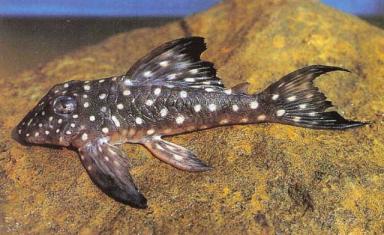 Original L102 image
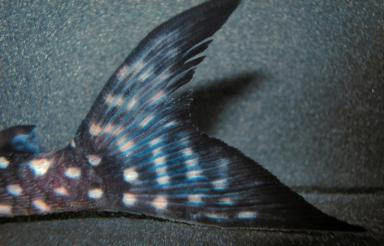 Caudal fin
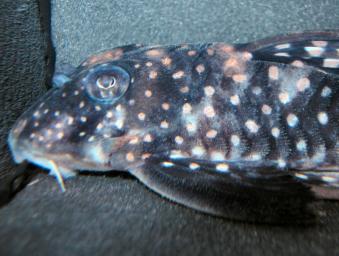 Close-up of head
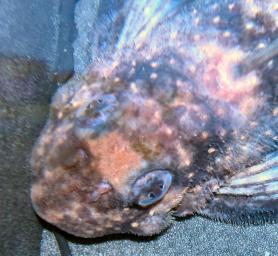

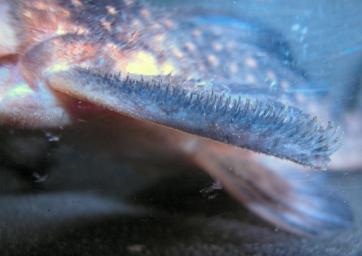 Close-up of male

 Adult

 Holotype - ventral view
 Holotype


 Close-up of head
 Ventral view of head

 "san filepe"
 Close-up of head

| ⇓ Zebra Pleco (Hypancistrus zebra) Data Sheet | |
|---|---|
| Scientific Name | Hypancistrus inspector Armbruster, 2002 |
| Common Names | L102, Snowball Pleco ægplettet Sugemalle (Danish, Denmark), Snowball-pleco (German, Germany) |
| Type Locality | Río Casiquiare, Río Negro, Río Amazonas drainage, about 10 river kilometres above the Río Negro, below Solano, 1°58'N, 67°05'W, Dpto. Casiquiare, Amazonas, Venezuela. |
| Synonym(s) | |
| Pronunciation | hype an siss truss |
| Etymology | A contraction of the Greek hypo (meaning less than) and ancistrus, an allusion to the reduced number of teeth (particularly in the lower jaw) found in this genus. Inspector is Latin for observer. It is in reference to the large eyes. |
| ⇓ Species Information | |
| Size | 160mm or 6.3" SL. Find near, nearer or same sized spp. |
| Identification | Although black or reddish dark grey with white spots, the snowball pleco is most easily identified by the black ribbon or seam along the margin of its caudal and dorsal fins. Additionally its dentition is noticeably different from other plecos matching what you would expect in a species of Hypancistrus. Similarity to other light-spotted Hypancistrus species are H. contradens, H. sp. L201 and H. sp. L501. This species is higher bodied than L201 and has smaller spots on the head versus fairly uniform sized spots in L501. |
| Sexing | Mature males have thicker first pectoral ray, more pronounced odontodes on the first pectoral fin ray and odontodes on the cheeks and/or rear of the body, and typically a wider head. Mature females are wider around the middle of the body, and much less noticeable body and fin odontodes. The female is black-brown with white spots while the male has a lot more reddish tones in its colours and white spots. The male has strong odontodal growth while the female has almost none and is a lot fuller and rounder in body shape. |
| General Remarks | Introduced as DATZ 7/1992 pp416-417. |
| ⇓ Habitat Information | |
| Distribution | Brazil, Amazonas, Rio Negro (Barcelos) Amazon, Middle Amazon (Solimoes), Negro (click on these areas to find other species found there) Login to view the map. |
| pH | 5.4 - 7.6 |
| Temperature | 22.0-30.0°C or 71.6-86°F (Show species within this range) |
| Other Parameters | It is unclear if this fish is a white, clear or black water species. |
| ⇓ Husbandry Information | |
| Feeding | It is a carnivore but will also do well on a variety of foods. Feed mainly with spirulina, tabimin and some shrimp mix / artemia. User data. |
| Furniture | Keep them in a tank with caves, some roots and no plants. A strong current is not necessary for this species. |
| Compatibility | They do well with peaceful tankmates. |
| Suggested Tankmates | Small tetras and other similar small fish. Also Corydoras. Care has to be taken to ensure that they get enough food, as they can be a bit shy and slow to grab food when available. |
| Breeding | See article link below. |
| Breeding Reports | There is no breeding report. |
| ⇓ Further Information | |
| Literature & References | Original Description: <b> Armbruster, J. W.</b> 2002 <a href="https://www.researchgate.net/publication/237303642_Hypancistrus_inspector_A_New_Species_of_Suckermouth_Armored_Catfish_Loricariidae_Ancistrinae" target=_blank>See ref. online</a> |
| Wishlists | There is no wish to keep this species. |
| Spotters | There is no record of this fish being seen. |
| ⇓ More Resources | |
| Forum BBCode | |
| Find CLOG | 88 mentions on the forum, starting 12th Aug 04 |
 | Look up H. inspector on PlanetCatfish.com |
 | Look up H. inspector on Fishbase |
 | Look up H. inspector on Encyclopedia of Life |
 | Look up H. inspector on Global Biodiversity Information Facility |
 | LFS label creator ARN ref:1.4.7.204 |
| Last Update | Wed Jan 01, 2025 8:01 pm (Species record created: Thu Apr 19, 2001 7:00 am) |
