
PAGE_HEADER
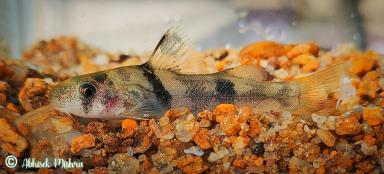
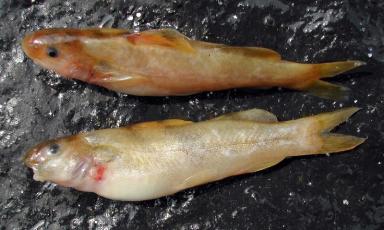
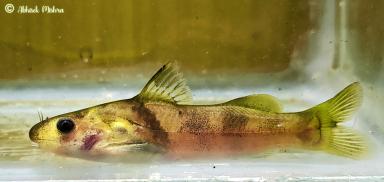
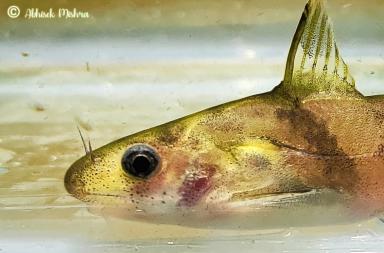 Close-up of head
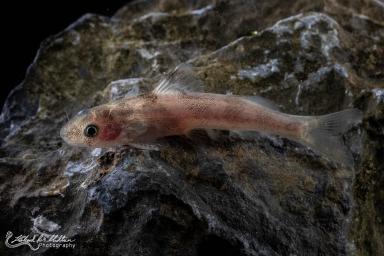
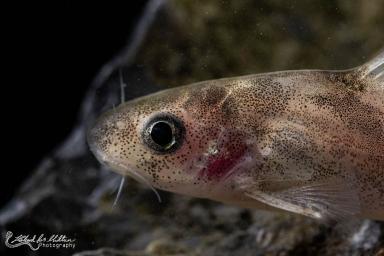 Close-up of head
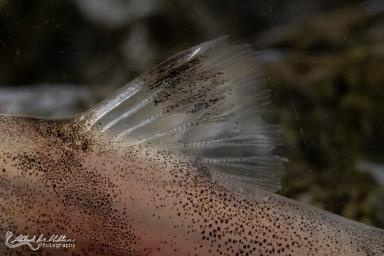 Close-up of dorsal fin
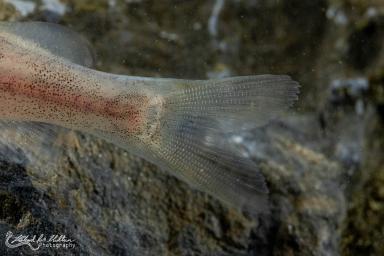 Close-up of caudal fin
| ⇓ Zebra Pleco (Hypancistrus zebra) Data Sheet | |
|---|---|
| Scientific Name | Batasio fasciolatus Ng, 2006 |
| Common Name | |
| Type Locality | Market at Malbazar, 26°32'30"N, 88°44'17"E, West Bengal, India. |
| Synonym(s) | |
| Pronunciation | bah tah see oh - faa see oh late us |
| Etymology | The genus name comes from the local (Bengali) name of the fish (batasio or batashi). From the Latin fasciolatus, the diminutive form of fascia, meaning belt, in
reference to the banded pattern of this species. There are 4 other speciesEnteromius fasciolatus Epiplatys fasciolatus Petrochromis fasciolatus Phallotorynus fasciolatus with this name. |
| ⇓ Species Information | |
| Size | 71mm or 2.8" SL. Find near, nearer or same sized spp. |
| Identification | The bagrid genus Batasio Blyth comprises of small, laterally compressed catfishes distributed in South and Southeast Asia, diagnosed from its confamilials in having large sensory pores on the head, a narrow mental region, a pair of posteriorly-directed processes on the anterior part of vomer, a transversely-elongated bar-like entopterygoid, and the metapterygoid in close contact with the quadrate but free from the hyomandibular (Mo, 1991). Batasio fasciolatus n. sp. can be distinguished from all congeners except B. tigrinus by the adult colouration of five to six vertical dark brown bars on a light brown body (vs two or less vertical bars, uniform colouration or only horizontal marks). It differs from B. tigrinus in having longer dorsal spines (13.6–16.8 vs 9.4–12.5% LS) and pectoral spines (12. 7–14.3 vs 10.3–12.9% LS)and smaller eye [16.5–18.8 vs 20.3–24.8% head length (LH)]. Specimens of Batasio fasciolatus n. sp. were previously identified as B. tengana, but can be further distinguished from it in having a longer adipose-fin base (24.5–25.3 vs 14.5–17.5% LS), deeper caudal peduncle (10.1– 11.8 vs 6.7–8.2% LS) and smaller eye (16.5–18.8 vs 21.9–32.1% LH). The only other species of Batasio with at least one vertical bar on the body found in the Brahmaputra River drainage is B. merianiensis, but B.fasciolatus differs from it in having smaller pectoral spine (12.7–14 .3 vs 16.3% LS) and eye (16.5–18.8 vs 25.9% LH). |
| Sexing | Not known. Males have a long, slender genital papilla extending to base of first anal-fin ray. |
| ⇓ Habitat Information | |
| Distribution | Asia: Tista River drainage of the Brahmaputra River in India. Indian waters, North Eastern India Waters, Padma, Jamuna, Brahmaputra, Tista (click on these areas to find other species found there) Login to view the map. |
| IUCN Red List Category | Least Concern , a distribution map is available on the IUCN species page. Last assessed 2009. |
| Temperature | 20.5-25.0°C or 68.9-77°F (Show species within this range) |
| Other Parameters | The water should be cool and heavily oxygenated with a good flow as these fish occur in hill streams.Anything above 25 C will hamper long term survival as these fish tend to burn away at higher temperatures. |
| ⇓ Husbandry Information | |
| Feeding | Is known to take processed food but prefers live food like blood worms, frozen brine shrimp etc. Needs sometime to gradually get weaned off live foods. Spot feeding will help in case tank mates are voracious feeders. User data. |
| Furniture | Fine sand for the bottom and smooth pebbles / rocks. Cover / hiding spots can be created with either plants or wood. |
| Compatibility | A peaceful species suitable for a hillstream biotope. |
| Suggested Tankmates | Peaceful Cyprinids like Puntius or Oreichthys and Balitorine loaches like Schistura or Nemacheilus species. |
| Breeding | Unreported in the aquarium. |
| Breeding Reports | There is no breeding report. |
| ⇓ Further Information | |
| Literature & References | Original Description: <b> Ng, H. H.</b> 2006 <a href="https://deepblue.lib.umich.edu/bitstream/handle/2027.42/74276/j.0022-1112.2006.001019.x.pdf?sequence=1" target=_blank>Download ref. <img src="images/pdficon_small.gif" border="0" alt="" /></a> |
| Wishlists | There is no wish to keep this species. |
| Spotters | There is no record of this fish being seen. |
| ⇓ More Resources | |
| Forum BBCode | |
| Find CLOG | 4 mentions on the forum, starting 8th Mar 10 |
 | Look up B. fasciolatus on PlanetCatfish.com |
 | Look up B. fasciolatus on Fishbase |
 | Look up B. fasciolatus on Encyclopedia of Life |
 | Look up B. fasciolatus on Global Biodiversity Information Facility |
 | LFS label creator ARN ref:1.8.222.1929 |
| Last Update | Wed Jan 01, 2025 7:55 pm (Species record created: Tue Jan 08, 2008 8:42 pm) |
